
Eco Yoga Sanctuary & Integrated Therapy Work — Jumeirah, Dubai

Asana in Function:
Understanding the Cardinal Planes of Movement
Why every yoga posture belongs to a plane — and why that changes everything about how you practise, teach, and heal
The cardinal planes of movement are three imaginary flat surfaces — Sagittal (forward/backward, Anterior–Posterior axis), Frontal (side-to-side, Mediolateral axis), and Transverse (rotational, Vertical axis) — that intersect at the body’s centre of gravity. Every yoga asana moves through one or more of these planes.
“I used to think yoga was about making shapes. I’d look at the teacher, look in the mirror, and try to force my body to match the picture. It took years before I realised: my body doesn’t understand Triangle Pose. It only understands movement through space.”
— Kamal Saad, Lead Therapist, Integrated Therapy Work (ITW) Dubai
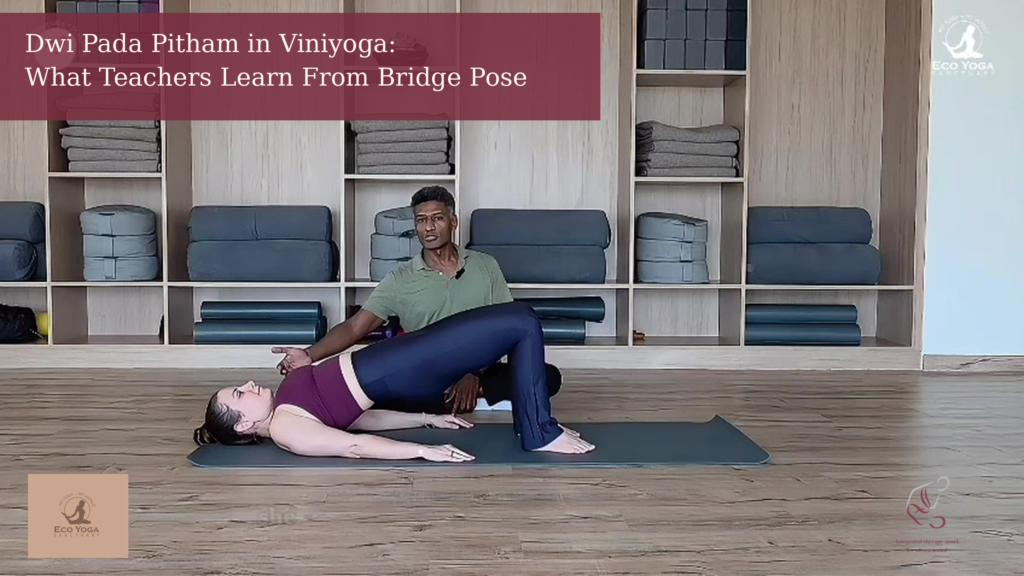
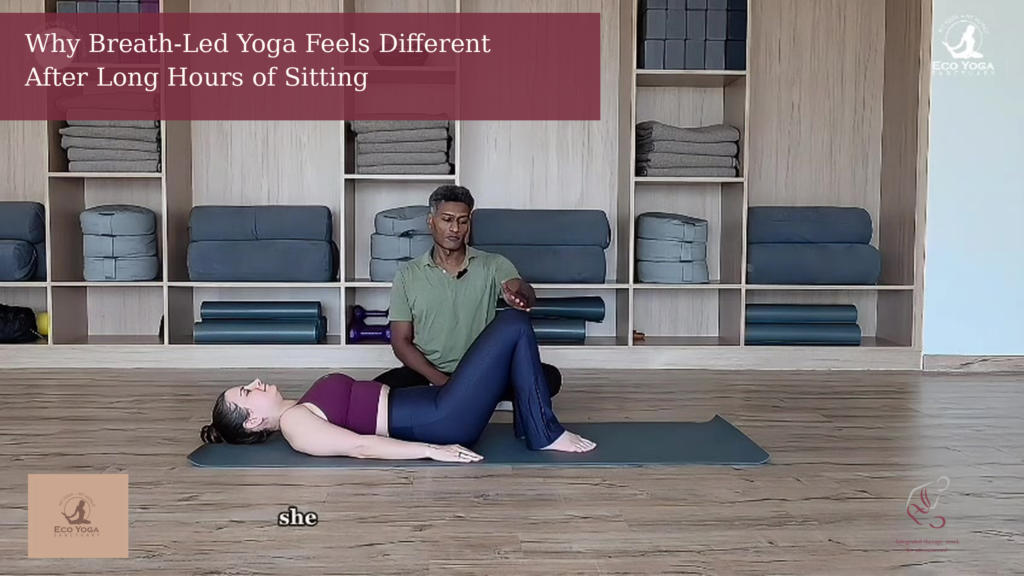
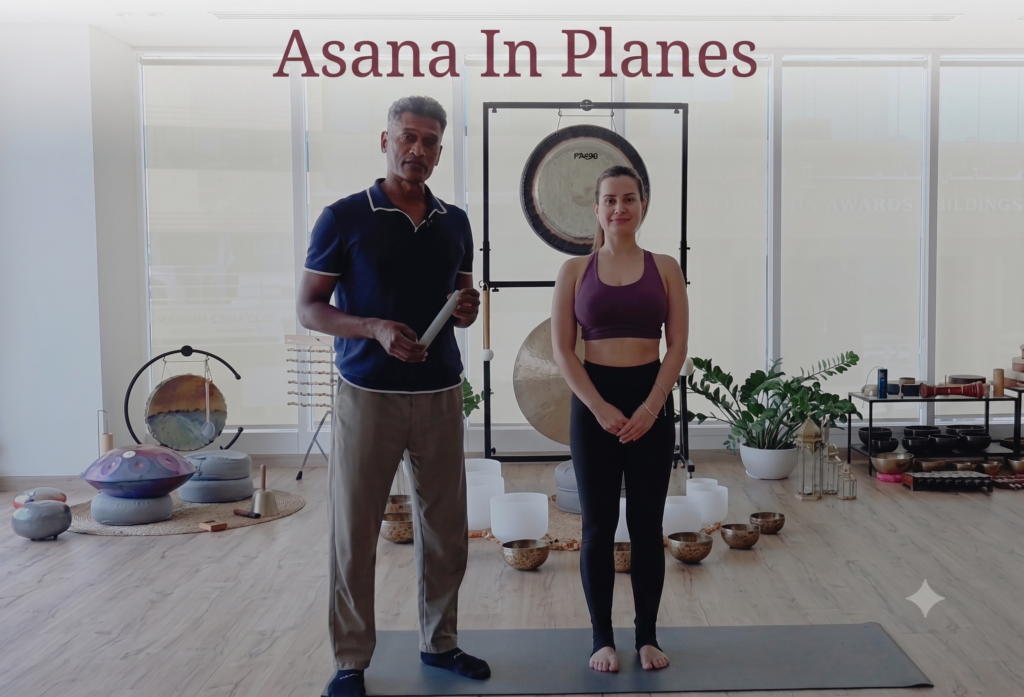
Kamal (Viniyoga Therapist) & Teacher Tala demonstrate the Sagittal, Frontal, and Transverse planes of movement at Eco Yoga Sanctuary, Jumeirah, Dubai. Part of the Asana in Function series by Integrated Therapy Work (ITW).
The Illusion of the “Perfect” Pose
This is the great illusion of modern yoga: we are taught to focus on the external form of an asana, rather than its internal function. Your body does not understand “Triangle Pose” or “Warrior II”. Your body only understands joint mechanics, muscle tension, and movement through space.
When we shift our perspective from form to function — a core principle of the Viniyoga lineage developed by T.K.V. Desikachar and Gary Kraftsow of the American Viniyoga Institute (AVI) — we must first understand the invisible architecture of movement: the Cardinal Planes.
What Are the Cardinal Planes?
The cardinal planes are three imaginary, two-dimensional surfaces that intersect at the body’s centre of gravity — roughly the lower pelvis, at the level of the second sacral vertebra. Every human movement, and every yoga asana, occurs along one or more of these planes. Each plane has a corresponding axis of movement — the line around or along which the body moves within that plane.

Fig. 1 — The three cardinal planes and their axes. Sagittal (Anterior–Posterior Axis) · Frontal (Mediolateral Axis) · Transverse (Vertical Axis).
Plane 1 — The Sagittal Plane: Forward and Backward
The Sagittal plane divides the body into left and right halves. Movement occurs through the Anterior–Posterior axis — this is the plane of flexion (bending forward) and extension (bending backward). Sagittal movements are the foundation of spinal health and the most dominant plane in modern yoga practice.
| Movement | Key Asanas | Primary Intention |
|---|---|---|
| Flexion (Forward) | Uttanasana · Paschimottanasana · Balasana · Janu Sirsasana | Calm nervous system, posterior chain stretch |
| Extension (Backward) | Bhujangasana · Ustrasana · Setu Bandha · Urdhva Mukha | Stimulate nervous system, anterior chain opening |
Plane 2 — The Frontal (Coronal) Plane: Side to Side
The Frontal plane divides the body into front and back halves. Movement occurs through the Mediolateral axis — this is the plane of abduction, adduction, and lateral flexion. Frontal plane asanas are vital for pelvic stability and lateral spinal mobility — muscles frequently neglected in our Sagittal-dominant modern lifestyles.
| Movement | Key Asanas | Primary Intention |
|---|---|---|
| Lateral Flexion | Trikonasana · Parsvakonasana · Ardha Chandrasana · Parighasana | Lateral spinal mobility, intercostal opening |
| Abduction / Adduction | Virabhadrasana II · Prasarita Padottanasana · Upavistha Konasana · Baddha Konasana | Hip stability, inner/outer thigh balance |
Plane 3 — The Transverse (Horizontal) Plane: Rotation
The Transverse plane divides the body into upper and lower halves. Movement occurs through the Vertical (Long) axis — this is the plane of internal and external rotation and spinal rotation. Transverse plane movements are the great neutralisers of the body — resetting spinal muscle tone, hydrating intervertebral discs, and integrating left and right hemispheres.
| Movement | Key Asanas | Primary Intention |
|---|---|---|
| Spinal Rotation | Ardha Matsyendrasana · Marichyasana · Parivrtta Trikonasana · Parivrtta Parsvakonasana | Disc hydration, spinal tone reset |
| Hip Rotation | Gomukhasana · Kapotasana · Supta Kapotasana · Agnistambhasana | Hip external rotation, piriformis release |
Why Knowing the Planes Changes Your Practice
If you are practising yoga in Dubai to manage back pain, reduce stress, or recover from an injury, treating asanas as mere “shapes” is risky. Understanding the cardinal planes allows you to apply yoga therapeutically. A student with an acute lumbar disc herniation cannot safely perform deep Sagittal flexion. A teacher who understands the planes will instead sequence Frontal plane lateral stretches and gentle Transverse plane twists — creating space without loading the disc. This is the difference between performing a posture and applying an asana.
Who Is This For?
Understanding the planes helps you identify which movements trigger your pain and which bring relief. You stop fighting your body and start moving intelligently within the planes that serve your healing.
If your entire class moves only in the Sagittal plane, your students will leave with imbalanced joints. The cardinal planes are a core component of the ITW Mastery Series YACEP curriculum in Dubai.
When you understand the planes, you unlock the deeper intentions of the Viniyoga methodology — combining a Sagittal extension with a Transverse twist to target specific areas of tension with surgical precision.
Paschimottanasana (Sagittal Plane · Anterior–Posterior Axis) & Ardha Matsyendrasana (Transverse Plane · Vertical Axis) — demonstrated at Eco Yoga Sanctuary, Jumeirah, Dubai.
Frequently Asked Questions
A cardinal plane is an imaginary two-dimensional surface that passes through the body’s centre of gravity. There are three: Sagittal (Anterior–Posterior axis), Frontal (Mediolateral axis), and Transverse (Vertical axis). In yoga, they help categorise and understand the functional mechanics of every asana.
Most traditional Surya Namaskar sequences move almost entirely in the Sagittal plane. Because modern life (sitting, driving, typing) is also highly Sagittal, many practitioners develop weak lateral stabilisers and poor rotational mobility unless Frontal and Transverse movements are consciously included.
Categorise your postures by their primary plane — Sagittal, Frontal, Transverse — and ensure all three are represented in each session. This is a foundational sequencing principle taught in the ITW Mastery Series in Dubai.
In the ITW methodology, position refers to your orientation in space relative to gravity (standing, seated, supine, prone), while posture refers to the internal muscular and skeletal arrangement of your body — the asana itself. The cardinal planes help us understand the mechanics of the posture, regardless of the position.
About the Author — Kamal Saad, Lead Therapist, ITW Dubai
Written by Kamal Saad, lead therapist at Integrated Therapy Work (ITW), a Dubai-based yoga therapy and continuing education organisation. ITW’s curriculum is grounded in the Viniyoga tradition of T.K.V. Desikachar and Gary Kraftsow (AVI). ITW’s Mastery Series is YACEP-accredited and held at Eco Yoga Sanctuary, Jumeirah, Dubai. [INSERT: Kamal Saad’s full credentials]
Join Viniyoga Therapy Classes at Eco Yoga Sanctuary, Jumeirah
Practise asana in function — not just in form. Experience all three cardinal planes in a single breath-led, therapeutically sequenced class.
Book Your ClassITW Mastery Series — Anatomy, Kinesiology & Therapeutic Sequencing
YACEP-accredited continuing education for yoga teachers and advanced practitioners. Eco Yoga Sanctuary, Jumeirah, Dubai.
Up Next: Asana Symmetry — When the Two Sides of the Body Tell Different Stories
Discover why symmetry in yoga is a myth — and why understanding left-right asymmetry in the body is the key to truly individualised therapeutic practice.
WordPress Block Editor Code
Copy & paste into WordPress → Code Editor (⋮ → Code editor)
- Open your post → click ⋮ (three dots) → Code editor
- Select all and paste the copied code
- Switch back to Visual editor
- Upload plane_01_overview_v2.png to Media Library → replace [UPLOAD: plane_01_overview_v2.png]
- Replace [VIDEO_ID] with your YouTube video ID
Paste the JSON-LD schema block into your SEO plugin’s custom schema field (Yoast / Rank Math).