ASANA IN FUNCTION — ECO YOGA SANCTUARY × INTEGRATED THERAPY WORK


Closed Frame vs. Open Frame in Yoga
What Your Hand Placement Is Really Doing to Your Joints
By Kamal · Eco Yoga Sanctuary, Jumeirah, Dubai · 7 min read
“Most people focus on how deep they can go into a pose. But the question that matters most for your joints is not how far — it is whether you are closing or opening the frame of your body.”
— Kamal, Lead Therapist · Integrated Therapy Work (ITW) Dubai
At Eco Yoga Sanctuary in Jumeirah, Dubai, our wellness team teaches practitioners how to practice yoga intelligently — understanding not just the shape of a pose, but the biomechanical forces at work inside it. The difference between a closed frame and an open frame is one of the most practical concepts you can learn, and it directly affects how much pressure lands on your joints, especially if you carry a previous knee or lower back injury.
WATCH THE CLASS
Closed Frame vs. Open Frame — Explained on the Mat
Watch Kamal demonstrate the difference between closed and open frames in Trikonasana, Warrior poses, and standing balances — and see exactly how hand placement changes the pressure on your joints.
CLOSED FRAME
Hand Fixed to Body or Floor
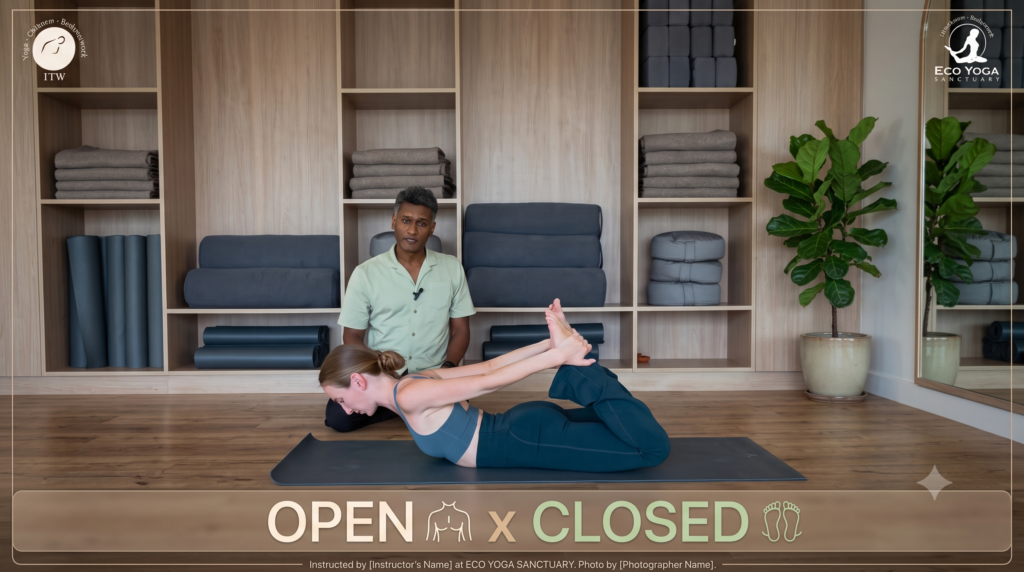
A closed frame occurs when your hand (or another body part) connects to your foot, leg, or the floor in a way that creates a continuous, fixed loop of tension through the body. Every joint within that loop — including the knee — bears a compressive load.
Example: Holding your foot with your hand in a standing balance pose.
OPEN FRAME
Limb Free to Move in Space
An open frame occurs when the limb is free to move in space without being fixed to another body part or the floor. Joints can work in relative isolation, and compressive forces on the joints are significantly lower — making it the safer default for most practitioners.
Example: Reaching your top arm freely toward the ceiling in Triangle Pose.
Why Closing the Frame Increases Joint Pressure
When you close the frame, you introduce compressive forces into every joint within the loop. Research in rehabilitation science confirms that closed kinetic chain movements create superior co-contraction of muscles and add compressive forces to the joints — which enhances stability in healthy joints, but also means that any joint already compromised by a previous injury will receive significantly more load.
The closed frame does not know whether your joint is healthy or injured. It applies the same compressive force regardless. If there is a previous injury — such as a knee injury, a meniscus issue, or a ligament strain — the additional compression from a closed frame can aggravate the tissues and slow recovery.
Key principle: Closed frames should be reserved for the end of a class, after the body has received a proper warm-up. They should be avoided completely if there is a previous joint injury such as a knee or lower back condition.
Trikonasana (Triangle Pose): The Perfect Illustration
Trikonasana — Triangle Pose — is one of the most commonly practiced standing poses in yoga, and it provides a perfect real-world illustration of how frame choice affects the lower back. The same pose can be safe or stressful depending entirely on where you place your hand.
| Frame Type | Hand Position in Trikonasana | Effect on Spine & Joints | Best For |
|---|---|---|---|
| Closed Frame | Hand grips the floor | High lumbar compression; spine curves to compensate if hamstrings are tight | Advanced practice after thorough warm-up only |
| Supported Frame | Hand rests on shin, calf, or block | Spine remains long and neutral; lower back protected | Most practitioners; injury recovery; everyday practice |
| Open Frame | Bottom arm floats freely | Demands active core strength; risk of lateral spinal collapse if core is weak | Building active core strength in advanced practice |
When you reach your bottom hand all the way to the floor in Trikonasana, you are effectively closing the frame between your hand and the ground. The floor becomes the fixed point. If your body does not yet have the required hamstring and hip mobility, the spine compensates — curving and compressing at the lumbar vertebrae and sacroiliac joints. The result is a significant increase in pressure on the lower back.
Conversely, resting your hand on your shin, calf, or a block removes the obligation to reach the floor. The spine can remain long and neutral, the chest opens fully, and the lower back is protected. This is the recommended position for most practitioners and is essential for anyone with a previous lower back or knee injury.
A Special Note on Knee Injuries
The knee is one of the most vulnerable joints in a closed frame because it sits in the middle of the chain — between the hip and the ankle — and therefore receives compressive forces from both directions simultaneously. If you have a previous knee injury, such as a meniscus tear, ligament strain, or patellofemoral pain, the additional compression of a closed frame can be significant.
Interestingly, in some poses a partially closed frame is actually safer than a fully open frame for the knee. In Trikonasana, resting the hand on the leg (supported frame) reduces the lateral spinal load that would otherwise pull on the IT band and the lateral knee structures. The key is always to choose the frame that creates the least compensatory strain on the vulnerable joint — and to inform your yoga teacher before class so the right modification can be offered.
The Warm-Up Principle
Even for practitioners with healthy joints, a closed frame should only be introduced after the body has warmed up properly. A warm-up increases blood flow to the muscles, raises tissue temperature, and activates the proprioceptive system — the body’s internal sensing network that coordinates joint stability. Attempting a closed frame on a cold body is like tightening a bolt without lubricating the thread. At Eco Yoga Sanctuary, our classes are structured so that closed-frame movements appear later in the sequence, after the body has been progressively prepared.
WATCH THE CLASS
How to Sequence Open and Closed Frame Poses Safely
Watch Kamal explain how to position open and closed frame poses within a yoga sequence. Learn the three-step protocol — Open Frame (preparation) → Closed Frame (main posture) → Open Frame (compensation) — and see why skipping this order is the leading cause of yoga-related injury.
Who This Is For
HEALING PRACTITIONER
Women managing a previous knee, hip, or lower back injury who want to continue practicing yoga safely with intelligent modifications.
YOGA TEACHER
Teachers who want to understand the biomechanical reasoning behind modifications so they can confidently guide students with joint sensitivities.
MASTERY SEEKER
Advanced practitioners who want to move beyond shape and form — understanding the functional anatomy that makes a pose truly sustainable over a lifetime of practice.
Frequently Asked Questions
What is the difference between a closed frame and an open frame in yoga?
A closed frame occurs when your hand or foot is fixed against another body part or the floor, creating a continuous loop of tension through the joints. An open frame means the limb moves freely in space with no fixed contact point. Closed frames increase joint compression; open frames reduce it.
Is a closed frame dangerous in yoga?
A closed frame is not inherently dangerous for healthy joints, but it significantly increases compressive forces on every joint within the loop. It should only be practiced after a proper warm-up and should be avoided completely if there is a previous injury such as a knee or lower back condition.
Why does resting my hand on my leg in Trikonasana feel better for my lower back?
Resting your hand on your leg (a supported frame) allows your spine to remain long and neutral, reducing the lateral compression on the lumbar vertebrae and sacroiliac joints. Reaching the hand to the floor forces the spine into extreme lateral flexion, which increases lower back pressure — especially if hamstring and hip flexibility is limited.
Can I practice closed-frame poses if I have a knee injury?
In most cases, closed-frame poses that create a direct loop through the knee should be avoided if you have a previous knee injury. Speak with your yoga teacher before class to receive appropriate modifications. Some supported-frame variations may actually offer better protection for the knee than a fully open frame.
Where is Eco Yoga Sanctuary located in Dubai?
Eco Yoga Sanctuary is located in the heart of old Jumeirah, Dubai. It is a women-only studio offering group classes, private sessions, workshops, and wellness programs. Contact us at +971 54 490 7907 or visit ecoyogasanctuary.com.
PRACTICE WITH US
Join Yoga Classes at Eco Yoga Sanctuary, Jumeirah
Practice asana intelligently — understanding frames, breath, and your body’s unique structure. Small groups, expert guidance, in the heart of old Jumeirah, Dubai.
ITW MASTERY SERIES · JULY 2026
Integrated Therapy Work — Mastery Series
Deepen your anatomical knowledge and earn YACEP continuing education credits. For yoga teachers and advanced practitioners. Eco Yoga Sanctuary, Jumeirah, Dubai.
Last updated: July 2026 · Written by Kamal, Lead Therapist at Integrated Therapy Work (ITW) Dubai · Eco Yoga Sanctuary, Jumeirah
ASANA IN FUNCTION SERIES
Up Next: Symmetric vs. Asymmetric Poses — What Is the Difference and How Do We Sequence Them?
Discover how symmetric and asymmetric postures create different demands on the spine and hips, and learn how to intelligently position them within a class sequence for maximum benefit and safety.
ONLINE COURSE
The Art & Science of Yoga Sequencing
Ready to go deeper? Learn how to build intelligent, functional yoga sequences that honour the body’s biomechanics — from warm-up to closed-frame peak poses. Available online, at your own pace.