Balance vs. Stability in Yoga:
Base of Support, Centre of Gravity & Line of Gravity Explained
A Biomechanics Guide for Dubai Yoga Therapy & Workshops — Standing, Seated, Prone & Supine
Quick Answer
Balance is an active, dynamic process — your neuromuscular system continuously working to keep the line of gravity within the base of support. Stability is a structural property — how resistant a position is to being disturbed. The centre of gravity in the human body is always located near the pelvis (~S2 level), regardless of position. What changes between yoga positions is the height of the centre of gravity relative to the ground and the size of the base of support. A wider base of support and a lower centre of gravity always produce greater stability and reduce the balance demand. This principle is at the core of every Dubai yoga therapy session and Dubai yoga workshop delivered by Kamal Saad at Eco Yoga Sanctuary, Jumeirah.

The Three Biomechanical Principles
Every yoga position can be analysed through three interconnected biomechanical concepts. Understanding these principles explains why Savasana feels effortless while Tree Pose demands intense concentration — and how to use this knowledge to design safer, more effective yoga sequences. These concepts are taught in depth across all Dubai yoga therapy programmes and Dubai yoga workshops run by Integrated Therapy Work (ITW) at Eco Yoga Sanctuary, Jumeirah, Dubai.
1. Base of Support (BoS)
The area enclosed by all points of contact between the body and the supporting surface. A larger BoS always produces greater stability. In standing poses, the BoS is defined by the feet; in supine positions, by the entire posterior body surface.
2. Centre of Gravity (CoG)
The single point where the body’s total mass is considered to act. In the human body, the CoG is always located near the pelvis (~S2 level). What changes between positions is the CoG’s height relative to the ground — lower CoG means greater stability.
3. Line of Gravity (LoG)
An imaginary vertical line passing downward through the CoG to the ground. For a position to be stable, the LoG must fall within the BoS. The closer the LoG is to the centre of the BoS, the more stable the position. When the LoG approaches the edge of the BoS, balance effort increases dramatically.
Standing Positions
Standing poses present the greatest balance challenge in yoga. The BoS is limited to the area of the feet, the CoG (near the pelvis) is elevated high above the ground, and the LoG must be actively controlled to remain within the narrow BoS. Even small perturbations — a gust of wind, a moment of distraction — can shift the LoG outside the BoS, requiring immediate neuromuscular correction. In Dubai yoga therapy and Dubai yoga workshops at Eco Yoga Sanctuary, standing poses are introduced progressively, always with awareness of the base of support and centre of gravity.
Tadasana — Mountain Pose
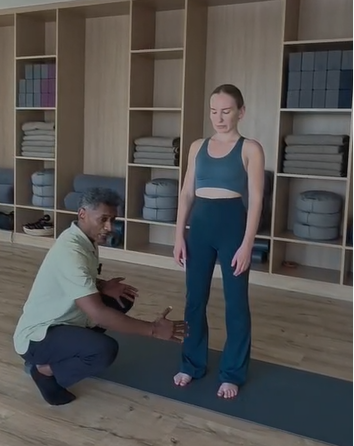
Tadasana is the foundational standing position. Both feet are together, creating a narrow BoS. The CoG sits near the pelvis, elevated well above the ground. The LoG passes through the ankle joint and must remain within the small area between the feet. Despite appearing effortless, Tadasana requires continuous low-level activation of the postural muscles to maintain alignment.

Vrksasana — Tree Pose
Tree Pose represents the most challenging balance demand in a standard yoga class. The entire body weight is supported on a single foot, reducing the BoS to its absolute minimum. The CoG remains near the pelvis but is now elevated above a BoS that is only as wide as one foot. The LoG must be continuously controlled by the ankle, knee, and hip stabilisers of the standing leg. Any shift in attention or a slight head movement can displace the LoG outside the BoS.

Seated Positions
Seated positions offer significantly greater stability than standing poses. The sit bones and the extended or folded legs create a wide BoS, and the CoG (near the pelvis) sits much closer to the ground than in standing. The LoG falls easily within the wide BoS, requiring only minimal muscular effort to maintain — making seated poses ideal for pranayama, meditation, and restorative work. Seated postures are frequently used in Dubai yoga workshops and Dubai yoga therapy sessions at Eco Yoga Sanctuary for students who need a lower balance demand while building strength and awareness.
Dandasana — Seated Staff Pose
Dandasana is the foundational seated position. The sit bones and the full length of both extended legs form a large BoS. The CoG, located near the pelvis, is lower than in any standing pose. The LoG falls directly through the sit bones and well within the BoS. The primary demand in Dandasana is not balance but axial extension — maintaining the upright spine against gravity.

Supine Positions
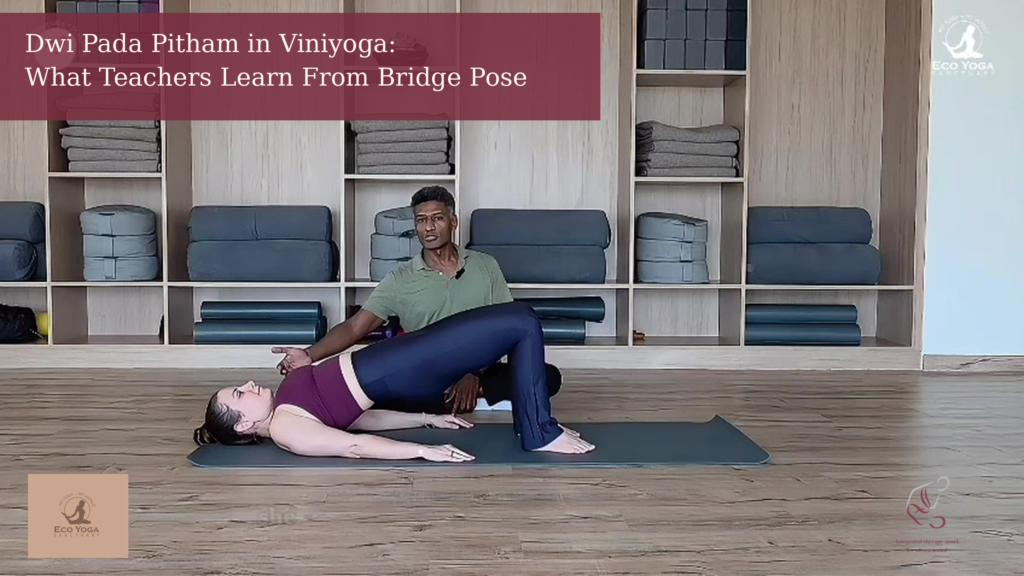
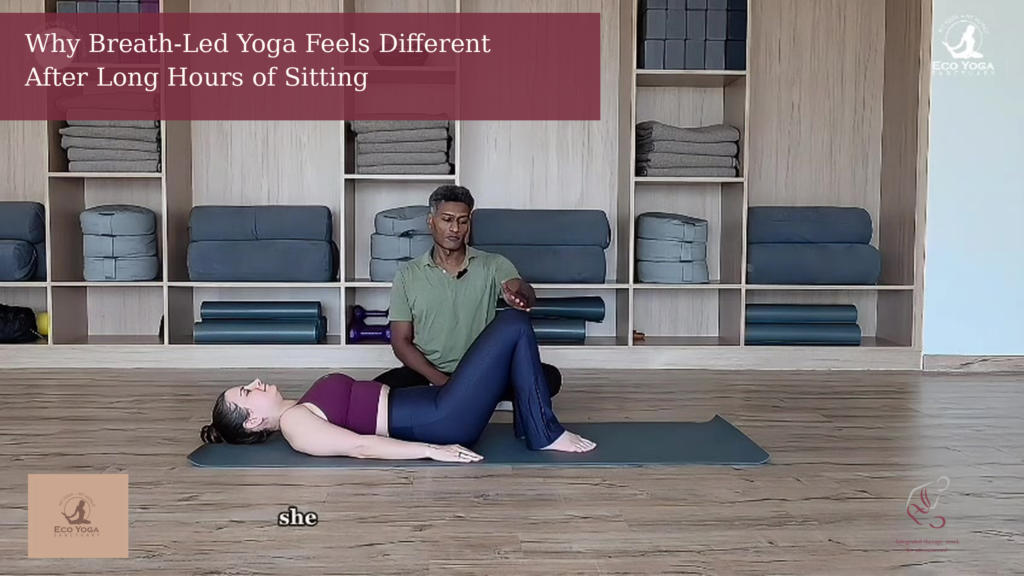
Supine (lying on the back) positions represent the gold standard of stability in yoga. The entire posterior surface of the body — from the back of the head to the heels — forms the BoS. The CoG (near the pelvis) is at its lowest possible height relative to the ground. The LoG is extremely short and always falls within the enormous BoS. No active balance effort is required whatsoever, which is precisely why Savasana is used for deep relaxation and integration at the end of every Dubai yoga therapy session and Dubai yoga workshop at Eco Yoga Sanctuary, Jumeirah.
Savasana — Corpse Pose

Prone Positions
Prone (lying face down) positions share many stability advantages with supine positions. The anterior surface of the body — abdomen, pelvis, thighs — forms a wide BoS. The CoG (near the pelvis) remains low relative to the ground. Prone backbends like Bhujangasana add a posterior chain activation element while maintaining the inherent stability of the prone position. In Dubai yoga therapy programmes at Integrated Therapy Work (ITW), prone poses are used to safely activate the posterior chain in clients recovering from back pain or postural imbalances.
Bhujangasana — Cobra Pose

All Positions Compared
The following table and diagram summarise the biomechanical profile of each position. Note that the CoG is always near the pelvis (~S2) — what changes is its height relative to the ground and the size of the BoS. This comparison forms the foundation of the sequencing approach used in all Dubai yoga therapy sessions and Dubai yoga workshops delivered by Kamal Saad at Eco Yoga Sanctuary, Jumeirah, Dubai.
| Pose | Position | Base of Support | CoG Height | LoG Control | Stability |
|---|---|---|---|---|---|
| Savasana | Supine | Maximum (full posterior) | Lowest | Effortless | ★★★★★ Maximum |
| Bhujangasana | Prone | Wide (anterior surface) | Very Low | Effortless | ★★★★☆ Very High |
| Dandasana | Seated | Wide (sit bones + legs) | Low–Medium | Minimal | ★★★★☆ High |
| Tadasana | Standing | Narrow (both feet) | High | Active | ★★★☆☆ Moderate |
| Vrksasana | Standing | Minimal (one foot) | High | Continuous | ★★☆☆☆ Low |

Frequently Asked Questions — Dubai Yoga Therapy & Workshops
Book a Dubai Yoga Therapy Session or Workshop
Join Kamal Saad at Eco Yoga Sanctuary, Jumeirah, Dubai — for Dubai yoga therapy sessions and Dubai yoga workshops that apply these biomechanical principles to your individual body. Serving clients across Jumeirah, DIFC, Business Bay, and the wider UAE.