Axial Extension in Yoga: Creating Space, Protecting the Spine
Why every pose begins with length — and how intervertebral space determines the quality of every spinal movement you make
“Every time a student asks me why their back hurts in a twist, I ask them one question: did you lengthen before you turned? The answer is almost always no. We have been taught to chase depth. We have never been taught to create space first. Axial extension is not a cue — it is the foundation of every safe, intelligent movement the spine will ever make.”
— Kamal, Lead Therapist, Integrated Therapy Work (ITW) Dubai
Axial extension is the active lengthening of the spine along its vertical axis — and it is the single most important principle you can apply in your yoga practice. When we create axial extension before any spinal movement, we increase the intervertebral space: the gap between each vertebra that houses the disc and allows the facet joints to glide freely. This decompression is what enables high-quality motion in all cardinal planes — flexion, extension, lateral flexion, and rotation — without the compression that leads to disc wear, facet joint irritation, and chronic pain.
Kamal demonstrates axial extension through key asanas — Tadasana, Chaturanga, Adho Mukha Svanasana, and Mahamudra. Integrated Therapy Work (ITW) Dubai × Eco Yoga Sanctuary, Jumeirah.
The Illusion of Depth: Why Flexibility Without Length Harms the Spine
Modern yoga culture has created a dangerous misconception: that deeper is better. Students are encouraged to push further into forward folds, twist harder, and bend more dramatically. But movement without prior axial extension is compression in disguise. When the vertebrae are not first separated by active lengthening, every bend, twist, and fold drives the bony structures toward each other. The disc — a fibrocartilaginous cushion that absorbs load and transmits force — becomes pinched. The facet joints, which guide and limit spinal movement, are forced into positions they were never designed to sustain under load.
The Viniyoga approach, developed through the lineage of T.K.V. Desikachar and refined by Gary Kraftsow and the American Viniyoga Institute, teaches us that the primary purpose of asana is function, not form. The posture serves the practitioner — not the other way around. This means that before we ask the spine to flex, extend, laterally bend, or rotate, we must first create the space that makes those movements safe, efficient, and therapeutically valuable.
What Happens to the Intervertebral Space Without Axial Extension?
The spine has two primary joint systems that govern its movement: the intervertebral disc joints and the facet (zygapophyseal) joints. The disc joints provide cushioning and allow for multi-directional movement. The facet joints provide stability and guide the direction of movement. Both systems are vulnerable to compression when axial extension is absent.
In lateral flexion (side bending) without axial extension, the vertebrae on the concave side of the bend compress against each other, pinching the disc and closing down the facet joint on that side. In flexion (forward bending), the posterior disc is placed under tension while the anterior disc is compressed. In extension (backbending), the posterior elements — including the facet joints and the spinous processes — are driven together. In twists (rotation), the facet joints are subjected to shear forces that they can only tolerate safely when the spine is first lengthened. Axial extension before each of these movements creates the intervertebral space that distributes these forces evenly, rather than concentrating them at a single point.

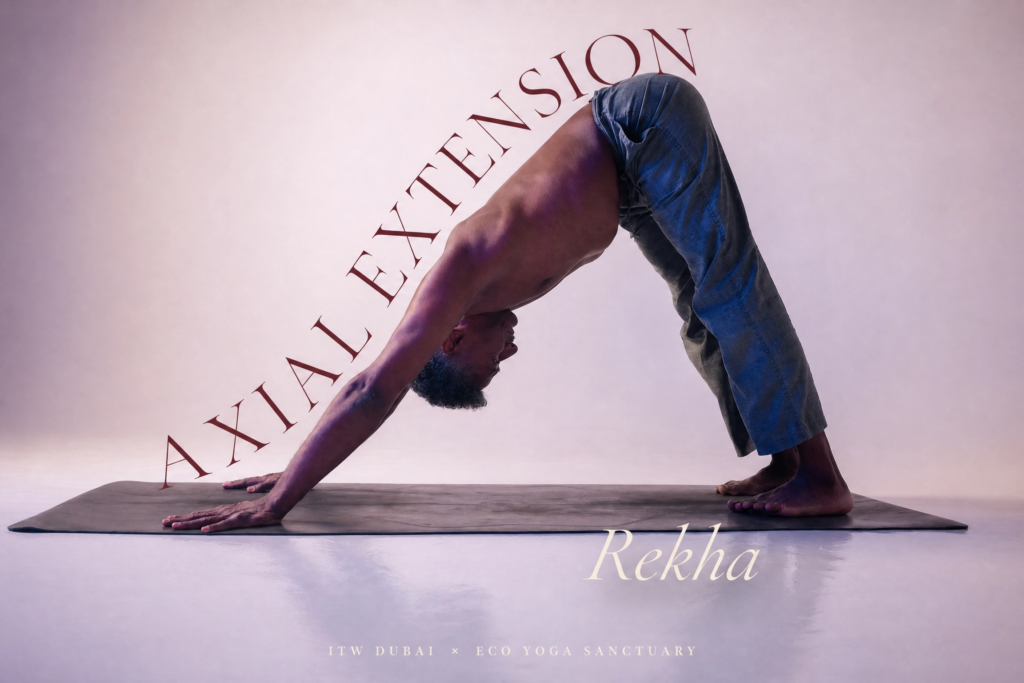
Adho Mukha Svanasana (Downward-Facing Dog) — the spine lengthens from the wrists to the sitting bones, increasing intervertebral space throughout the entire column.

Ardha Uttanasana (Half Forward Fold) — the spine actively lengthens before descending into the fold, protecting the intervertebral discs and facet joints from compression.
Axial Extension in Practice: Four Essential Postures
Understanding axial extension as a concept is only the beginning. The real transformation happens when you feel it in your body through specific postures. The following four asanas are the clearest demonstrations of this principle in action.
1. Tadasana — Mountain Pose: The Blueprint for Axial Extension
Tadasana is not a passive standing posture. It is the active practice of axial extension in its purest form. In Tadasana, we ground through the four corners of both feet, engage the inner arches, and draw the energy upward through the legs, pelvis, and spine. The rib cage lifts away from the pelvis, the shoulders draw back and down, and the crown of the head reaches toward the ceiling. This creates maximum intervertebral space throughout the entire spinal column — from the sacrum to the atlas — while maintaining the natural curves of the cervical, thoracic, and lumbar spine. Tadasana is the posture against which every other posture is measured. When a student cannot find axial extension in Tadasana, they will not find it in any other pose.
2. Chaturanga Dandasana: Axial Extension Under Load
Chaturanga Dandasana is one of the most misunderstood postures in vinyasa yoga. It is taught primarily as a test of upper-body strength, but its deeper function is the maintenance of axial extension under significant gravitational load. When the core fails to maintain the lengthened spine — when the hips drop or the lower back sags — the lumbar vertebrae are compressed in extension. Correct Chaturanga requires the practitioner to actively lengthen the spine from the crown of the head to the heels, creating a single, straight line that distributes the load evenly across the entire spinal column. This is not a strength cue — it is an axial extension cue.

Chaturanga Dandasana — axial extension under gravitational load. The spine maintains its length from crown to heels, protecting the lumbar discs and distributing force evenly across the entire column.
3. Adho Mukha Svanasana — Downward-Facing Dog: Traction and Decompression
Adho Mukha Svanasana is one of the most powerful spinal decompression postures in the yoga canon. When practiced with axial extension, the spine undergoes a form of traction — the weight of the torso, combined with the grounding of the hands and the lifting of the sitting bones, creates a lengthening force that separates the vertebrae and increases intervertebral space throughout the entire column. The key is not to push the heels to the floor, but to draw the sitting bones upward and backward while pressing the hands firmly into the mat and reaching the crown of the head toward the ground.
4. Ardha Uttanasana — Half Forward Fold: Length Before Depth
Ardha Uttanasana is the transitional posture that teaches the most important lesson in spinal biomechanics: you must create length before you create depth. In this half-fold, the practitioner draws the sternum forward and the tailbone backward simultaneously, creating a long, flat back that maximizes intervertebral space before the spine descends into full flexion. By practicing Ardha Uttanasana with full axial extension, we train the nervous system to seek length before depth — a pattern that carries over into every forward fold, every twist, and every lateral bend in the practice.
Mahamudra: The Integration of Axial Extension, Breath, and Bandha
Mahamudra — the Great Seal — is perhaps the most complete expression of axial extension in the entire yoga tradition. In this seated posture, the practitioner extends one leg forward, places the heel of the other foot at the perineum, and folds forward over the extended leg while maintaining a long, extended spine. The combination of Jalandhara Bandha (chin lock), Mula Bandha (root lock), and Uddiyana Bandha (abdominal lock) creates an internal pressure system that supports the spine from within, while the active lengthening of the torso over the extended leg provides a powerful decompressive traction force. Mahamudra is not a passive stretch — it is an active practice of creating and maintaining intervertebral space under the conditions of forward flexion.

Mahamudra — the Great Seal. Axial extension is maintained throughout the forward fold, creating intervertebral space even as the spine enters flexion. This is the integration of length and depth.
The Swing as a Tool for Spinal Decompression and Axial Extension
At Integrated Therapy Work (ITW) Dubai, we are proud to support the Swing Yoga Teacher Training led by Yara, hosted at Serendipity Dubai. The yoga swing is one of the most effective tools available for teaching and experiencing axial extension. Through inversion and supported traction, the swing allows the practitioner to feel genuine spinal decompression — the intervertebral space opening under gravity rather than against it. This is not possible in any standing or seated posture. The swing removes the compressive force of body weight from the spine entirely, allowing the discs to rehydrate, the facet joints to decompress, and the practitioner to experience what a truly lengthened spine feels like.
The Swing Yoga Teacher Training — a 50-hour Yoga Alliance certified program running on October 17–18, 24–25, and 31, 2026 — includes a dedicated Spine Module that covers exactly this: why the swing is such an effective tool for releasing back pain, maintaining a healthy and mobile spine, and teaching functional anatomy. The training is designed for 200-hour certified yoga teachers, Pilates instructors, and fitness trainers in Dubai who want to offer a refined, in-demand approach that sets their teaching apart.
| Spinal Movement | Risk Without Axial Extension | Benefit With Axial Extension | Key Posture |
|---|---|---|---|
| Flexion (Forward Bend) | Posterior disc compression, ligament strain | Even load distribution, disc protection | Ardha Uttanasana |
| Extension (Backbend) | Facet joint impingement, spinous process compression | Posterior elements glide freely | Tadasana → Urdhva Mukha Svanasana |
| Lateral Flexion (Side Bend) | Concave-side disc pinch, facet joint closure | Balanced disc loading, joint space maintained | Parsvakonasana |
| Rotation (Twist) | Facet joint shear, disc annulus stress | Rotation around a lengthened axis, reduced shear | Parivrtta Trikonasana |
Frequently Asked Questions About Axial Extension and Spinal Health in Yoga
What exactly is axial extension in yoga, and how do I feel it in my body?
Axial extension in yoga is the active lengthening of the spine along its vertical axis — the feeling of growing taller from the inside. You feel it in your body as a simultaneous grounding downward through the feet or sitting bones and a lifting upward through the crown of the head. The rib cage lifts away from the pelvis, creating space in the waist. The most accessible way to experience it is in Tadasana (Mountain Pose): stand tall, press your feet into the floor, and imagine a thread pulling the crown of your head toward the ceiling. That sensation of length is axial extension.
Why does my back hurt when I twist in yoga, and can axial extension help?
Back pain in twists is almost always a sign that you are rotating without first creating axial extension. When the vertebrae are not lengthened apart before you rotate, the facet joints are forced into a shearing position and the intervertebral discs experience uneven stress. The solution is simple: before every twist, inhale and lengthen your spine as tall as possible. Then, on the exhale, begin your rotation. This sequence — length first, then movement — is the foundation of safe, intelligent twisting in yoga and is taught in every functional anatomy module at Integrated Therapy Work (ITW) in Dubai, UAE.
How does the yoga swing help with spinal decompression in Dubai?
The yoga swing helps with spinal decompression in Dubai by allowing the practitioner to invert and experience traction — a lengthening force that separates the vertebrae without any muscular effort. In inversion, gravity works with the spine rather than against it, creating intervertebral space and allowing the discs to rehydrate. This is why many practitioners report immediate relief from back pain after swing yoga sessions. The Swing Yoga Teacher Training led by Yara at Serendipity Dubai includes a dedicated Spine Module that teaches you exactly how to use the swing as a decompression and rehabilitation tool for your students.
Where can I learn functional anatomy and spinal biomechanics for yoga teachers in Dubai?
You can learn functional anatomy and spinal biomechanics for yoga teachers in Dubai through two pathways. The first is the ITW Mastery Series at Eco Yoga Sanctuary in Jumeirah, Dubai — a YACEP-accredited continuing education program that covers anatomy, movement therapy, and the functional approach to asana. The second is the Swing Yoga Teacher Training led by Yara, a 50-hour Yoga Alliance certified program that includes a dedicated Functional Anatomy module and a Spine Module. Both programs are designed for yoga teachers, Pilates instructors, and fitness professionals in the UAE who want to teach with precision and confidence.
What is the difference between axial extension and hyperextension of the spine?
Axial extension and hyperextension are very different things. Axial extension is the lengthening of the spine along its vertical axis — it increases intervertebral space and maintains the natural curves of the spine. Hyperextension is an excessive backward bending of the spine that compresses the posterior elements, including the facet joints and spinous processes. Axial extension actually prevents hyperextension by creating space in the spine before any movement occurs. When you lengthen first, the spine has room to move safely in any direction without compressing any of its structures.
Join Viniyoga Therapy Classes at Eco Yoga Sanctuary, Jumeirah
Practice asana in function — not just in form. Small groups, breath-led sequencing, and therapeutic adaptation to your unique spinal structure. Learn axial extension from the inside out.
Book Your Class at Eco Yoga SanctuarySwing Yoga Teacher Training — Led by Yara
A 50-hour Yoga Alliance certified training covering functional anatomy, the spine module, shoulder stability, and how to use the swing as a progressive decompression and teaching tool. October 17–18, 24–25 & 31, 2026 · Serendipity Dubai · For 200-hour yoga teachers, Pilates instructors & fitness trainers.
Register for the Swing Yoga TrainingITW Mastery Series — Functional Anatomy for Yoga Teachers
Deepen your anatomical knowledge and earn YACEP continuing education credits. For yoga teachers and advanced practitioners. Eco Yoga Sanctuary, Jumeirah, Dubai, UAE.
Register for the ITW Mastery SeriesViniyoga Therapy Classes at Eco Yoga Sanctuary
Experience breath-led, therapeutically adapted yoga in small groups at Eco Yoga Sanctuary, Jumeirah, Dubai. Ideal for those managing back pain, stress, or seeking a deeper, safer practice.
Book a Yoga Therapy ClassYoga Sequencing Online Course — ITW Dubai
Learn the functional principles of therapeutic yoga sequencing from Kamal, Lead Therapist at Integrated Therapy Work (ITW) Dubai. Master axial extension, breath-led movement, and safe asana design — from anywhere in the world.
Enrol in the Yoga Sequencing Course