
Cakravakasana: The Sunbird Pose
That Is Not Cat-Cow
How the Red Goose pose releases your thoracolumbar fascia, restores lumbopelvic rhythm, and relieves lower back tension — one breath at a time.
“Every week I see practitioners in Dubai who have been doing yoga for years — but their lower backs are still tight, still aching. When I ask them about Cakravakasana, they show me Cat-Cow. That is the moment I know exactly what we need to work on.”
— Kamal, Lead Therapist, Integrated Therapy Work (ITW) Dubai
What Is Cakravakasana — and Why Is It Not Cat-Cow?
Cakravakasana — named after the Cakravaka bird, the Red Goose of Sanskrit poetry, a symbol of longing and reunion — is one of the most therapeutically significant movements in the Viniyoga tradition. It is a breath-led, asymmetrical kneeling movement that takes the practitioner from a neutral tabletop position forward into a gentle extension, and then back toward a modified child’s pose on the exhale. The movement is slow, intentional, and deeply connected to the breath cycle.
This is fundamentally different from Cat-Cow (Marjaryasana-Bitilasana). Cat-Cow is a general mobilisation of the entire spine — from the cervical neck all the way down to the sacrum — moving in a wave-like pattern. It is valuable, but it is not targeted. Cakravakasana, by contrast, is a functional movement with a precise therapeutic intention: to isolate the lower back, engage the lumbopelvic rhythm, and release the thoracolumbar fascia. When a teacher or practitioner conflates the two, the specific therapeutic benefit of Cakravakasana is lost entirely.


At Eco Yoga Sanctuary in Jumeirah, Dubai, Cakravakasana is a cornerstone of every Viniyoga Therapy class. The methodology is rooted in the teachings of T.K.V. Desikachar and Gary Kraftsow of the American Viniyoga Institute — a lineage that places the individual’s structural reality at the centre of every practice decision.
The Thoracolumbar Fascia: Why Your Lower Back Is So Prone to Tightness
The thoracolumbar fascia is a large, diamond-shaped sheet of dense connective tissue that covers the entire lower back region — from the thoracic spine above to the sacrum and pelvis below, and from the spinous processes of the vertebrae to the lateral edges of the back muscles. It is not simply a passive wrapping. The thoracolumbar fascia is a highly innervated, mechanically active structure that transmits force between the spine, pelvis, and limbs. It is intimately connected to the latissimus dorsi, the gluteus maximus, the erector spinae, and the deep abdominal muscles.
Because of its role in force transmission and its dense network of nerve endings, the thoracolumbar fascia is extremely responsive to stress — and extremely prone to tightness. In our modern life in Dubai and across the UAE, where high-demand jobs often mean eight to twelve hours of sitting, sustained postural compression, and chronic stress, the thoracolumbar fascia is under near-constant load. It becomes dehydrated, stiff, and sensitised. This is why so many people describe a deep, diffuse ache across the lower back that does not respond to simple stretching — because they are not reaching the fascia.
Cakravakasana is one of the most effective tools for releasing this tissue. The combination of spinal flexion, posterior pelvic tilt, and the gentle traction created by the arm and leg extension creates a multidirectional stretch across the entire thoracolumbar region. Crucially, the breath amplifies this effect: a slow, complete exhale increases intra-abdominal pressure in a way that gently decompresses the lumbar vertebrae while the fascia is under stretch.
What Is Lumbopelvic Rhythm — and Why Does It Matter in This Pose?
Lumbopelvic rhythm is the coordinated, sequential relationship between the movement of the lumbar spine and the movement of the pelvis. When you bend forward to touch your toes, for example, your pelvis tilts forward (anteriorly) over the hip joints at the same time as your lumbar spine flexes. This coordination is not random — it follows a predictable, healthy pattern that distributes the mechanical load across multiple joints rather than concentrating it at one or two lumbar segments.
When lumbopelvic rhythm is disrupted — as it commonly is in people with chronic lower back pain, tight hip flexors, or weak deep abdominals — the lumbar spine tends to do most of the work while the pelvis barely moves. This creates excessive shear and compression at the lumbar discs and facet joints. Over time, this is a primary driver of disc deterioration and chronic lower back dysfunction.
In Cakravakasana, restoring healthy lumbopelvic rhythm is the primary movement goal. The key instruction is this: keep the lower back relatively flat as you begin to move your hips back, and allow the pelvis to initiate the movement first. Do not let the upper back collapse or the shoulders round. The movement should feel like the pelvis is gently scooping backward and downward — not like the spine is crumpling.
Breath Awareness: How the Rectus Abdominis Drives the Movement
In the Viniyoga tradition, the breath is never a background event. It is the primary mover. In Cakravakasana, the exhale is the engine of the therapeutic action. As you breathe out slowly and completely, the rectus abdominis — the long, vertical muscle running from the pubic bone to the sternum — gently contracts. This contraction does something specific and important: it creates a posterior pelvic tilt.
A posterior pelvic tilt means the tailbone tucks slightly under and the front of the pelvis lifts. This action gently rounds and decompresses the lumbar spine, creating space between the vertebrae and placing the thoracolumbar fascia under a lengthening tension. When this happens simultaneously with the hips moving back toward the heels, the stretch across the lower back is both deep and safe — because the movement is controlled from the inside, by the breath and the abdominals, rather than forced from the outside by gravity or momentum.
This is the fundamental difference between a therapeutic yoga movement and a generic stretch. The breath awareness transforms Cakravakasana from a passive position into an active, intelligent release. Each exhale is an opportunity to go a little deeper — not by pushing, but by letting the breath do the work.
Krama: Adapting Cakravakasana for Disc Deterioration and Sensitive Spines
One of the most important principles in the Viniyoga methodology is Krama — the art of intelligent sequencing and progressive adaptation. Krama recognises that not every practitioner can or should perform the full expression of a movement on the first attempt, or at all. The teacher’s role is to segment the movement into stages that meet the practitioner where they are.
For practitioners with disc deterioration, disc herniation, or significant lower back sensitivity, the full Cakravakasana — moving all the way back to the heels — may not be appropriate. In this case, Krama offers a staged approach:
Stage 1 — Breath and Pelvic Awareness Only: Remain in the tabletop position. On the exhale, simply engage the lower abdominals and feel the subtle posterior tilt of the pelvis without moving the hips at all. This builds the neuromuscular connection between the breath, the abdominals, and the pelvis. It is the foundation of the entire movement.
Stage 2 — Minimal Range, Maximum Awareness: On the exhale, allow the hips to move only two to four centimetres back — just enough to feel the lower back lengthen slightly. Hold the lower back flat. Inhale back to neutral. Repeat six to eight times, focusing entirely on the quality of the movement rather than the range.
Stage 3 — Progressive Deepening: Only when Stages 1 and 2 feel comfortable and pain-free does the practitioner begin to explore a greater range of motion, moving further back on each exhale over multiple sessions. The full expression of Cakravakasana — hips to heels, forehead toward the mat — is the destination, not the starting point.
Who Is Cakravakasana For? Three Practitioners, One Pose
If you are dealing with chronic lower back tension, stiffness after long work days, or recovering from a back injury, Cakravakasana offers a safe, gentle, and deeply effective way to release the thoracolumbar fascia and restore mobility.
Understanding the anatomical distinction between Cakravakasana and Cat-Cow is essential continuing education. When you can teach the lumbopelvic rhythm and the Krama adaptations, you become a significantly more effective and safe teacher.
If you have been practising yoga for years and want to understand the functional anatomy beneath the postures, Cakravakasana is a masterclass in breath-body integration and fascial release.
Step-by-Step: How to Practise Cakravakasana
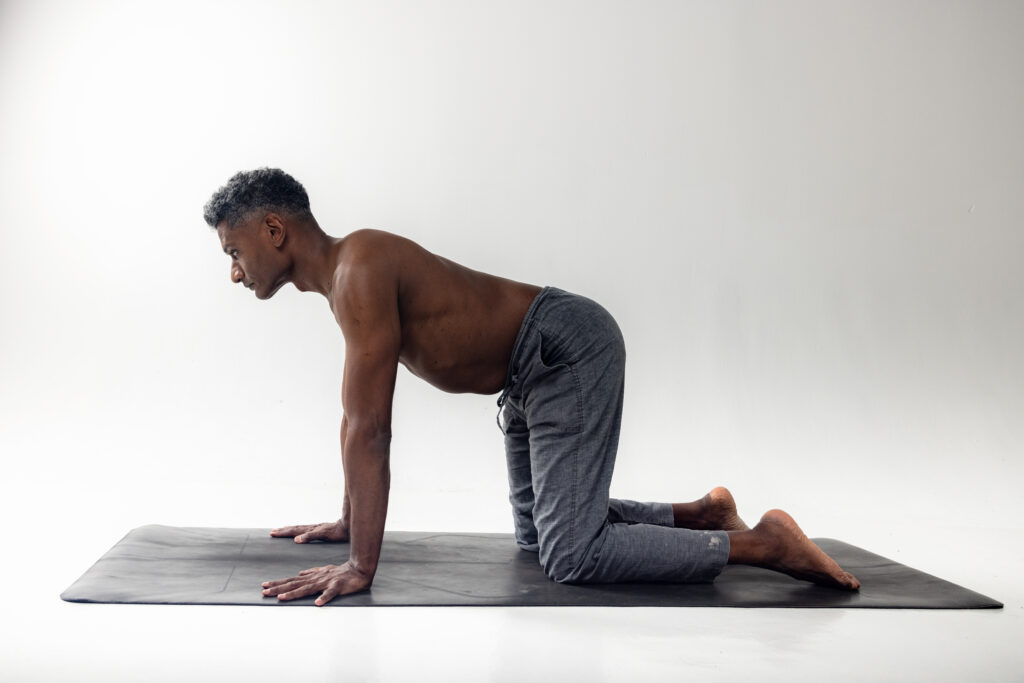
Begin on your hands and knees in a neutral tabletop position. Your wrists are directly under your shoulders, your knees are under your hips, and your spine is long and neutral — neither arched nor rounded. Take a moment here to feel the natural curve of your lower back and the weight of your pelvis.
On your inhale, extend your right arm forward at shoulder height and your left leg back at hip height. Keep your lower back flat — do not allow the lumbar spine to arch or the pelvis to tilt forward. Your gaze is softly down toward the mat. This is the extension phase: the Sunbird in flight.
On your exhale, begin to draw your right elbow and left knee toward each other under your body, simultaneously allowing your hips to move back toward your heels. As you exhale, feel the lower abdominals gently engage, creating the posterior pelvic tilt. Your lower back rounds slightly. Your hips descend. The thoracolumbar fascia lengthens. This is the therapeutic heart of the movement.
Inhale to return to the extended position. Repeat four to six times on each side. The movement should feel like a wave — fluid, breath-led, and deeply releasing.
Frequently Asked Questions About Cakravakasana
What is the difference between Cakravakasana and Cat-Cow pose?
Cakravakasana is a targeted therapeutic movement that isolates the lower back and specifically stretches the thoracolumbar fascia by moving the hips back toward the heels on an exhale. Cat-Cow is a general mobilisation of the entire spine from a static tabletop position. They are different movements with different intentions. Cakravakasana is not a variation of Cat-Cow — it is a distinct pose in the Viniyoga tradition with a specific therapeutic function.
How does Cakravakasana help with lower back pain in Dubai?
Cakravakasana helps with lower back pain by releasing the thoracolumbar fascia — the dense connective tissue across the lower back that becomes tight from prolonged sitting and high-demand work. The breath-led posterior pelvic tilt, driven by the rectus abdominis, gently decompresses the lumbar spine and restores healthy lumbopelvic rhythm. Practised regularly in a Viniyoga Therapy class at Eco Yoga Sanctuary in Jumeirah, Dubai, it is one of the most effective tools for chronic lower back relief.
What is lumbopelvic rhythm and why does it matter?
Lumbopelvic rhythm is the coordinated, sequential movement between the lumbar spine and the pelvis. When this rhythm is healthy, the load of movement is distributed across multiple joints. When it is disrupted, the lumbar spine bears too much of the load, accelerating disc wear and joint stress. Cakravakasana is specifically designed to retrain this rhythm by teaching the pelvis to initiate movement before the spine flexes.
Can I practise Cakravakasana if I have a disc problem?
Yes, but the movement must be adapted using the Krama principle. For practitioners with disc deterioration or herniation, the movement is segmented into stages — beginning with breath and pelvic awareness only, then progressing to a minimal range of motion, and only deepening the range over time as the body responds positively. Always consult your medical provider or physiotherapist before beginning any yoga practice if you have a diagnosed spinal condition.
Where can I learn Viniyoga therapy and Cakravakasana in Dubai?
Viniyoga Therapy classes, including the therapeutic application of Cakravakasana, are taught at Eco Yoga Sanctuary in Jumeirah, Dubai, by Kamal, Lead Therapist at Integrated Therapy Work (ITW) Dubai. Classes are small-group, breath-led, and adapted to each practitioner’s individual structure. The methodology is rooted in the lineage of T.K.V. Desikachar and Gary Kraftsow of the American Viniyoga Institute.
Join Viniyoga Therapy Classes
at Eco Yoga Sanctuary, Jumeirah
Practice asana in function — not just in form. Learn Cakravakasana and the full Viniyoga Therapy repertoire in small groups with breath-led sequencing, therapeutic adaptation, and deep anatomical awareness. Located in Jumeirah, Dubai, UAE.
Book Your Class at Eco Yoga SanctuaryITW Mastery Series — July Bundle
Deepen your anatomical knowledge of the spine, fascia, and lumbopelvic mechanics. Earn YACEP continuing education credits. For yoga teachers and advanced practitioners. Eco Yoga Sanctuary, Jumeirah, Dubai.
Register – July BundleITW Mastery Series — August Bundle
Continue your therapeutic yoga education with the August Mastery Series. Explore pranayama, kinesiology, and functional anatomy in a small-group, immersive format. YACEP accredited. Eco Yoga Sanctuary, Jumeirah, Dubai.
Register – August BundleUp Next: Pranayama and the Diaphragm — Breathing as Spinal Medicine
In the next article in the Asana in Function series, we explore how the diaphragm and the pelvic floor work together as a pressure system — and how conscious breath work can be one of the most powerful tools for spinal health and nervous system regulation.
WordPress Block Code
Copy the entire block below and paste it into the WordPress Code Editor (three-dot menu → Code editor).
- Open a new post in WordPress and click the
⋮menu (top-right) → Code editor. - Select all existing content and delete it, then paste the copied code.
- Switch back to Visual editor to preview the layout.
- Replace
{MASTERY_JULY_BUNDLE_LINK}and{MASTERY_AUGUST_BUNDLE_LINK}with your actual registration URLs. - Upload
cakravakasana_hero.jpgas the Featured Image of the post. - The YouTube video (
https://youtu.be/gyU_xZo4yZE) is already embedded as a WordPress block after the first paragraph of “What Is Cakravakasana”. WordPress will auto-render it as a native video embed.
<!-- wp:group {"className":"aif-series-label","style":{"spacing":{"padding":{"top":"8px","bottom":"8px","left":"20px","right":"20px"}},"border":{"radius":"3px"},"color":{"background":"#2c1f14"}}} -->
<div class="wp-block-group aif-series-label" style="background-color:#2c1f14;padding-top:8px;padding-right:20px;padding-bottom:8px;padding-left:20px;border-radius:3px">
<!-- wp:paragraph {"align":"center","style":{"typography":{"fontSize":"12px","letterSpacing":"0.22em","textTransform":"uppercase","fontWeight":"700"},"color":{"text":"#c8a97a"}}} -->
<p class="has-text-align-center" style="color:#c8a97a;font-size:12px;letter-spacing:0.22em;text-transform:uppercase;font-weight:700">ASANA IN FUNCTION — THERAPEUTIC SERIES</p>
<!-- /wp:paragraph -->
</div>
<!-- /wp:group -->
<!-- wp:heading {"level":1,"textAlign":"center","style":{"typography":{"fontFamily":"Cormorant Garamond, Georgia, serif","fontSize":"clamp(2rem,4.5vw,3.4rem)","fontWeight":"300","lineHeight":"1.2"},"color":{"text":"#2c1f14"}}} -->
<h1 class="wp-block-heading has-text-align-center" style="color:#2c1f14;font-family:Cormorant Garamond, Georgia, serif;font-size:clamp(2rem,4.5vw,3.4rem);font-weight:300;line-height:1.2">Cakravakasana: The Sunbird Pose That Is Not Cat-Cow</h1>
<!-- /wp:heading -->
<!-- wp:paragraph {"align":"center","style":{"typography":{"fontSize":"15px","fontWeight":"300"},"color":{"text":"#6a5a4a"}}} -->
<p class="has-text-align-center" style="color:#6a5a4a;font-size:15px;font-weight:300">How the Red Goose pose releases your thoracolumbar fascia, restores lumbopelvic rhythm, and relieves lower back tension — one breath at a time.</p>
<!-- /wp:paragraph -->
<!-- wp:paragraph {"align":"center","style":{"typography":{"fontSize":"12px","letterSpacing":"0.1em","textTransform":"uppercase"},"color":{"text":"#a89070"}}} -->
<p class="has-text-align-center" style="color:#a89070;font-size:12px;letter-spacing:0.1em;text-transform:uppercase">By Kamal · Eco Yoga Sanctuary, Jumeirah, Dubai · 8 min read</p>
<!-- /wp:paragraph -->
<!-- wp:separator {"style":{"color":{"background":"#e8ddd0"}}} -->
<hr class="wp-block-separator has-text-color has-background" style="background-color:#e8ddd0;color:#e8ddd0"/>
<!-- /wp:separator -->
<!-- wp:quote {"className":"aif-hook","style":{"border":{"left":{"color":"#8b5e3c","width":"4px"}},"spacing":{"padding":{"top":"28px","bottom":"28px","left":"32px","right":"32px"}},"color":{"background":"#f5efe8"}}} -->
<blockquote class="wp-block-quote aif-hook" style="background-color:#f5efe8;border-left-color:#8b5e3c;border-left-width:4px;padding-top:28px;padding-right:32px;padding-bottom:28px;padding-left:32px">
<p style="font-family:Cormorant Garamond,Georgia,serif;font-size:1.3rem;font-style:italic;font-weight:300;color:#3a2a1a;line-height:1.65">"Every week I see practitioners in Dubai who have been doing yoga for years — but their lower backs are still tight, still aching. When I ask them about Cakravakasana, they show me Cat-Cow. That is the moment I know exactly what we need to work on."</p>
<cite style="font-size:12px;font-weight:700;letter-spacing:0.12em;text-transform:uppercase;color:#8b5e3c">— Kamal, Lead Therapist, Integrated Therapy Work (ITW) Dubai</cite>
</blockquote>
<!-- /wp:quote -->
<!-- wp:heading {"level":2,"style":{"typography":{"fontFamily":"Cormorant Garamond,Georgia,serif","fontSize":"1.8rem","fontWeight":"400"},"color":{"text":"#2c1f14"}}} -->
<h2 class="wp-block-heading" style="color:#2c1f14;font-family:Cormorant Garamond,Georgia,serif;font-size:1.8rem;font-weight:400">What Is Cakravakasana — and Why Is It Not Cat-Cow?</h2>
<!-- /wp:heading -->
<!-- wp:paragraph {"style":{"typography":{"fontSize":"16px","lineHeight":"1.8"},"color":{"text":"#3a2a1a"}}} -->
<p style="color:#3a2a1a;font-size:16px;line-height:1.8">Cakravakasana — named after the Cakravaka bird, the Red Goose of Sanskrit poetry, a symbol of longing and reunion — is one of the most therapeutically significant movements in the Viniyoga tradition. It is a breath-led, asymmetrical kneeling movement that takes the practitioner from a neutral tabletop position forward into a gentle extension, and then back toward a modified child's pose on the exhale. The movement is slow, intentional, and deeply connected to the breath cycle.</p>
<!-- /wp:paragraph -->
<!-- wp:paragraph {"style":{"typography":{"fontSize":"16px","lineHeight":"1.8"},"color":{"text":"#3a2a1a"}}} -->
<p style="color:#3a2a1a;font-size:16px;line-height:1.8">This is fundamentally different from Cat-Cow (Marjaryasana-Bitilasana). Cat-Cow is a general mobilisation of the entire spine — from the cervical neck all the way down to the sacrum — moving in a wave-like pattern. It is valuable, but it is not targeted. Cakravakasana, by contrast, is a <em>functional</em> movement with a precise therapeutic intention: to isolate the lower back, engage the lumbopelvic rhythm, and release the thoracolumbar fascia. When a teacher or practitioner conflates the two, the specific therapeutic benefit of Cakravakasana is lost entirely.</p>
<!-- /wp:paragraph -->
<!-- wp:paragraph {"style":{"typography":{"fontSize":"16px","lineHeight":"1.8"},"color":{"text":"#3a2a1a"}}} -->
<p style="color:#3a2a1a;font-size:16px;line-height:1.8">At Eco Yoga Sanctuary in Jumeirah, Dubai, Cakravakasana is a cornerstone of every Viniyoga Therapy class. The methodology is rooted in the teachings of T.K.V. Desikachar and Gary Kraftsow of the American Viniyoga Institute — a lineage that places the individual's structural reality at the centre of every practice decision.</p>
<!-- /wp:paragraph -->
<!-- wp:embed {"url":"https://youtu.be/gyU_xZo4yZE","type":"video","providerNameSlug":"youtube","responsive":true,"className":"wp-embed-aspect-16-9 wp-has-aspect-ratio"} -->
<figure class="wp-block-embed is-type-video is-provider-youtube wp-block-embed-youtube wp-embed-aspect-16-9 wp-has-aspect-ratio">
<div class="wp-block-embed__wrapper">
</div>
<figcaption class="wp-element-caption" style="font-size:13px;font-style:italic;color:#8a7a6a;text-align:center;margin-top:10px">Asana in Function: Cakravakasana — Viniyoga Therapy for Lower Back Pain | Eco Yoga Sanctuary, Jumeirah, Dubai</figcaption>
</figure>
<!-- /wp:embed -->
<!-- wp:separator {"style":{"color":{"background":"#e8ddd0"}}} -->
<hr class="wp-block-separator has-text-color has-background" style="background-color:#e8ddd0;color:#e8ddd0"/>
<!-- /wp:separator -->
<!-- wp:heading {"level":2,"style":{"typography":{"fontFamily":"Cormorant Garamond,Georgia,serif","fontSize":"1.8rem","fontWeight":"400"},"color":{"text":"#2c1f14"}}} -->
<h2 class="wp-block-heading" style="color:#2c1f14;font-family:Cormorant Garamond,Georgia,serif;font-size:1.8rem;font-weight:400">The Thoracolumbar Fascia: Why Your Lower Back Is So Prone to Tightness</h2>
<!-- /wp:heading -->
<!-- wp:paragraph {"style":{"typography":{"fontSize":"16px","lineHeight":"1.8"},"color":{"text":"#3a2a1a"}}} -->
<p style="color:#3a2a1a;font-size:16px;line-height:1.8">The thoracolumbar fascia is a large, diamond-shaped sheet of dense connective tissue that covers the entire lower back region — from the thoracic spine above to the sacrum and pelvis below, and from the spinous processes of the vertebrae to the lateral edges of the back muscles. It is not simply a passive wrapping. The thoracolumbar fascia is a highly innervated, mechanically active structure that transmits force between the spine, pelvis, and limbs. It is intimately connected to the latissimus dorsi, the gluteus maximus, the erector spinae, and the deep abdominal muscles.</p>
<!-- /wp:paragraph -->
<!-- wp:paragraph {"style":{"typography":{"fontSize":"16px","lineHeight":"1.8"},"color":{"text":"#3a2a1a"}}} -->
<p style="color:#3a2a1a;font-size:16px;line-height:1.8">Because of its role in force transmission and its dense network of nerve endings, the thoracolumbar fascia is <strong>extremely responsive to stress — and extremely prone to tightness</strong>. In our modern life in Dubai and across the UAE, where high-demand jobs often mean eight to twelve hours of sitting, sustained postural compression, and chronic stress, the thoracolumbar fascia is under near-constant load. It becomes dehydrated, stiff, and sensitised. This is why so many people describe a deep, diffuse ache across the lower back that does not respond to simple stretching — because they are not reaching the fascia.</p>
<!-- /wp:paragraph -->
<!-- wp:paragraph {"style":{"typography":{"fontSize":"16px","lineHeight":"1.8"},"color":{"text":"#3a2a1a"}}} -->
<p style="color:#3a2a1a;font-size:16px;line-height:1.8">Cakravakasana is one of the most effective tools for releasing this tissue. The combination of spinal flexion, posterior pelvic tilt, and the gentle traction created by the arm and leg extension creates a multidirectional stretch across the entire thoracolumbar region. Crucially, the breath amplifies this effect: a slow, complete exhale increases intra-abdominal pressure in a way that gently decompresses the lumbar vertebrae while the fascia is under stretch.</p>
<!-- /wp:paragraph -->
<!-- wp:separator {"style":{"color":{"background":"#e8ddd0"}}} -->
<hr class="wp-block-separator has-text-color has-background" style="background-color:#e8ddd0;color:#e8ddd0"/>
<!-- /wp:separator -->
<!-- wp:heading {"level":2,"style":{"typography":{"fontFamily":"Cormorant Garamond,Georgia,serif","fontSize":"1.8rem","fontWeight":"400"},"color":{"text":"#2c1f14"}}} -->
<h2 class="wp-block-heading" style="color:#2c1f14;font-family:Cormorant Garamond,Georgia,serif;font-size:1.8rem;font-weight:400">What Is Lumbopelvic Rhythm — and Why Does It Matter in This Pose?</h2>
<!-- /wp:heading -->
<!-- wp:paragraph {"style":{"typography":{"fontSize":"16px","lineHeight":"1.8"},"color":{"text":"#3a2a1a"}}} -->
<p style="color:#3a2a1a;font-size:16px;line-height:1.8">Lumbopelvic rhythm is the coordinated, sequential relationship between the movement of the lumbar spine and the movement of the pelvis. When you bend forward to touch your toes, for example, your pelvis tilts forward (anteriorly) over the hip joints at the same time as your lumbar spine flexes. This coordination is not random — it follows a predictable, healthy pattern that distributes the mechanical load across multiple joints rather than concentrating it at one or two lumbar segments.</p>
<!-- /wp:paragraph -->
<!-- wp:paragraph {"style":{"typography":{"fontSize":"16px","lineHeight":"1.8"},"color":{"text":"#3a2a1a"}}} -->
<p style="color:#3a2a1a;font-size:16px;line-height:1.8">When lumbopelvic rhythm is disrupted — as it commonly is in people with chronic lower back pain, tight hip flexors, or weak deep abdominals — the lumbar spine tends to do most of the work while the pelvis barely moves. This creates excessive shear and compression at the lumbar discs and facet joints. Over time, this is a primary driver of disc deterioration and chronic lower back dysfunction.</p>
<!-- /wp:paragraph -->
<!-- wp:paragraph {"style":{"typography":{"fontSize":"16px","lineHeight":"1.8"},"color":{"text":"#3a2a1a"}}} -->
<p style="color:#3a2a1a;font-size:16px;line-height:1.8">In Cakravakasana, restoring healthy lumbopelvic rhythm is the primary movement goal. The key instruction is this: <strong>keep the lower back relatively flat as you begin to move your hips back, and allow the pelvis to initiate the movement first</strong>. Do not let the upper back collapse or the shoulders round. The movement should feel like the pelvis is gently scooping backward and downward — not like the spine is crumpling. This isolation requires awareness, and it is exactly the kind of awareness that is cultivated in a Viniyoga Therapy class.</p>
<!-- /wp:paragraph -->
<!-- wp:separator {"style":{"color":{"background":"#e8ddd0"}}} -->
<hr class="wp-block-separator has-text-color has-background" style="background-color:#e8ddd0;color:#e8ddd0"/>
<!-- /wp:separator -->
<!-- wp:heading {"level":2,"style":{"typography":{"fontFamily":"Cormorant Garamond,Georgia,serif","fontSize":"1.8rem","fontWeight":"400"},"color":{"text":"#2c1f14"}}} -->
<h2 class="wp-block-heading" style="color:#2c1f14;font-family:Cormorant Garamond,Georgia,serif;font-size:1.8rem;font-weight:400">Breath Awareness: How the Rectus Abdominis Drives the Movement</h2>
<!-- /wp:heading -->
<!-- wp:paragraph {"style":{"typography":{"fontSize":"16px","lineHeight":"1.8"},"color":{"text":"#3a2a1a"}}} -->
<p style="color:#3a2a1a;font-size:16px;line-height:1.8">In the Viniyoga tradition, the breath is never a background event. It is the primary mover. In Cakravakasana, the exhale is the engine of the therapeutic action. As you breathe out slowly and completely, the rectus abdominis — the long, vertical muscle running from the pubic bone to the sternum — gently contracts. This contraction does something specific and important: it creates a <strong>posterior pelvic tilt</strong>.</p>
<!-- /wp:paragraph -->
<!-- wp:paragraph {"style":{"typography":{"fontSize":"16px","lineHeight":"1.8"},"color":{"text":"#3a2a1a"}}} -->
<p style="color:#3a2a1a;font-size:16px;line-height:1.8">A posterior pelvic tilt means the tailbone tucks slightly under and the front of the pelvis lifts. This action gently rounds and decompresses the lumbar spine, creating space between the vertebrae and placing the thoracolumbar fascia under a lengthening tension. When this happens simultaneously with the hips moving back toward the heels, the stretch across the lower back is both deep and safe — because the movement is controlled from the inside, by the breath and the abdominals, rather than forced from the outside by gravity or momentum.</p>
<!-- /wp:paragraph -->
<!-- wp:paragraph {"style":{"typography":{"fontSize":"16px","lineHeight":"1.8"},"color":{"text":"#3a2a1a"}}} -->
<p style="color:#3a2a1a;font-size:16px;line-height:1.8">This is the fundamental difference between a therapeutic yoga movement and a generic stretch. The breath awareness transforms Cakravakasana from a passive position into an active, intelligent release. Each exhale is an opportunity to go a little deeper — not by pushing, but by letting the breath do the work.</p>
<!-- /wp:paragraph -->
<!-- wp:separator {"style":{"color":{"background":"#e8ddd0"}}} -->
<hr class="wp-block-separator has-text-color has-background" style="background-color:#e8ddd0;color:#e8ddd0"/>
<!-- /wp:separator -->
<!-- wp:heading {"level":2,"style":{"typography":{"fontFamily":"Cormorant Garamond,Georgia,serif","fontSize":"1.8rem","fontWeight":"400"},"color":{"text":"#2c1f14"}}} -->
<h2 class="wp-block-heading" style="color:#2c1f14;font-family:Cormorant Garamond,Georgia,serif;font-size:1.8rem;font-weight:400">Krama: Adapting Cakravakasana for Disc Deterioration and Sensitive Spines</h2>
<!-- /wp:heading -->
<!-- wp:paragraph {"style":{"typography":{"fontSize":"16px","lineHeight":"1.8"},"color":{"text":"#3a2a1a"}}} -->
<p style="color:#3a2a1a;font-size:16px;line-height:1.8">One of the most important principles in the Viniyoga methodology is <em>Krama</em> — the art of intelligent sequencing and progressive adaptation. Krama recognises that not every practitioner can or should perform the full expression of a movement on the first attempt, or at all. The teacher's role is to segment the movement into stages that meet the practitioner where they are.</p>
<!-- /wp:paragraph -->
<!-- wp:paragraph {"style":{"typography":{"fontSize":"16px","lineHeight":"1.8"},"color":{"text":"#3a2a1a"}}} -->
<p style="color:#3a2a1a;font-size:16px;line-height:1.8">For practitioners with disc deterioration, disc herniation, or significant lower back sensitivity, the full Cakravakasana — moving all the way back to the heels — may not be appropriate. In this case, Krama offers a staged approach:</p>
<!-- /wp:paragraph -->
<!-- wp:group {"style":{"border":{"radius":"8px","width":"1px","color":"#e8ddd0"},"spacing":{"padding":{"top":"24px","bottom":"24px","left":"28px","right":"28px"}},"color":{"background":"#faf8f5"}},"layout":{"type":"constrained"}} -->
<div class="wp-block-group" style="background-color:#faf8f5;border-color:#e8ddd0;border-width:1px;border-radius:8px;padding-top:24px;padding-right:28px;padding-bottom:24px;padding-left:28px">
<!-- wp:paragraph {"style":{"typography":{"fontSize":"11px","fontWeight":"700","letterSpacing":"0.2em","textTransform":"uppercase"},"color":{"text":"#8b5e3c"}}} -->
<p style="color:#8b5e3c;font-size:11px;font-weight:700;letter-spacing:0.2em;text-transform:uppercase">KRAMA ADAPTATION — THREE STAGES</p>
<!-- /wp:paragraph -->
<!-- wp:paragraph {"style":{"typography":{"fontSize":"15px","lineHeight":"1.8"},"color":{"text":"#3a2a1a"}}} -->
<p style="color:#3a2a1a;font-size:15px;line-height:1.8"><strong>Stage 1 — Breath and Pelvic Awareness Only:</strong> Remain in the tabletop position. On the exhale, simply engage the lower abdominals and feel the subtle posterior tilt of the pelvis without moving the hips at all. This builds the neuromuscular connection between the breath, the abdominals, and the pelvis. It is the foundation of the entire movement.</p>
<!-- /wp:paragraph -->
<!-- wp:paragraph {"style":{"typography":{"fontSize":"15px","lineHeight":"1.8"},"color":{"text":"#3a2a1a"}}} -->
<p style="color:#3a2a1a;font-size:15px;line-height:1.8"><strong>Stage 2 — Minimal Range, Maximum Awareness:</strong> On the exhale, allow the hips to move only two to four centimetres back — just enough to feel the lower back lengthen slightly. Hold the lower back flat. Inhale back to neutral. Repeat six to eight times, focusing entirely on the quality of the movement rather than the range.</p>
<!-- /wp:paragraph -->
<!-- wp:paragraph {"style":{"typography":{"fontSize":"15px","lineHeight":"1.8"},"color":{"text":"#3a2a1a"}}} -->
<p style="color:#3a2a1a;font-size:15px;line-height:1.8"><strong>Stage 3 — Progressive Deepening:</strong> Only when Stages 1 and 2 feel comfortable and pain-free does the practitioner begin to explore a greater range of motion, moving further back on each exhale over multiple sessions. The full expression of Cakravakasana — hips to heels, forehead toward the mat — is the destination, not the starting point.</p>
<!-- /wp:paragraph -->
<!-- wp:paragraph {"style":{"typography":{"fontSize":"13px","fontStyle":"italic","lineHeight":"1.6"},"color":{"text":"#8b5e3c"}}} -->
<p style="color:#8b5e3c;font-size:13px;font-style:italic;line-height:1.6">⚠️ Important: Always consult your medical provider or physiotherapist before beginning any new movement practice, particularly if you have a diagnosed spinal condition, disc herniation, or history of lower back injury. The information in this article is educational and does not replace professional medical advice.</p>
<!-- /wp:paragraph -->
</div>
<!-- /wp:group -->
<!-- wp:spacer {"height":"24px"} -->
<div style="height:24px" aria-hidden="true" class="wp-block-spacer"></div>
<!-- /wp:spacer -->
<!-- wp:separator {"style":{"color":{"background":"#e8ddd0"}}} -->
<hr class="wp-block-separator has-text-color has-background" style="background-color:#e8ddd0;color:#e8ddd0"/>
<!-- /wp:separator -->
<!-- wp:heading {"level":2,"style":{"typography":{"fontFamily":"Cormorant Garamond,Georgia,serif","fontSize":"1.8rem","fontWeight":"400"},"color":{"text":"#2c1f14"}}} -->
<h2 class="wp-block-heading" style="color:#2c1f14;font-family:Cormorant Garamond,Georgia,serif;font-size:1.8rem;font-weight:400">Who Is Cakravakasana For? Three Practitioners, One Pose</h2>
<!-- /wp:heading -->
<!-- wp:columns {"style":{"spacing":{"blockGap":"20px"}}} -->
<div class="wp-block-columns">
<!-- wp:column {"style":{"border":{"radius":"8px","width":"1px","color":"#e8ddd0"},"spacing":{"padding":{"top":"20px","bottom":"20px","left":"20px","right":"20px"}},"color":{"background":"#faf8f5"}}} -->
<div class="wp-block-column" style="background-color:#faf8f5;border-color:#e8ddd0;border-width:1px;border-radius:8px;padding-top:20px;padding-right:20px;padding-bottom:20px;padding-left:20px">
<!-- wp:paragraph {"style":{"typography":{"fontSize":"11px","fontWeight":"700","letterSpacing":"0.18em","textTransform":"uppercase"},"color":{"text":"#8b5e3c"}}} -->
<p style="color:#8b5e3c;font-size:11px;font-weight:700;letter-spacing:0.18em;text-transform:uppercase">For the Healing Practitioner</p>
<!-- /wp:paragraph -->
<!-- wp:paragraph {"style":{"typography":{"fontSize":"14px","lineHeight":"1.7"},"color":{"text":"#3a2a1a"}}} -->
<p style="color:#3a2a1a;font-size:14px;line-height:1.7">If you are dealing with chronic lower back tension, stiffness after long work days, or recovering from a back injury, Cakravakasana offers a safe, gentle, and deeply effective way to release the thoracolumbar fascia and restore mobility. The staged Krama approach means you can always find a version that works for your body today.</p>
<!-- /wp:paragraph -->
</div>
<!-- /wp:column -->
<!-- wp:column {"style":{"border":{"radius":"8px","width":"1px","color":"#e8ddd0"},"spacing":{"padding":{"top":"20px","bottom":"20px","left":"20px","right":"20px"}},"color":{"background":"#faf8f5"}}} -->
<div class="wp-block-column" style="background-color:#faf8f5;border-color:#e8ddd0;border-width:1px;border-radius:8px;padding-top:20px;padding-right:20px;padding-bottom:20px;padding-left:20px">
<!-- wp:paragraph {"style":{"typography":{"fontSize":"11px","fontWeight":"700","letterSpacing":"0.18em","textTransform":"uppercase"},"color":{"text":"#8b5e3c"}}} -->
<p style="color:#8b5e3c;font-size:11px;font-weight:700;letter-spacing:0.18em;text-transform:uppercase">For the Yoga Teacher</p>
<!-- /wp:paragraph -->
<!-- wp:paragraph {"style":{"typography":{"fontSize":"14px","lineHeight":"1.7"},"color":{"text":"#3a2a1a"}}} -->
<p style="color:#3a2a1a;font-size:14px;line-height:1.7">Understanding the anatomical distinction between Cakravakasana and Cat-Cow is essential continuing education. When you can teach the lumbopelvic rhythm, the role of the rectus abdominis, and the Krama adaptations, you become a significantly more effective and safe teacher for students with lower back conditions — which is most of your students.</p>
<!-- /wp:paragraph -->
</div>
<!-- /wp:column -->
<!-- wp:column {"style":{"border":{"radius":"8px","width":"1px","color":"#e8ddd0"},"spacing":{"padding":{"top":"20px","bottom":"20px","left":"20px","right":"20px"}},"color":{"background":"#faf8f5"}}} -->
<div class="wp-block-column" style="background-color:#faf8f5;border-color:#e8ddd0;border-width:1px;border-radius:8px;padding-top:20px;padding-right:20px;padding-bottom:20px;padding-left:20px">
<!-- wp:paragraph {"style":{"typography":{"fontSize":"11px","fontWeight":"700","letterSpacing":"0.18em","textTransform":"uppercase"},"color":{"text":"#8b5e3c"}}} -->
<p style="color:#8b5e3c;font-size:11px;font-weight:700;letter-spacing:0.18em;text-transform:uppercase">For the Mastery Seeker</p>
<!-- /wp:paragraph -->
<!-- wp:paragraph {"style":{"typography":{"fontSize":"14px","lineHeight":"1.7"},"color":{"text":"#3a2a1a"}}} -->
<p style="color:#3a2a1a;font-size:14px;line-height:1.7">If you have been practising yoga for years and want to understand the functional anatomy beneath the postures, Cakravakasana is a masterclass in breath-body integration. Learning to isolate the lower back from the upper back, to feel the fascial release, and to coordinate the breath with the pelvic tilt is a profound deepening of your practice.</p>
<!-- /wp:paragraph -->
</div>
<!-- /wp:column -->
</div>
<!-- /wp:columns -->
<!-- wp:spacer {"height":"24px"} -->
<div style="height:24px" aria-hidden="true" class="wp-block-spacer"></div>
<!-- /wp:spacer -->
<!-- wp:separator {"style":{"color":{"background":"#e8ddd0"}}} -->
<hr class="wp-block-separator has-text-color has-background" style="background-color:#e8ddd0;color:#e8ddd0"/>
<!-- /wp:separator -->
<!-- wp:heading {"level":2,"style":{"typography":{"fontFamily":"Cormorant Garamond,Georgia,serif","fontSize":"1.8rem","fontWeight":"400"},"color":{"text":"#2c1f14"}}} -->
<h2 class="wp-block-heading" style="color:#2c1f14;font-family:Cormorant Garamond,Georgia,serif;font-size:1.8rem;font-weight:400">Step-by-Step: How to Practise Cakravakasana</h2>
<!-- /wp:heading -->
<!-- wp:paragraph {"style":{"typography":{"fontSize":"16px","lineHeight":"1.8"},"color":{"text":"#3a2a1a"}}} -->
<p style="color:#3a2a1a;font-size:16px;line-height:1.8">Begin on your hands and knees in a neutral tabletop position. Your wrists are directly under your shoulders, your knees are under your hips, and your spine is long and neutral — neither arched nor rounded. Take a moment here to feel the natural curve of your lower back and the weight of your pelvis.</p>
<!-- /wp:paragraph -->
<!-- wp:paragraph {"style":{"typography":{"fontSize":"16px","lineHeight":"1.8"},"color":{"text":"#3a2a1a"}}} -->
<p style="color:#3a2a1a;font-size:16px;line-height:1.8">On your inhale, extend your right arm forward at shoulder height and your left leg back at hip height. Keep your lower back flat — do not allow the lumbar spine to arch or the pelvis to tilt forward. Your gaze is softly down toward the mat. This is the extension phase: the Sunbird in flight.</p>
<!-- /wp:paragraph -->
<!-- wp:paragraph {"style":{"typography":{"fontSize":"16px","lineHeight":"1.8"},"color":{"text":"#3a2a1a"}}} -->
<p style="color:#3a2a1a;font-size:16px;line-height:1.8">On your exhale, begin to draw your right elbow and left knee toward each other under your body, simultaneously allowing your hips to move back toward your heels. As you exhale, feel the lower abdominals gently engage, creating the posterior pelvic tilt. Your lower back rounds slightly. Your hips descend. The thoracolumbar fascia lengthens. This is the therapeutic heart of the movement.</p>
<!-- /wp:paragraph -->
<!-- wp:paragraph {"style":{"typography":{"fontSize":"16px","lineHeight":"1.8"},"color":{"text":"#3a2a1a"}}} -->
<p style="color:#3a2a1a;font-size:16px;line-height:1.8">Inhale to return to the extended position. Repeat four to six times on each side. The movement should feel like a wave — fluid, breath-led, and deeply releasing. If at any point you feel sharp pain or discomfort in the lower back, stop and consult your teacher or medical provider.</p>
<!-- /wp:paragraph -->
<!-- wp:separator {"style":{"color":{"background":"#e8ddd0"}}} -->
<hr class="wp-block-separator has-text-color has-background" style="background-color:#e8ddd0;color:#e8ddd0"/>
<!-- /wp:separator -->
<!-- wp:heading {"level":2,"style":{"typography":{"fontFamily":"Cormorant Garamond,Georgia,serif","fontSize":"1.8rem","fontWeight":"400"},"color":{"text":"#2c1f14"}}} -->
<h2 class="wp-block-heading" style="color:#2c1f14;font-family:Cormorant Garamond,Georgia,serif;font-size:1.8rem;font-weight:400">Frequently Asked Questions About Cakravakasana</h2>
<!-- /wp:heading -->
<!-- wp:heading {"level":3,"style":{"typography":{"fontSize":"1.2rem","fontWeight":"600"},"color":{"text":"#2c1f14"}}} -->
<h3 class="wp-block-heading" style="color:#2c1f14;font-size:1.2rem;font-weight:600">What is the difference between Cakravakasana and Cat-Cow pose?</h3>
<!-- /wp:heading -->
<!-- wp:paragraph {"style":{"typography":{"fontSize":"16px","lineHeight":"1.8"},"color":{"text":"#3a2a1a"}}} -->
<p style="color:#3a2a1a;font-size:16px;line-height:1.8">Cakravakasana is a targeted therapeutic movement that isolates the lower back and specifically stretches the thoracolumbar fascia by moving the hips back toward the heels on an exhale. Cat-Cow is a general mobilisation of the entire spine from a static tabletop position. They are different movements with different intentions. Cakravakasana is not a variation of Cat-Cow — it is a distinct pose in the Viniyoga tradition with a specific therapeutic function.</p>
<!-- /wp:paragraph -->
<!-- wp:heading {"level":3,"style":{"typography":{"fontSize":"1.2rem","fontWeight":"600"},"color":{"text":"#2c1f14"}}} -->
<h3 class="wp-block-heading" style="color:#2c1f14;font-size:1.2rem;font-weight:600">How does Cakravakasana help with lower back pain in Dubai?</h3>
<!-- /wp:heading -->
<!-- wp:paragraph {"style":{"typography":{"fontSize":"16px","lineHeight":"1.8"},"color":{"text":"#3a2a1a"}}} -->
<p style="color:#3a2a1a;font-size:16px;line-height:1.8">Cakravakasana helps with lower back pain by releasing the thoracolumbar fascia — the dense connective tissue across the lower back that becomes tight from prolonged sitting and high-demand work. The breath-led posterior pelvic tilt, driven by the rectus abdominis, gently decompresses the lumbar spine and restores healthy lumbopelvic rhythm. Practised regularly in a Viniyoga Therapy class at Eco Yoga Sanctuary in Jumeirah, Dubai, it is one of the most effective tools for chronic lower back relief.</p>
<!-- /wp:paragraph -->
<!-- wp:heading {"level":3,"style":{"typography":{"fontSize":"1.2rem","fontWeight":"600"},"color":{"text":"#2c1f14"}}} -->
<h3 class="wp-block-heading" style="color:#2c1f14;font-size:1.2rem;font-weight:600">What is lumbopelvic rhythm and why does it matter?</h3>
<!-- /wp:heading -->
<!-- wp:paragraph {"style":{"typography":{"fontSize":"16px","lineHeight":"1.8"},"color":{"text":"#3a2a1a"}}} -->
<p style="color:#3a2a1a;font-size:16px;line-height:1.8">Lumbopelvic rhythm is the coordinated, sequential movement between the lumbar spine and the pelvis. When this rhythm is healthy, the load of movement is distributed across multiple joints. When it is disrupted — as it commonly is in people with lower back pain — the lumbar spine bears too much of the load, accelerating disc wear and joint stress. Cakravakasana is specifically designed to retrain this rhythm by teaching the pelvis to initiate movement before the spine flexes.</p>
<!-- /wp:paragraph -->
<!-- wp:heading {"level":3,"style":{"typography":{"fontSize":"1.2rem","fontWeight":"600"},"color":{"text":"#2c1f14"}}} -->
<h3 class="wp-block-heading" style="color:#2c1f14;font-size:1.2rem;font-weight:600">Can I practise Cakravakasana if I have a disc problem?</h3>
<!-- /wp:heading -->
<!-- wp:paragraph {"style":{"typography":{"fontSize":"16px","lineHeight":"1.8"},"color":{"text":"#3a2a1a"}}} -->
<p style="color:#3a2a1a;font-size:16px;line-height:1.8">Yes, but the movement must be adapted using the Krama principle. For practitioners with disc deterioration or herniation, the movement is segmented into stages — beginning with breath and pelvic awareness only, then progressing to a minimal range of motion, and only deepening the range over time as the body responds positively. Always consult your medical provider or physiotherapist before beginning any yoga practice if you have a diagnosed spinal condition.</p>
<!-- /wp:paragraph -->
<!-- wp:heading {"level":3,"style":{"typography":{"fontSize":"1.2rem","fontWeight":"600"},"color":{"text":"#2c1f14"}}} -->
<h3 class="wp-block-heading" style="color:#2c1f14;font-size:1.2rem;font-weight:600">Where can I learn Viniyoga therapy and Cakravakasana in Dubai?</h3>
<!-- /wp:heading -->
<!-- wp:paragraph {"style":{"typography":{"fontSize":"16px","lineHeight":"1.8"},"color":{"text":"#3a2a1a"}}} -->
<p style="color:#3a2a1a;font-size:16px;line-height:1.8">Viniyoga Therapy classes, including the therapeutic application of Cakravakasana, are taught at Eco Yoga Sanctuary in Jumeirah, Dubai, by Kamal, Lead Therapist at Integrated Therapy Work (ITW) Dubai. Classes are small-group, breath-led, and adapted to each practitioner's individual structure. The methodology is rooted in the lineage of T.K.V. Desikachar and Gary Kraftsow of the American Viniyoga Institute.</p>
<!-- /wp:paragraph -->
<!-- wp:separator {"style":{"color":{"background":"#e8ddd0"}}} -->
<hr class="wp-block-separator has-text-color has-background" style="background-color:#e8ddd0;color:#e8ddd0"/>
<!-- /wp:separator -->
<!-- wp:group {"style":{"border":{"radius":"10px"},"spacing":{"padding":{"top":"40px","bottom":"40px","left":"36px","right":"36px"}},"color":{"background":"#2c1f14"}},"layout":{"type":"constrained"}} -->
<div class="wp-block-group" style="background-color:#2c1f14;border-radius:10px;padding-top:40px;padding-right:36px;padding-bottom:40px;padding-left:36px">
<!-- wp:paragraph {"align":"center","style":{"typography":{"fontSize":"11px","fontWeight":"700","letterSpacing":"0.22em","textTransform":"uppercase"},"color":{"text":"#c8a97a"}}} -->
<p class="has-text-align-center" style="color:#c8a97a;font-size:11px;font-weight:700;letter-spacing:0.22em;text-transform:uppercase">EXPERIENCE THE DIFFERENCE</p>
<!-- /wp:paragraph -->
<!-- wp:heading {"level":3,"textAlign":"center","style":{"typography":{"fontFamily":"Cormorant Garamond,Georgia,serif","fontSize":"1.8rem","fontWeight":"300"},"color":{"text":"#faf8f5"}}} -->
<h3 class="wp-block-heading has-text-align-center" style="color:#faf8f5;font-family:Cormorant Garamond,Georgia,serif;font-size:1.8rem;font-weight:300">Join Viniyoga Therapy Classes at Eco Yoga Sanctuary, Jumeirah</h3>
<!-- /wp:heading -->
<!-- wp:paragraph {"align":"center","style":{"typography":{"fontSize":"14px","fontWeight":"300"},"color":{"text":"#c8b89a"}}} -->
<p class="has-text-align-center" style="color:#c8b89a;font-size:14px;font-weight:300">Practice asana in function — not just in form. Learn Cakravakasana and the full Viniyoga Therapy repertoire in small groups with breath-led sequencing, therapeutic adaptation, and deep anatomical awareness. Located in Jumeirah, Dubai, UAE.</p>
<!-- /wp:paragraph -->
<!-- wp:buttons {"layout":{"type":"flex","justifyContent":"center"}} -->
<div class="wp-block-buttons">
<!-- wp:button {"style":{"color":{"background":"#8b5e3c","text":"#ffffff"},"border":{"radius":"4px"},"spacing":{"padding":{"top":"13px","bottom":"13px","left":"32px","right":"32px"}},"typography":{"fontSize":"13px","fontWeight":"600","letterSpacing":"0.14em","textTransform":"uppercase"}}} -->
<div class="wp-block-button"><a class="wp-block-button__link has-text-color has-background wp-element-button" href="https://ecoyogasanctuary.com/schedule-appointment/" target="_blank" rel="noopener" style="background-color:#8b5e3c;color:#ffffff;border-radius:4px;padding-top:13px;padding-right:32px;padding-bottom:13px;padding-left:32px;font-size:13px;font-weight:600;letter-spacing:0.14em;text-transform:uppercase">Book Your Class at Eco Yoga Sanctuary</a></div>
<!-- /wp:button -->
</div>
<!-- /wp:buttons -->
</div>
<!-- /wp:group -->
<!-- wp:spacer {"height":"16px"} -->
<div style="height:16px" aria-hidden="true" class="wp-block-spacer"></div>
<!-- /wp:spacer -->
<!-- wp:group {"style":{"border":{"radius":"10px","width":"1px","color":"#e8ddd0"},"spacing":{"padding":{"top":"28px","bottom":"28px","left":"28px","right":"28px"}},"color":{"background":"#ffffff"}},"layout":{"type":"constrained"}} -->
<div class="wp-block-group" style="background-color:#ffffff;border-color:#e8ddd0;border-width:1px;border-radius:10px;padding-top:28px;padding-right:28px;padding-bottom:28px;padding-left:28px">
<!-- wp:paragraph {"align":"center","style":{"typography":{"fontSize":"11px","fontWeight":"700","letterSpacing":"0.18em","textTransform":"uppercase"},"color":{"text":"#8b5e3c"}}} -->
<p class="has-text-align-center" style="color:#8b5e3c;font-size:11px;font-weight:700;letter-spacing:0.18em;text-transform:uppercase">JULY 2026</p>
<!-- /wp:paragraph -->
<!-- wp:heading {"level":4,"textAlign":"center","style":{"typography":{"fontFamily":"Cormorant Garamond,Georgia,serif","fontSize":"1.25rem","fontWeight":"400"},"color":{"text":"#2c1f14"}}} -->
<h4 class="wp-block-heading has-text-align-center" style="color:#2c1f14;font-family:Cormorant Garamond,Georgia,serif;font-size:1.25rem;font-weight:400">ITW Mastery Series — July Bundle</h4>
<!-- /wp:heading -->
<!-- wp:paragraph {"align":"center","style":{"typography":{"fontSize":"13px","fontWeight":"300"},"color":{"text":"#6a5a4a"}}} -->
<p class="has-text-align-center" style="color:#6a5a4a;font-size:13px;font-weight:300">Deepen your anatomical knowledge of the spine, fascia, and lumbopelvic mechanics. Earn YACEP continuing education credits. For yoga teachers and advanced practitioners. Eco Yoga Sanctuary, Jumeirah, Dubai.</p>
<!-- /wp:paragraph -->
<!-- wp:buttons {"layout":{"type":"flex","justifyContent":"center"}} -->
<div class="wp-block-buttons">
<!-- wp:button {"className":"is-style-outline","style":{"color":{"text":"#8b5e3c"},"border":{"color":"#8b5e3c","width":"1.5px","radius":"4px"},"spacing":{"padding":{"top":"9px","bottom":"9px","left":"22px","right":"22px"}},"typography":{"fontSize":"12px","fontWeight":"600","letterSpacing":"0.12em","textTransform":"uppercase"}}} -->
<div class="wp-block-button is-style-outline"><a class="wp-block-button__link has-text-color wp-element-button" href="{MASTERY_JULY_BUNDLE_LINK}" target="_blank" rel="noopener" style="color:#8b5e3c;border-color:#8b5e3c;border-width:1.5px;border-radius:4px;padding-top:9px;padding-right:22px;padding-bottom:9px;padding-left:22px;font-size:12px;font-weight:600;letter-spacing:0.12em;text-transform:uppercase">Register – July Bundle</a></div>
<!-- /wp:button -->
</div>
<!-- /wp:buttons -->
</div>
<!-- /wp:group -->
<!-- wp:spacer {"height":"12px"} -->
<div style="height:12px" aria-hidden="true" class="wp-block-spacer"></div>
<!-- /wp:spacer -->
<!-- wp:group {"style":{"border":{"radius":"10px","width":"1px","color":"#e8ddd0"},"spacing":{"padding":{"top":"28px","bottom":"28px","left":"28px","right":"28px"}},"color":{"background":"#ffffff"}},"layout":{"type":"constrained"}} -->
<div class="wp-block-group" style="background-color:#ffffff;border-color:#e8ddd0;border-width:1px;border-radius:10px;padding-top:28px;padding-right:28px;padding-bottom:28px;padding-left:28px">
<!-- wp:paragraph {"align":"center","style":{"typography":{"fontSize":"11px","fontWeight":"700","letterSpacing":"0.18em","textTransform":"uppercase"},"color":{"text":"#8b5e3c"}}} -->
<p class="has-text-align-center" style="color:#8b5e3c;font-size:11px;font-weight:700;letter-spacing:0.18em;text-transform:uppercase">AUGUST 2026</p>
<!-- /wp:paragraph -->
<!-- wp:heading {"level":4,"textAlign":"center","style":{"typography":{"fontFamily":"Cormorant Garamond,Georgia,serif","fontSize":"1.25rem","fontWeight":"400"},"color":{"text":"#2c1f14"}}} -->
<h4 class="wp-block-heading has-text-align-center" style="color:#2c1f14;font-family:Cormorant Garamond,Georgia,serif;font-size:1.25rem;font-weight:400">ITW Mastery Series — August Bundle</h4>
<!-- /wp:heading -->
<!-- wp:paragraph {"align":"center","style":{"typography":{"fontSize":"13px","fontWeight":"300"},"color":{"text":"#6a5a4a"}}} -->
<p class="has-text-align-center" style="color:#6a5a4a;font-size:13px;font-weight:300">Continue your therapeutic yoga education with the August Mastery Series. Explore pranayama, kinesiology, and functional anatomy in a small-group, immersive format. YACEP accredited. Eco Yoga Sanctuary, Jumeirah, Dubai.</p>
<!-- /wp:paragraph -->
<!-- wp:buttons {"layout":{"type":"flex","justifyContent":"center"}} -->
<div class="wp-block-buttons">
<!-- wp:button {"className":"is-style-outline","style":{"color":{"text":"#8b5e3c"},"border":{"color":"#8b5e3c","width":"1.5px","radius":"4px"},"spacing":{"padding":{"top":"9px","bottom":"9px","left":"22px","right":"22px"}},"typography":{"fontSize":"12px","fontWeight":"600","letterSpacing":"0.12em","textTransform":"uppercase"}}} -->
<div class="wp-block-button is-style-outline"><a class="wp-block-button__link has-text-color wp-element-button" href="{MASTERY_AUGUST_BUNDLE_LINK}" target="_blank" rel="noopener" style="color:#8b5e3c;border-color:#8b5e3c;border-width:1.5px;border-radius:4px;padding-top:9px;padding-right:22px;padding-bottom:9px;padding-left:22px;font-size:12px;font-weight:600;letter-spacing:0.12em;text-transform:uppercase">Register – August Bundle</a></div>
<!-- /wp:button -->
</div>
<!-- /wp:buttons -->
</div>
<!-- /wp:group -->
<!-- wp:spacer {"height":"16px"} -->
<div style="height:16px" aria-hidden="true" class="wp-block-spacer"></div>
<!-- /wp:spacer -->
<!-- wp:paragraph {"align":"center","style":{"typography":{"fontSize":"12px","fontStyle":"italic"},"color":{"text":"#8a7a6a"}}} -->
<p class="has-text-align-center" style="color:#8a7a6a;font-size:12px;font-style:italic">Last updated: July 2026 · Written by Kamal, Lead Therapist at Integrated Therapy Work (ITW) Dubai · Eco Yoga Sanctuary, Jumeirah, Dubai, UAE</p>
<!-- /wp:paragraph -->
<!-- wp:group {"style":{"border":{"radius":"10px"},"spacing":{"padding":{"top":"24px","bottom":"24px","left":"28px","right":"28px"}},"color":{"background":"#f5efe8"}},"layout":{"type":"constrained"}} -->
<div class="wp-block-group" style="background-color:#f5efe8;border-radius:10px;padding-top:24px;padding-right:28px;padding-bottom:24px;padding-left:28px">
<!-- wp:paragraph {"style":{"typography":{"fontSize":"11px","fontWeight":"700","letterSpacing":"0.2em","textTransform":"uppercase"},"color":{"text":"#8b5e3c"}}} -->
<p style="color:#8b5e3c;font-size:11px;font-weight:700;letter-spacing:0.2em;text-transform:uppercase">ASANA IN FUNCTION SERIES</p>
<!-- /wp:paragraph -->
<!-- wp:heading {"level":4,"style":{"typography":{"fontFamily":"Cormorant Garamond,Georgia,serif","fontSize":"1.25rem","fontWeight":"400"},"color":{"text":"#2c1f14"}}} -->
<h4 class="wp-block-heading" style="color:#2c1f14;font-family:Cormorant Garamond,Georgia,serif;font-size:1.25rem;font-weight:400">Up Next: Pranayama and the Diaphragm — Breathing as Spinal Medicine</h4>
<!-- /wp:heading -->
<!-- wp:paragraph {"style":{"typography":{"fontSize":"13px","fontWeight":"300"},"color":{"text":"#6a5a4a"}}} -->
<p style="color:#6a5a4a;font-size:13px;font-weight:300">In the next article in the Asana in Function series, we explore how the diaphragm and the pelvic floor work together as a pressure system — and how conscious breath work can be one of the most powerful tools for spinal health and nervous system regulation.</p>
<!-- /wp:paragraph -->
</div>
<!-- /wp:group -->