

Symmetric vs. Asymmetric Poses in Yoga
What Is the Difference, Which Is More Risky, and How Do We Sequence Them Intelligently?
“Symmetry in yoga is often misunderstood as perfection. But the true art of sequencing lies in knowing when to use symmetry to stabilize, and when to use asymmetry to challenge — and always, always returning to balance.”
— Kamal, Lead Therapist · Integrated Therapy Work (ITW) Dubai
At Eco Yoga Sanctuary in Jumeirah, Dubai, our wellness team teaches practitioners how to sequence yoga intelligently — understanding not just the shape of a pose, but the biomechanical forces it creates inside the body. The difference between a symmetric pose and an asymmetric pose is one of the most foundational concepts in functional yoga. Symmetric poses distribute load evenly across both sides of the body, providing stability and grounding. Asymmetric poses shift the load to one side, challenging balance and revealing compensations. Knowing which carries more risk — and how to sequence them — is essential for every practitioner, especially those managing joint sensitivities or previous injuries.
Symmetric vs. Asymmetric Poses — Explained on the Mat
Watch Kamal demonstrate the key differences between symmetric and asymmetric poses, and how hand placement, weight distribution, and spinal position change with each type.
Symmetric vs. Asymmetric Poses in Yoga · Eco Yoga Sanctuary × Integrated Therapy Work (ITW) Dubai
Defining Symmetry and Asymmetry in Yoga
In yoga, the terms symmetric and asymmetric describe how the left and right sides of the body relate to each other within a posture. Understanding this distinction is the first step toward building an intelligent, safe practice.
Both Sides Mirror Each Other
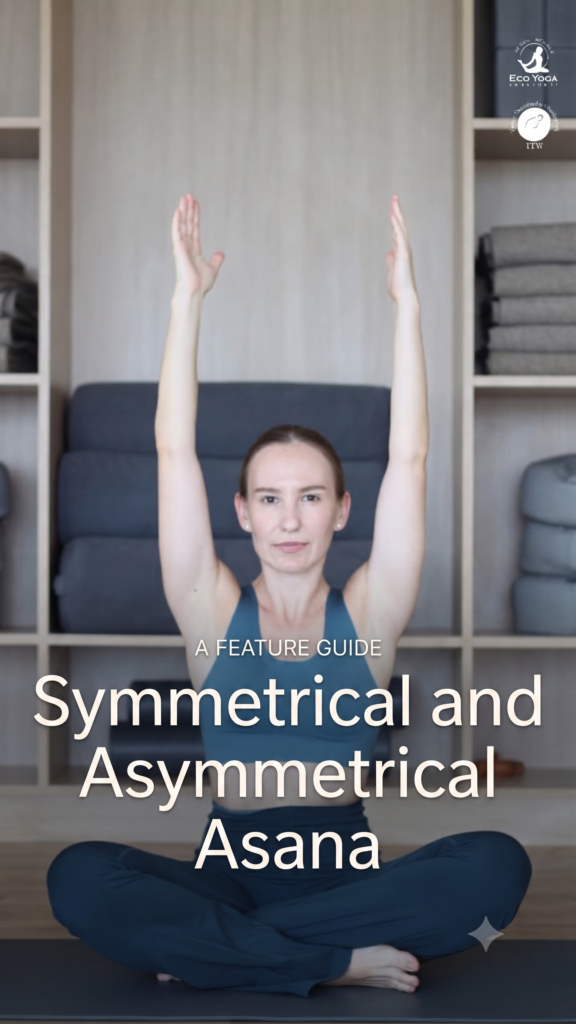
A symmetric pose is one where the left and right sides of the body perform the same action simultaneously. The spine remains neutral or moves symmetrically in flexion or extension. The load is distributed evenly across both legs or both arms.
Examples: Tadasana (Mountain Pose), Adho Mukha Svanasana (Downward Dog), Paschimottanasana (Seated Forward Fold).
Each Side Does Something Different
An asymmetric pose is one where the left and right sides of the body perform different actions. The spine often rotates or flexes laterally, and the load is shifted predominantly to one side — challenging the body’s compensatory mechanisms.
Examples: Trikonasana (Triangle Pose), Vrksasana (Tree Pose), Virabhadrasana II (Warrior II), Parivrtta Trikonasana (Revolved Triangle).
  SYMMETRIC (Paschimottanasana)        ASYMMETRIC (Trikonasana)

        ↓ Load                               ↓ Load (shifted LEFT)
     ┌──┴──┐                              ┌──┴──┐
     │  ●  │  Spine: neutral              │  ●  │  Spine: lateral flexion
     │  │  │  Both hips even              │  ╲  │  Left hip lower
     │  │  │  Both legs active            │   ╲ │  Right hip raised
     └──┴──┘                              └────╲┘
      L   R                                L    R
  Load: EVEN (50/50)                   Load: UNEVEN (70/30)
In a symmetric pose, the spine loads evenly. In an asymmetric pose, the spine flexes laterally and the load shifts — increasing shear forces on the lower back and pelvis.
Which Is More Risky?
Asymmetric poses generally carry a higher risk of injury, particularly for the sacroiliac (SI) joints, the lower back, and the hip complex. Because the load is uneven, the body’s weaker side is forced to compensate. If a practitioner has an underlying muscular imbalance or a previous injury, an asymmetric pose can exacerbate the issue by placing disproportionate shear forces on the joints.
Symmetric poses are inherently more stable. They are used to “reset” the nervous system and the spine after asymmetric work. However, symmetric forward folds carry their own risk: if performed with a rounded lumbar spine rather than hinging at the hips, they can place significant compressive load on the intervertebral discs.
Key principle: Asymmetric poses should be introduced progressively, after the body is warm and the core is engaged. They should be avoided or significantly modified if there is a previous injury to the sacroiliac joint, lower back, or hip. Symmetric poses are the safe default for opening and closing a class sequence.
| Pose Type | Spinal Load | Primary Risk | Best Used For |
|---|---|---|---|
| Symmetric | Even, bilateral | Lumbar disc compression if spine rounds in forward folds | Opening, closing, and neutralizing sequences; injury recovery |
| Asymmetric | Uneven, lateral shear | SI joint strain, lower back rotation, IT band tension | Building functional strength, balance, and range of motion after warm-up |
| Asymmetric (Twist) | Rotational + lateral | Highest risk — disc shear + SI joint stress combined | Advanced practice only; must be preceded by thorough warm-up and symmetric preparation |
The Relationship Between Symmetric and Asymmetric Poses in Sequencing
The relationship between symmetric and asymmetric poses is the backbone of intelligent yoga sequencing. In the Viniyoga tradition — as taught by T.K.V. Desikachar and Gary Kraftsow of the American Viniyoga Institute — the golden rule is: always neutralize asymmetry with symmetry.
When you perform an asymmetric pose such as a deep twist or a one-sided standing balance, you create a temporary neuromuscular imbalance. The muscles on one side contract and shorten while the other side lengthens. To prevent this from accumulating into chronic strain, you must follow it with a symmetric pose — such as Apanasana (knees-to-chest) or a gentle symmetric forward fold — to restore equilibrium to the spine and pelvis.
Think of it this way: asymmetric poses are the challenge, and symmetric poses are the resolution. A well-structured class moves from symmetric stability → asymmetric challenge → symmetric neutralization, in a progressive wave.
  BEFORE (Symmetric Preparation — Tadasana)
  ┌─────────────────────────────────────────────────┐
  │  Cue: "Stand tall. Feel both feet equally       │
  │  grounded. Both hips level. Spine neutral."     │
  │                                                 │
  │         ↑ head                                  │
  │         │                                       │
  │    ─────┼─────  ← shoulders level               │
  │         │                                       │
  │    ─────┼─────  ← hips level                    │
  │        / \                                      │
  │       L   R     ← equal weight                  │
  └─────────────────────────────────────────────────┘

  DURING (Asymmetric — Trikonasana)
  ┌─────────────────────────────────────────────────┐
  │  Cue: "Hinge at the hip, not the waist.         │
  │  Rest your hand on your shin — not the floor.   │
  │  Keep the spine long. Top arm reaches up."      │
  │                                                 │
  │         ↑ top arm (open frame)                  │
  │         │                                       │
  │    ─────╲─────  ← spine lateral, NOT rounded    │
  │          ╲                                      │
  │    ────────╲──  ← hand on shin (supported)      │
  │            / \                                  │
  │           L   R  ← 70% weight on front leg      │
  └─────────────────────────────────────────────────┘

  AFTER (Symmetric Neutralization — Apanasana)
  ┌─────────────────────────────────────────────────┐
  │  Cue: "Draw both knees to your chest equally.   │
  │  Feel the lower back lengthen symmetrically.    │
  │  Breathe into both sides of the pelvis."        │
  │                                                 │
  │         ○ head (relaxed)                        │
  │    ─────┤├─────  ← both knees drawn in evenly   │
  │         ││                                      │
  │    ─────┤├─────  ← lower back decompressing     │
  └─────────────────────────────────────────────────┘
Intelligent cueing guides the practitioner through the full arc: symmetric preparation → asymmetric challenge with protection → symmetric neutralization. This is the foundation of the Art of Sequencing.
A Special Note for Practitioners with Previous Injuries
If you have a previous injury to the sacroiliac joint, the lower back, the hip, or the knee, asymmetric poses require special attention. The uneven load of an asymmetric pose will always find the weakest link in the chain — and if that link is an injured tissue, it will be stressed disproportionately.
The practical guidance is this: always inform your yoga teacher before class. At Eco Yoga Sanctuary in Jumeirah, Dubai, our instructors are trained to offer supported modifications — such as placing the hand on the shin rather than the floor in Trikonasana, or using a block to reduce the lateral range — that allow you to receive the benefit of an asymmetric pose without the risk. When in doubt, remain in the symmetric version of the pose and build from there.
Who This Is For
Practitioners managing a previous SI joint, lower back, or hip injury who want to continue practicing yoga safely with intelligent modifications and supported asymmetric work.
Teachers who want to understand the biomechanical reasoning behind sequencing — knowing when to introduce asymmetric poses and how to cue the transition back to symmetry.
Advanced practitioners who want to move beyond shape and form — understanding the functional anatomy that makes a sequence not just beautiful, but genuinely safe and sustainable.
Frequently Asked Questions
A symmetric pose involves both sides of the body performing the same movement simultaneously — such as Downward-Facing Dog — distributing weight evenly across the spine and pelvis. An asymmetric pose involves the left and right sides doing different movements — such as Triangle Pose — shifting the load to one side and introducing lateral or rotational forces into the spine.
Asymmetric poses place uneven shear forces on the joints, particularly the sacroiliac (SI) joint and the lumbar vertebrae. If a practitioner has an existing muscular imbalance or a previous injury, the body compensates by overloading the vulnerable area. Asymmetric twists carry the highest risk, as they combine lateral flexion with rotation simultaneously.
Intelligent sequencing follows a wave: begin with symmetric poses to stabilize and warm the body, progress to asymmetric poses at the peak of the class, and always return to symmetric poses at the close to neutralize the imbalance created. This is the core principle taught in the ITW Art of Sequencing course and at Eco Yoga Sanctuary, Jumeirah, Dubai.
In most cases, asymmetric poses should be significantly modified or avoided if you have an active lower back or SI joint injury. Supported modifications — such as using a block or resting the hand on the shin — can reduce the load. Always inform your instructor before class so the appropriate adaptation can be offered.
Eco Yoga Sanctuary in Jumeirah, Dubai, offers specialized yoga classes where sequencing is taught functionally, not just aesthetically. The ITW Mastery Series and the online Art of Sequencing course by Integrated Therapy Work (ITW) provide in-depth training for yoga teachers and advanced practitioners in the UAE and globally.
How to Cue Symmetric and Asymmetric Poses in a Logical, Safe Sequence
In this video, Kamal walks through the practical art of cueing the transition between symmetric and asymmetric poses — showing you exactly how to guide students safely through the sequencing wave.
The Art of Sequencing · Integrated Therapy Work (ITW) × Eco Yoga Sanctuary, Jumeirah, Dubai
Join Yoga Classes at Eco Yoga Sanctuary, Jumeirah
Practice asana intelligently — understanding frames, breath, and your body’s unique structure. Small groups, expert guidance, in the heart of old Jumeirah, Dubai.
Book Your Yoga Class
Integrated Therapy Work — Mastery Series
Deepen your anatomical knowledge and earn YACEP continuing education credits. For yoga teachers and advanced practitioners. Eco Yoga Sanctuary, Jumeirah, Dubai.
Register — July BundleThe Art & Science of Yoga Sequencing
Ready to go deeper? Learn how to build intelligent, functional yoga sequences that honour the body’s biomechanics — from symmetric opening to asymmetric peak to symmetric resolution. Available online, at your own pace.
Explore the CourseUp Next: Asana in Planes — How the Body Moves in Three Dimensions
Every yoga pose lives in one or more planes of movement — sagittal, frontal, or transverse. Understanding which plane a pose operates in is the key to building sequences that are truly balanced, functional, and injury-aware.