

Bhujangasana: The Cobra Pose
That Actually Strengthens Your Back
How to engage your weak upper back muscles, protect your neck from compensatory hyperextension, and prevent tension headaches — the functional Viniyoga approach.
“Every day in Dubai, I see practitioners throw their heads back in Cobra Pose, thinking they are opening their hearts. Instead, they are compressing their cervical spines and setting themselves up for tension headaches. Bhujangasana is not about the neck — it is about waking up the forgotten muscles of the upper back.”
— Kamal Saad, Lead Therapist, Integrated Therapy Work (ITW) Dubai
What Is Bhujangasana — and Why Is It Widely Misperformed?
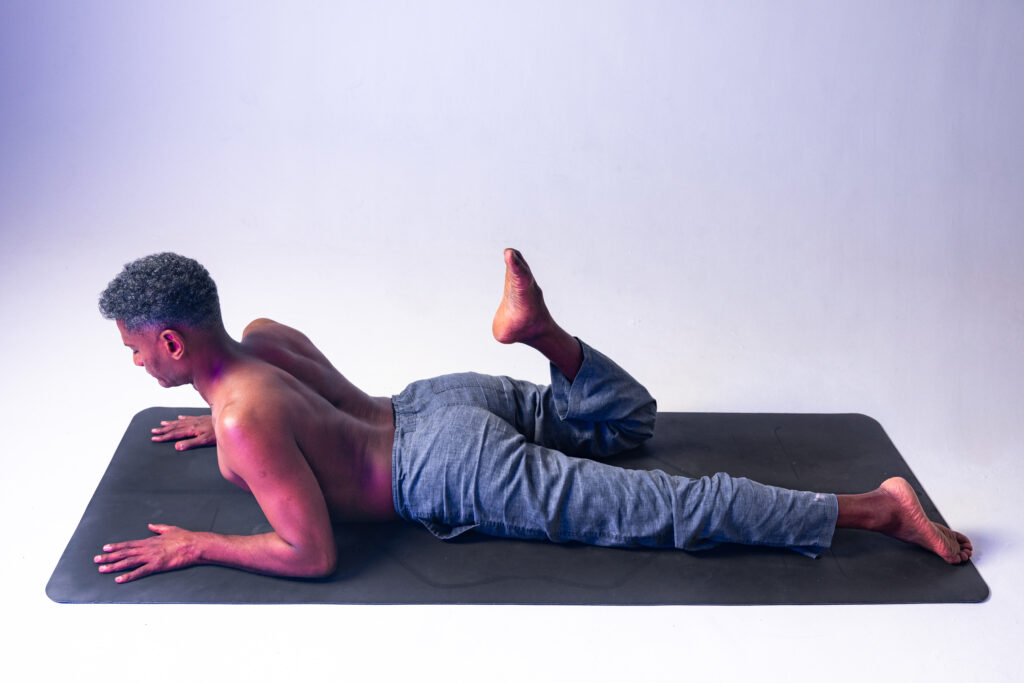
Bhujangasana, or Cobra Pose, is one of the most commonly taught prone backbends in yoga. In its functional form, it is designed to strengthen the posterior chain — specifically the muscles of the mid and upper back — while gently opening the chest and counteracting the forward-rounding posture of modern life. In Dubai and across the UAE, where many of us spend eight to twelve hours per day seated at desks or looking at screens, this pose should be a daily therapeutic tool.
Yet in most yoga classes, Bhujangasana has become something else entirely: an arm-driven push-up accompanied by extreme neck hyperextension. Practitioners push heavily into their hands to lift as high as possible, and throw their heads back to look at the ceiling. This approach completely bypasses the muscles the pose is designed to strengthen, and creates a dangerous compensatory mechanism at the most vulnerable joints of the upper cervical spine.
At Eco Yoga Sanctuary in Jumeirah, Dubai, we teach Bhujangasana through the lens of the Viniyoga tradition — a methodology rooted in the teachings of T.K.V. Desikachar and Gary Kraftsow of the American Viniyoga Institute (AVI). In this approach, the posture is adapted to the individual, the action comes from the back muscles rather than the arms, and the neck is always protected.
The Modern Posture Crisis: Janda’s Phasic Muscles and Why They Matter
To understand why a functional Bhujangasana is so critical for modern life, we must look at the pioneering research of Dr. Vladimir Janda, a Czech neurologist and rehabilitation physician who transformed our understanding of how muscles function in the modern body.
Janda classified muscles into two functional groups: tonic muscles, which are prone to tightness, shortening, and hyperactivity; and phasic muscles, which are prone to weakness, lengthening, and inhibition. This is not a fixed anatomical truth — it is a functional tendency shaped by how we use our bodies. In our screen-dominated, desk-bound modern lives, certain predictable patterns emerge.
| Muscle Group | Classification | Modern Tendency | Effect on Posture |
|---|---|---|---|
| Pectorals (Chest) | Tonic | Tight & Short | Pulls shoulders forward, rounds upper back |
| Upper Trapezius | Tonic | Tight & Overactive | Elevates shoulders, compresses neck |
| Rhomboids | Phasic | Weak & Long | Cannot retract shoulder blades effectively |
| Lower/Mid Trapezius | Phasic | Weak & Inhibited | Fails to stabilise and depress the scapulae |
| Serratus Anterior | Phasic | Weak & Underactive | Allows scapular winging, reduces shoulder stability |
Janda described the resulting pattern as Upper Crossed Syndrome: the tight tonic muscles (pectorals, upper trapezius) pull the shoulders forward and the head forward, while the weak phasic muscles (rhomboids, lower trapezius) are overstretched and unable to counteract this pull. The result is the characteristic “desk posture” — rounded shoulders, forward head, compressed upper neck.
A correctly performed Bhujangasana directly targets and reactivates these dormant phasic muscles. It is, in essence, the anatomical antidote to the modern postural epidemic — but only if it is performed correctly.

The Hidden Danger: Compensatory Neck Hyperextension and Tension Headaches
When the upper back muscles are weak and the thoracic spine is stiff — as is the case for most people living a modern urban lifestyle — the body cannot generate a genuine thoracic extension in Bhujangasana. It looks for the easiest path to create the shape of a backbend. This is where the most common and most damaging compensatory mechanism occurs.
Instead of extending through the thoracic spine (the mid-back, between the shoulder blades), the practitioner hyperextends the cervical spine — throwing the head back and compressing the neck. This may look dramatic and “open,” but it is structurally harmful.
Throwing the head back in Bhujangasana places direct compressive load on the Atlanto-Occipital (OA) joint — the joint between the skull and the first cervical vertebra (Atlas/C1) — and the Atlanto-Axial (AA) joint — between C1 and C2. These joints are designed for delicate, nuanced movements, not for bearing the compressive load of a forced backbend. When compressed, the suboccipital muscles at the base of the skull go into spasm, irritating the greater occipital nerve and producing the characteristic cervicogenic tension headache: a band of pressure that radiates from the base of the skull over the top of the head. If you regularly leave yoga class with a headache or stiff neck, your backbends are very likely the cause.

The solution is not to avoid backbends — it is to perform them correctly. The neck should always follow the natural extension of the thoracic spine, not exceed it. In a functional Bhujangasana, the gaze is directed slightly forward and down, the back of the neck remains long, and the chin is neither tucked aggressively nor thrown back.
The Functional Approach: Pulling the Chest Forward, Not Pushing Up
The most transformative instruction in functional Bhujangasana is this: your hands are not there to push you up — they are there to pull the chest forward. This single shift in intention changes everything about how the pose is experienced and what it achieves.
Hand Placement: Place your hands on the mat directly below the shoulder line, or slightly below. Your elbows are bent and close to the body. The hands are light — they should not bear significant weight.
The Pulling Action: Before you lift, press your pubic bone gently into the mat. Then, as you inhale, imagine dragging your hands backward toward your hips without actually moving them. This isometric pulling action engages the latissimus dorsi and draws the shoulder blades down and back, activating the rhomboids and lower trapezius — the phasic muscles we are targeting.
Lift from the Upper Back: Allow the chest to lift forward and up, driven by the contraction of the thoracic extensors and the retraction of the shoulder blades. The lift may be modest — perhaps only 10 to 15 centimetres off the mat. This is correct. A low, muscle-driven Cobra Pose is infinitely more therapeutic than a high, arm-driven one.
The Neck: Keep the back of the neck long. Your gaze is directed slightly forward and downward — not at the ceiling. The cervical spine follows the line of the thoracic extension. There is no compression at the base of the skull.
The Test: Lift your hands one inch off the mat. If your chest immediately drops, you were using your arms to push. If you can maintain the lift, you are correctly engaging your upper back. This is the gold standard of functional Bhujangasana.
Who Is This Pose For? Three Practitioners, One Posture
If you suffer from “desk posture,” chronic upper back tension, or tension headaches after yoga, a low, functional Cobra Pose is your daily medicine. By reactivating your weak rhomboids and opening your tight chest without straining your neck, you directly address the root cause of modern postural pain — not just the symptoms.
Understanding Janda’s phasic and tonic muscle classifications will transform how you teach backbends. When you instruct students to “pull” the mat rather than “push,” and to keep the back of the neck long, you protect them from OA/AA joint compression and help them build genuine structural integrity. This is essential continuing education for any teacher working with students who have neck pain or headaches.
For the advanced practitioner, Bhujangasana is an exercise in profound muscular isolation. Learning to lift the chest using only the strength of the thoracic extensors and rhomboids, while keeping the arms relatively passive, the breath smooth, and the neck decompressed, requires immense focus and refines your mind-body connection at a deep level.
Frequently Asked Questions About Bhujangasana
Why do I get a headache after doing Cobra Pose?
Headaches after Cobra Pose are typically cervicogenic tension headaches caused by hyperextending the neck. Throwing the head back compresses the Atlanto-Occipital (OA) and Atlanto-Axial (AA) joints, causing the suboccipital muscles to spasm and irritating the greater occipital nerve. To prevent this, keep the back of your neck long and your gaze directed slightly forward and down, not at the ceiling.
What are phasic muscles and why do they matter in yoga?
According to Dr. Vladimir Janda’s research, phasic muscles — such as the rhomboids, lower trapezius, and serratus anterior — have a functional tendency to become long, weak, and inhibited in modern sedentary lifestyles. This is the anatomical root of “desk posture.” A functional Bhujangasana is one of the most effective yoga tools for reactivating these muscles and correcting the resulting postural imbalance.
Should I push my arms straight in Bhujangasana?
No. Pushing the arms straight typically disengages the back muscles and transfers the load to the arms and wrists, while also encouraging neck hyperextension. In a functional Bhujangasana, the elbows remain bent and the hands bear minimal weight. The lift comes from the upper back muscles — the rhomboids and thoracic extensors — not from the arms.
How do I know if I am using my upper back correctly in Cobra Pose?
The simplest test: while in the pose, lift your hands one inch off the mat. If your chest immediately drops to the floor, you were using your arms to push. If you can maintain the lift, you are correctly engaging your upper back muscles. Start with a very low lift and build gradually — the quality of the muscle engagement matters far more than the height of the backbend.
Is Bhujangasana safe for people with neck pain?
A low, functional Bhujangasana with a long neck is generally safe and often beneficial for people with neck tension. However, the common version — with the head thrown back and arms fully extended — can aggravate neck pain significantly. Always consult your medical provider or physiotherapist before beginning any new movement practice if you have a diagnosed cervical condition.
Join Viniyoga Therapy Classes at Eco Yoga Sanctuary, Jumeirah
Practice Bhujangasana and the full Asana in Function series — breath-led, therapeutically adapted, and grounded in functional anatomy. Small groups, individual attention, and a methodology that actually works for your body.
Book Your ClassITW Mastery Series — Functional Anatomy for Yoga Teachers
Deepen your anatomical knowledge of the upper back, cervical spine, and postural correction. Earn YACEP continuing education credits. For yoga teachers and advanced practitioners. Eco Yoga Sanctuary, Jumeirah.
Register — July BundleITW Mastery Series — August Bundle
Continue your journey into therapeutic yoga and functional movement science. YACEP credits available. Eco Yoga Sanctuary, Jumeirah, Dubai.
Register — August BundleUp Next: Cakravakasana — The Sunbird Pose That Is Not Cat-Cow
How the Red Goose pose releases your thoracolumbar fascia, restores lumbopelvic rhythm, and relieves lower back tension — one breath at a time.
<!-- ============================================================
ASANA IN FUNCTION SERIES
Bhujangasana: The Cobra Pose That Actually Strengthens Your Back
For: ecoyogasanctuary.com / itwdubai.com
Author: Kamal Saad, Lead Therapist, ITW Dubai
Last updated: July 2026
============================================================ -->
<!-- wp:group {"className":"aif-series-label","style":{"spacing":{"padding":{"top":"8px","bottom":"8px","left":"20px","right":"20px"}},"border":{"radius":"3px"},"color":{"background":"#5c1e2c"}}} -->
<div class="wp-block-group aif-series-label" style="background-color:#5c1e2c;padding-top:8px;padding-right:20px;padding-bottom:8px;padding-left:20px;border-radius:3px">
<!-- wp:paragraph {"align":"center","style":{"typography":{"fontSize":"12px","letterSpacing":"0.22em","textTransform":"uppercase","fontWeight":"700"},"color":{"text":"#b0b0b0"}}} -->
<p class="has-text-align-center" style="color:#b0b0b0;font-size:12px;letter-spacing:0.22em;text-transform:uppercase;font-weight:700">ASANA IN FUNCTION — THERAPEUTIC SERIES</p>
<!-- /wp:paragraph -->
</div>
<!-- /wp:group -->
<!-- wp:heading {"level":1,"textAlign":"center","style":{"typography":{"fontFamily":"Cormorant Garamond, Georgia, serif","fontSize":"clamp(2rem,4.5vw,3.4rem)","fontWeight":"300","lineHeight":"1.2"},"color":{"text":"#5c1e2c"}}} -->
<h1 class="wp-block-heading has-text-align-center" style="color:#5c1e2c;font-family:Cormorant Garamond, Georgia, serif;font-size:clamp(2rem,4.5vw,3.4rem);font-weight:300;line-height:1.2">Bhujangasana: The Cobra Pose That Actually Strengthens Your Back</h1>
<!-- /wp:heading -->
<!-- wp:paragraph {"align":"center","style":{"typography":{"fontSize":"15px","fontWeight":"300"},"color":{"text":"#4a4a4a"}}} -->
<p class="has-text-align-center" style="color:#4a4a4a;font-size:15px;font-weight:300">How to engage your weak upper back muscles, protect your neck from compensatory hyperextension, and prevent tension headaches — the functional Viniyoga approach.</p>
<!-- /wp:paragraph -->
<!-- wp:paragraph {"align":"center","style":{"typography":{"fontSize":"12px","letterSpacing":"0.1em","textTransform":"uppercase"},"color":{"text":"#888888"}}} -->
<p class="has-text-align-center" style="color:#888888;font-size:12px;letter-spacing:0.1em;text-transform:uppercase">By Kamal Saad · Eco Yoga Sanctuary, Jumeirah, Dubai · 7 min read</p>
<!-- /wp:paragraph -->
<!-- wp:separator {"style":{"color":{"background":"#e8e8e8"}}} -->
<hr class="wp-block-separator has-text-color has-background" style="background-color:#e8e8e8;color:#e8e8e8"/>
<!-- /wp:separator -->
<!-- wp:quote {"className":"aif-hook","style":{"border":{"left":{"color":"#7a2d3e","width":"4px"}},"spacing":{"padding":{"top":"28px","bottom":"28px","left":"32px","right":"32px"}},"color":{"background":"#f9f0f2"}}} -->
<blockquote class="wp-block-quote aif-hook" style="background-color:#f9f0f2;border-left-color:#7a2d3e;border-left-width:4px;padding-top:28px;padding-right:32px;padding-bottom:28px;padding-left:32px">
<p style="font-family:Cormorant Garamond,Georgia,serif;font-size:1.3rem;font-style:italic;font-weight:300;color:#1a1a1a;line-height:1.65">"Every day in Dubai, I see practitioners throw their heads back in Cobra Pose, thinking they are opening their hearts. Instead, they are compressing their cervical spines and setting themselves up for tension headaches. Bhujangasana is not about the neck — it is about waking up the forgotten muscles of the upper back."</p>
<cite style="font-size:12px;font-weight:700;letter-spacing:0.12em;text-transform:uppercase;color:#7a2d3e">— Kamal Saad, Lead Therapist, Integrated Therapy Work (ITW) Dubai</cite>
</blockquote>
<!-- /wp:quote -->
<!-- wp:heading {"level":2,"style":{"typography":{"fontFamily":"Cormorant Garamond, Georgia, serif","fontSize":"1.9rem","fontWeight":"400"},"color":{"text":"#5c1e2c"}}} -->
<h2 class="wp-block-heading" style="color:#5c1e2c;font-family:Cormorant Garamond, Georgia, serif;font-size:1.9rem;font-weight:400">What Is Bhujangasana — and Why Is It Widely Misperformed?</h2>
<!-- /wp:heading -->
<!-- wp:paragraph -->
<p>Bhujangasana, or Cobra Pose, is one of the most commonly taught prone backbends in yoga. In its <strong>functional form</strong>, it is designed to strengthen the posterior chain — specifically the muscles of the mid and upper back — while gently opening the chest and counteracting the forward-rounding posture of modern life. In Dubai and across the UAE, where many of us spend eight to twelve hours per day seated at desks or looking at screens, this pose should be a daily therapeutic tool.</p>
<!-- /wp:paragraph -->
<!-- wp:paragraph -->
<p>Yet in most yoga classes, Bhujangasana has become something else entirely: an arm-driven push-up accompanied by extreme neck hyperextension. Practitioners push heavily into their hands to lift as high as possible, and throw their heads back to look at the ceiling. This approach completely bypasses the muscles the pose is designed to strengthen, and creates a dangerous compensatory mechanism at the most vulnerable joints of the upper cervical spine.</p>
<!-- /wp:paragraph -->
<!-- wp:paragraph -->
<p>At Eco Yoga Sanctuary in Jumeirah, Dubai, we teach Bhujangasana through the lens of the Viniyoga tradition — a methodology rooted in the teachings of T.K.V. Desikachar and Gary Kraftsow of the American Viniyoga Institute (AVI). In this approach, the posture is adapted to the individual, the action comes from the back muscles rather than the arms, and the neck is always protected. The result is a pose that is both safer and far more therapeutically effective.</p>
<!-- /wp:paragraph -->
<!-- ═══════════════════════════════════════════════════════════
▶ VIDEO EMBED — Replace YOUR_VIDEO_ID_HERE with your YouTube ID
Example: https://youtube.com/watch?v=dQw4w9WgXcQ → ID = dQw4w9WgXcQ
═══════════════════════════════════════════════════════════ -->
<!-- wp:embed {"url":"https://www.youtube.com/watch?v=YOUR_VIDEO_ID_HERE","type":"video","providerNameSlug":"youtube","responsive":true,"className":"wp-embed-aspect-16-9 wp-has-aspect-ratio"} -->
<figure class="wp-block-embed is-type-video is-provider-youtube wp-block-embed-youtube wp-embed-aspect-16-9 wp-has-aspect-ratio"><div class="wp-block-embed__wrapper">
https://www.youtube.com/watch?v=YOUR_VIDEO_ID_HERE
</div><figcaption class="wp-element-caption">🎥 Functional Bhujangasana — Kamal Saad demonstrates the upper-back-driven Cobra Pose at Eco Yoga Sanctuary, Jumeirah, Dubai | Integrated Therapy Work (ITW)</figcaption></figure>
<!-- /wp:embed -->
<!-- wp:separator {"style":{"color":{"background":"#e8e8e8"}}} -->
<hr class="wp-block-separator has-text-color has-background" style="background-color:#e8e8e8;color:#e8e8e8"/>
<!-- /wp:separator -->
<!-- wp:heading {"level":2,"style":{"typography":{"fontFamily":"Cormorant Garamond, Georgia, serif","fontSize":"1.9rem","fontWeight":"400"},"color":{"text":"#5c1e2c"}}} -->
<h2 class="wp-block-heading" style="color:#5c1e2c;font-family:Cormorant Garamond, Georgia, serif;font-size:1.9rem;font-weight:400">The Modern Posture Crisis: Janda's Phasic Muscles and Why They Matter</h2>
<!-- /wp:heading -->
<!-- wp:paragraph -->
<p>To understand why a functional Bhujangasana is so critical for modern life, we must look at the pioneering research of Dr. Vladimir Janda, a Czech neurologist and rehabilitation physician who transformed our understanding of how muscles function in the modern body.</p>
<!-- /wp:paragraph -->
<!-- wp:paragraph -->
<p>Janda classified muscles into two functional groups: <strong>tonic muscles</strong>, which are prone to tightness, shortening, and hyperactivity; and <strong>phasic muscles</strong>, which are prone to weakness, lengthening, and inhibition. This is not a fixed anatomical truth — it is a functional tendency shaped by how we use our bodies. In our screen-dominated, desk-bound modern lives, certain predictable patterns emerge.</p>
<!-- /wp:paragraph -->
<!-- wp:table {"style":{"color":{"background":"#ffffff"}}} -->
<figure class="wp-block-table"><table style="background-color:#ffffff"><thead><tr><th style="background-color:#5c1e2c;color:#ffffff;">Muscle Group</th><th style="background-color:#5c1e2c;color:#ffffff;">Classification</th><th style="background-color:#5c1e2c;color:#ffffff;">Modern Tendency</th><th style="background-color:#5c1e2c;color:#ffffff;">Effect on Posture</th></tr></thead><tbody><tr><td><strong>Pectorals (Chest)</strong></td><td>Tonic</td><td>Tight & Short</td><td>Pulls shoulders forward, rounds upper back</td></tr><tr><td><strong>Upper Trapezius</strong></td><td>Tonic</td><td>Tight & Overactive</td><td>Elevates shoulders, compresses neck</td></tr><tr><td><strong>Rhomboids</strong></td><td>Phasic</td><td>Weak & Long</td><td>Cannot retract shoulder blades effectively</td></tr><tr><td><strong>Lower/Mid Trapezius</strong></td><td>Phasic</td><td>Weak & Inhibited</td><td>Fails to stabilise and depress the scapulae</td></tr><tr><td><strong>Serratus Anterior</strong></td><td>Phasic</td><td>Weak & Underactive</td><td>Allows scapular winging, reduces shoulder stability</td></tr></tbody></table></figure>
<!-- /wp:table -->
<!-- wp:paragraph -->
<p>Janda described the resulting pattern as <em>Upper Crossed Syndrome</em>: the tight tonic muscles (pectorals, upper trapezius) pull the shoulders forward and the head forward, while the weak phasic muscles (rhomboids, lower trapezius) are overstretched and unable to counteract this pull. The result is the characteristic "desk posture" — rounded shoulders, forward head, compressed upper neck.</p>
<!-- /wp:paragraph -->
<!-- wp:paragraph -->
<p>A correctly performed Bhujangasana directly targets and reactivates these dormant phasic muscles. It is, in essence, the anatomical antidote to the modern postural epidemic. But only if it is performed correctly.</p>
<!-- /wp:paragraph -->
<!-- [INSERT ANATOMY DIAGRAM IMAGE BLOCK HERE — Janda Upper Crossed Syndrome] -->
<!-- wp:separator {"style":{"color":{"background":"#e8e8e8"}}} -->
<hr class="wp-block-separator has-text-color has-background" style="background-color:#e8e8e8;color:#e8e8e8"/>
<!-- /wp:separator -->
<!-- wp:heading {"level":2,"style":{"typography":{"fontFamily":"Cormorant Garamond, Georgia, serif","fontSize":"1.9rem","fontWeight":"400"},"color":{"text":"#5c1e2c"}}} -->
<h2 class="wp-block-heading" style="color:#5c1e2c;font-family:Cormorant Garamond, Georgia, serif;font-size:1.9rem;font-weight:400">The Hidden Danger: Compensatory Neck Hyperextension and Tension Headaches</h2>
<!-- /wp:heading -->
<!-- wp:paragraph -->
<p>When the upper back muscles are weak and the thoracic spine is stiff — as is the case for most people living a modern urban lifestyle — the body cannot generate a genuine thoracic extension in Bhujangasana. It looks for the easiest path to create the shape of a backbend. This is where the most common and most damaging compensatory mechanism occurs.</p>
<!-- /wp:paragraph -->
<!-- wp:paragraph -->
<p>Instead of extending through the thoracic spine (the mid-back, between the shoulder blades), the practitioner <strong>hyperextends the cervical spine</strong> — throwing the head back and compressing the neck. This may look dramatic and "open," but it is structurally harmful.</p>
<!-- /wp:paragraph -->
<!-- wp:group {"style":{"border":{"radius":"6px","left":{"color":"#c87820","width":"4px"}},"spacing":{"padding":{"top":"20px","bottom":"20px","left":"24px","right":"24px"}},"color":{"background":"#fff8f0"}},"layout":{"type":"constrained"}} -->
<div class="wp-block-group" style="background-color:#fff8f0;border-left-color:#c87820;border-left-width:4px;border-radius:6px;padding-top:20px;padding-right:24px;padding-bottom:20px;padding-left:24px">
<!-- wp:paragraph {"style":{"typography":{"fontSize":"10px","fontWeight":"700","letterSpacing":"0.22em","textTransform":"uppercase"},"color":{"text":"#c87820"}}} -->
<p style="color:#c87820;font-size:10px;font-weight:700;letter-spacing:0.22em;text-transform:uppercase">⚠ Clinical Warning — OA & AA Joint Compression</p>
<!-- /wp:paragraph -->
<!-- wp:paragraph {"style":{"typography":{"fontSize":"15px"},"color":{"text":"#1a1a1a"}}} -->
<p style="color:#1a1a1a;font-size:15px;">Throwing the head back in Bhujangasana places direct compressive load on the <strong>Atlanto-Occipital (OA) joint</strong> — the joint between the skull and the first cervical vertebra (Atlas/C1) — and the <strong>Atlanto-Axial (AA) joint</strong> — between C1 and C2. These joints are designed for delicate, nuanced movements, not for bearing the compressive load of a forced backbend. When compressed, the suboccipital muscles at the base of the skull go into spasm, irritating the greater occipital nerve and producing the characteristic <strong>cervicogenic tension headache</strong>: a band of pressure that radiates from the base of the skull over the top of the head. If you regularly leave yoga class with a headache or stiff neck, your backbends are very likely the cause.</p>
<!-- /wp:paragraph -->
</div>
<!-- /wp:group -->
<!-- [INSERT NECK DIAGRAM IMAGE BLOCK HERE — OA/AA Joint Compression vs Functional Cobra] -->
<!-- wp:paragraph -->
<p>The solution is not to avoid backbends — it is to perform them correctly. The neck should always follow the natural extension of the thoracic spine, not exceed it. In a functional Bhujangasana, the gaze is directed slightly forward and down, the back of the neck remains long, and the chin is neither tucked aggressively nor thrown back. The cervical spine is a continuation of the movement, not its source.</p>
<!-- /wp:paragraph -->
<!-- wp:separator {"style":{"color":{"background":"#e8e8e8"}}} -->
<hr class="wp-block-separator has-text-color has-background" style="background-color:#e8e8e8;color:#e8e8e8"/>
<!-- /wp:separator -->
<!-- wp:heading {"level":2,"style":{"typography":{"fontFamily":"Cormorant Garamond, Georgia, serif","fontSize":"1.9rem","fontWeight":"400"},"color":{"text":"#5c1e2c"}}} -->
<h2 class="wp-block-heading" style="color:#5c1e2c;font-family:Cormorant Garamond, Georgia, serif;font-size:1.9rem;font-weight:400">The Functional Approach: Pulling the Chest Forward, Not Pushing Up</h2>
<!-- /wp:heading -->
<!-- wp:paragraph -->
<p>The most transformative instruction in functional Bhujangasana is this: <strong>your hands are not there to push you up — they are there to pull the chest forward</strong>. This single shift in intention changes everything about how the pose is experienced and what it achieves.</p>
<!-- /wp:paragraph -->
<!-- wp:group {"style":{"border":{"radius":"0 0 10px 10px","top":{"color":"#7a2d3e","width":"4px"}},"spacing":{"padding":{"top":"28px","bottom":"28px","left":"32px","right":"32px"}},"color":{"background":"#ffffff"}},"layout":{"type":"constrained"}} -->
<div class="wp-block-group" style="background-color:#ffffff;border-top-color:#7a2d3e;border-top-width:4px;border-radius:0 0 10px 10px;padding-top:28px;padding-right:32px;padding-bottom:28px;padding-left:32px">
<!-- wp:paragraph {"style":{"typography":{"fontSize":"10px","fontWeight":"700","letterSpacing":"0.24em","textTransform":"uppercase"},"color":{"text":"#7a2d3e"}}} -->
<p style="color:#7a2d3e;font-size:10px;font-weight:700;letter-spacing:0.24em;text-transform:uppercase">Functional Technique — Step by Step</p>
<!-- /wp:paragraph -->
<!-- wp:paragraph -->
<p><strong>Hand Placement:</strong> Place your hands on the mat directly below the shoulder line, or slightly below. Your elbows are bent and close to the body. The hands are light — they should not bear significant weight.</p>
<!-- /wp:paragraph -->
<!-- wp:paragraph -->
<p><strong>The Pulling Action:</strong> Before you lift, press your pubic bone gently into the mat. Then, as you inhale, imagine dragging your hands backward toward your hips without actually moving them. This isometric pulling action engages the latissimus dorsi and draws the shoulder blades down and back, activating the rhomboids and lower trapezius — the phasic muscles we are targeting.</p>
<!-- /wp:paragraph -->
<!-- wp:paragraph -->
<p><strong>Lift from the Upper Back:</strong> As you continue to inhale, allow the chest to lift forward and up, driven by the contraction of the thoracic extensors and the retraction of the shoulder blades. The lift may be modest — perhaps only 10 to 15 centimetres off the mat. This is correct. A low, muscle-driven Cobra Pose is infinitely more therapeutic than a high, arm-driven one.</p>
<!-- /wp:paragraph -->
<!-- wp:paragraph -->
<p><strong>The Neck:</strong> Keep the back of the neck long. Your gaze is directed slightly forward and downward — not at the ceiling. The cervical spine follows the line of the thoracic extension. There is no compression at the base of the skull.</p>
<!-- /wp:paragraph -->
<!-- wp:paragraph -->
<p><strong>The Test:</strong> Lift your hands one inch off the mat. If your chest immediately drops, you were using your arms to push. If you can maintain the lift, you are correctly engaging your upper back. This is the gold standard of functional Bhujangasana.</p>
<!-- /wp:paragraph -->
</div>
<!-- /wp:group -->
<!-- wp:separator {"style":{"color":{"background":"#e8e8e8"}}} -->
<hr class="wp-block-separator has-text-color has-background" style="background-color:#e8e8e8;color:#e8e8e8"/>
<!-- /wp:separator -->
<!-- wp:heading {"level":2,"style":{"typography":{"fontFamily":"Cormorant Garamond, Georgia, serif","fontSize":"1.9rem","fontWeight":"400"},"color":{"text":"#5c1e2c"}}} -->
<h2 class="wp-block-heading" style="color:#5c1e2c;font-family:Cormorant Garamond, Georgia, serif;font-size:1.9rem;font-weight:400">Who Is This Pose For? Three Practitioners, One Posture</h2>
<!-- /wp:heading -->
<!-- wp:columns -->
<div class="wp-block-columns">
<!-- wp:column {"style":{"border":{"top":{"color":"#7a2d3e","width":"3px"}},"spacing":{"padding":{"top":"20px","bottom":"20px","left":"20px","right":"20px"}},"color":{"background":"#ffffff"}}} -->
<div class="wp-block-column" style="background-color:#ffffff;border-top-color:#7a2d3e;border-top-width:3px;padding-top:20px;padding-right:20px;padding-bottom:20px;padding-left:20px">
<!-- wp:paragraph {"style":{"typography":{"fontSize":"10px","fontWeight":"700","letterSpacing":"0.2em","textTransform":"uppercase"},"color":{"text":"#7a2d3e"}}} -->
<p style="color:#7a2d3e;font-size:10px;font-weight:700;letter-spacing:0.2em;text-transform:uppercase">For the Healing Practitioner</p>
<!-- /wp:paragraph -->
<!-- wp:paragraph {"style":{"typography":{"fontSize":"14px"}}} -->
<p style="font-size:14px;">If you suffer from "desk posture," chronic upper back tension, or tension headaches after yoga, a low, functional Cobra Pose is your daily medicine. By reactivating your weak rhomboids and opening your tight chest without straining your neck, you directly address the root cause of modern postural pain — not just the symptoms.</p>
<!-- /wp:paragraph -->
</div>
<!-- /wp:column -->
<!-- wp:column {"style":{"border":{"top":{"color":"#7a2d3e","width":"3px"}},"spacing":{"padding":{"top":"20px","bottom":"20px","left":"20px","right":"20px"}},"color":{"background":"#ffffff"}}} -->
<div class="wp-block-column" style="background-color:#ffffff;border-top-color:#7a2d3e;border-top-width:3px;padding-top:20px;padding-right:20px;padding-bottom:20px;padding-left:20px">
<!-- wp:paragraph {"style":{"typography":{"fontSize":"10px","fontWeight":"700","letterSpacing":"0.2em","textTransform":"uppercase"},"color":{"text":"#7a2d3e"}}} -->
<p style="color:#7a2d3e;font-size:10px;font-weight:700;letter-spacing:0.2em;text-transform:uppercase">For the Yoga Teacher</p>
<!-- /wp:paragraph -->
<!-- wp:paragraph {"style":{"typography":{"fontSize":"14px"}}} -->
<p style="font-size:14px;">Understanding Janda's phasic and tonic muscle classifications will transform how you teach backbends. When you instruct students to "pull" the mat rather than "push," and to keep the back of the neck long, you protect them from OA/AA joint compression and help them build genuine structural integrity. This is essential continuing education for any teacher working with students who have neck pain or headaches.</p>
<!-- /wp:paragraph -->
</div>
<!-- /wp:column -->
<!-- wp:column {"style":{"border":{"top":{"color":"#7a2d3e","width":"3px"}},"spacing":{"padding":{"top":"20px","bottom":"20px","left":"20px","right":"20px"}},"color":{"background":"#ffffff"}}} -->
<div class="wp-block-column" style="background-color:#ffffff;border-top-color:#7a2d3e;border-top-width:3px;padding-top:20px;padding-right:20px;padding-bottom:20px;padding-left:20px">
<!-- wp:paragraph {"style":{"typography":{"fontSize":"10px","fontWeight":"700","letterSpacing":"0.2em","textTransform":"uppercase"},"color":{"text":"#7a2d3e"}}} -->
<p style="color:#7a2d3e;font-size:10px;font-weight:700;letter-spacing:0.2em;text-transform:uppercase">For the Mastery Seeker</p>
<!-- /wp:paragraph -->
<!-- wp:paragraph {"style":{"typography":{"fontSize":"14px"}}} -->
<p style="font-size:14px;">For the advanced practitioner, Bhujangasana is an exercise in profound muscular isolation. Learning to lift the chest using only the strength of the thoracic extensors and rhomboids, while keeping the arms relatively passive, the breath smooth, and the neck decompressed, requires immense focus and refines your mind-body connection at a deep level.</p>
<!-- /wp:paragraph -->
</div>
<!-- /wp:column -->
</div>
<!-- /wp:columns -->
<!-- wp:separator {"style":{"color":{"background":"#e8e8e8"}}} -->
<hr class="wp-block-separator has-text-color has-background" style="background-color:#e8e8e8;color:#e8e8e8"/>
<!-- /wp:separator -->
<!-- wp:heading {"level":2,"style":{"typography":{"fontFamily":"Cormorant Garamond, Georgia, serif","fontSize":"1.9rem","fontWeight":"400"},"color":{"text":"#5c1e2c"}}} -->
<h2 class="wp-block-heading" style="color:#5c1e2c;font-family:Cormorant Garamond, Georgia, serif;font-size:1.9rem;font-weight:400">Frequently Asked Questions About Bhujangasana</h2>
<!-- /wp:heading -->
<!-- wp:heading {"level":3,"style":{"typography":{"fontSize":"1.05rem","fontWeight":"600"},"color":{"text":"#5c1e2c"}}} -->
<h3 class="wp-block-heading" style="color:#5c1e2c;font-size:1.05rem;font-weight:600;">Why do I get a headache after doing Cobra Pose?</h3>
<!-- /wp:heading -->
<!-- wp:paragraph -->
<p>Headaches after Cobra Pose are typically cervicogenic tension headaches caused by hyperextending the neck. Throwing the head back compresses the Atlanto-Occipital (OA) and Atlanto-Axial (AA) joints at the top of the cervical spine, causing the suboccipital muscles to spasm and irritating the greater occipital nerve. To prevent this, keep the back of your neck long and your gaze directed slightly forward and down, not at the ceiling.</p>
<!-- /wp:paragraph -->
<!-- wp:heading {"level":3,"style":{"typography":{"fontSize":"1.05rem","fontWeight":"600"},"color":{"text":"#5c1e2c"}}} -->
<h3 class="wp-block-heading" style="color:#5c1e2c;font-size:1.05rem;font-weight:600;">What are phasic muscles and why do they matter in yoga?</h3>
<!-- /wp:heading -->
<!-- wp:paragraph -->
<p>According to Dr. Vladimir Janda's research, phasic muscles — such as the rhomboids, lower trapezius, and serratus anterior in the upper back — have a functional tendency to become long, weak, and inhibited in modern sedentary lifestyles. This is the anatomical root of "desk posture." A functional Bhujangasana is one of the most effective yoga tools for reactivating these muscles and correcting the resulting postural imbalance.</p>
<!-- /wp:paragraph -->
<!-- wp:heading {"level":3,"style":{"typography":{"fontSize":"1.05rem","fontWeight":"600"},"color":{"text":"#5c1e2c"}}} -->
<h3 class="wp-block-heading" style="color:#5c1e2c;font-size:1.05rem;font-weight:600;">Should I push my arms straight in Bhujangasana?</h3>
<!-- /wp:heading -->
<!-- wp:paragraph -->
<p>No. Pushing the arms straight typically disengages the back muscles and transfers the load to the arms and wrists, while also encouraging neck hyperextension. In a functional Bhujangasana, the elbows remain bent and the hands bear minimal weight. The lift comes from the upper back muscles — the rhomboids and thoracic extensors — not from the arms.</p>
<!-- /wp:paragraph -->
<!-- wp:heading {"level":3,"style":{"typography":{"fontSize":"1.05rem","fontWeight":"600"},"color":{"text":"#5c1e2c"}}} -->
<h3 class="wp-block-heading" style="color:#5c1e2c;font-size:1.05rem;font-weight:600;">How do I know if I am using my upper back correctly in Cobra Pose?</h3>
<!-- /wp:heading -->
<!-- wp:paragraph -->
<p>The simplest test: while in the pose, lift your hands one inch off the mat. If your chest immediately drops to the floor, you were using your arms to push. If you can maintain the lift, you are correctly engaging your upper back muscles. Start with a very low lift and build gradually — the quality of the muscle engagement matters far more than the height of the backbend.</p>
<!-- /wp:paragraph -->
<!-- wp:heading {"level":3,"style":{"typography":{"fontSize":"1.05rem","fontWeight":"600"},"color":{"text":"#5c1e2c"}}} -->
<h3 class="wp-block-heading" style="color:#5c1e2c;font-size:1.05rem;font-weight:600;">Is Bhujangasana safe for people with neck pain?</h3>
<!-- /wp:heading -->
<!-- wp:paragraph -->
<p>A low, functional Bhujangasana with a long neck is generally safe and often beneficial for people with neck tension. However, the common version — with the head thrown back and arms fully extended — can aggravate neck pain significantly. Always consult your medical provider or physiotherapist before beginning any new movement practice if you have a diagnosed cervical condition.</p>
<!-- /wp:paragraph -->
<!-- wp:separator {"style":{"color":{"background":"#e8e8e8"}}} -->
<hr class="wp-block-separator has-text-color has-background" style="background-color:#e8e8e8;color:#e8e8e8"/>
<!-- /wp:separator -->
<!-- CTA DARK — ECO YOGA CLASSES -->
<!-- wp:group {"style":{"border":{"radius":"10px"},"spacing":{"padding":{"top":"40px","bottom":"40px","left":"36px","right":"36px"}},"color":{"background":"#5c1e2c"}},"layout":{"type":"constrained"}} -->
<div class="wp-block-group" style="background-color:#5c1e2c;border-radius:10px;padding-top:40px;padding-right:36px;padding-bottom:40px;padding-left:36px">
<!-- wp:paragraph {"align":"center","style":{"typography":{"fontSize":"11px","fontWeight":"700","letterSpacing":"0.22em","textTransform":"uppercase"},"color":{"text":"#b0b0b0"}}} -->
<p class="has-text-align-center" style="color:#b0b0b0;font-size:11px;font-weight:700;letter-spacing:0.22em;text-transform:uppercase">EXPERIENCE THE DIFFERENCE</p>
<!-- /wp:paragraph -->
<!-- wp:heading {"level":3,"textAlign":"center","style":{"typography":{"fontFamily":"Cormorant Garamond,Georgia,serif","fontSize":"1.8rem","fontWeight":"300"},"color":{"text":"#ffffff"}}} -->
<h3 class="wp-block-heading has-text-align-center" style="color:#ffffff;font-family:Cormorant Garamond,Georgia,serif;font-size:1.8rem;font-weight:300">Join Viniyoga Therapy Classes at Eco Yoga Sanctuary, Jumeirah</h3>
<!-- /wp:heading -->
<!-- wp:paragraph {"align":"center","style":{"typography":{"fontSize":"14px","fontWeight":"300"},"color":{"text":"rgba(176,176,176,0.9)"}}} -->
<p class="has-text-align-center" style="color:rgba(176,176,176,0.9);font-size:14px;font-weight:300">Practice Bhujangasana and the full Asana in Function series — breath-led, therapeutically adapted, and grounded in functional anatomy. Small groups, individual attention, and a methodology that actually works for your body.</p>
<!-- /wp:paragraph -->
<!-- wp:buttons {"layout":{"type":"flex","justifyContent":"center"}} -->
<div class="wp-block-buttons">
<!-- wp:button {"style":{"color":{"background":"#7a2d3e","text":"#ffffff"},"border":{"radius":"4px"},"spacing":{"padding":{"top":"13px","bottom":"13px","left":"32px","right":"32px"}},"typography":{"fontSize":"13px","fontWeight":"600","letterSpacing":"0.14em","textTransform":"uppercase"}}} -->
<div class="wp-block-button"><a class="wp-block-button__link has-text-color has-background wp-element-button" href="https://ecoyogasanctuary.com/schedule-appointment/" target="_blank" rel="noopener" style="background-color:#7a2d3e;color:#ffffff;border-radius:4px;padding-top:13px;padding-right:32px;padding-bottom:13px;padding-left:32px;font-size:13px;font-weight:600;letter-spacing:0.14em;text-transform:uppercase">Book Your Class</a></div>
<!-- /wp:button -->
</div>
<!-- /wp:buttons -->
</div>
<!-- /wp:group -->
<!-- wp:spacer {"height":"16px"} -->
<div style="height:16px" aria-hidden="true" class="wp-block-spacer"></div>
<!-- /wp:spacer -->
<!-- CTA LIGHT — JULY MASTERY SERIES -->
<!-- wp:group {"style":{"border":{"radius":"10px","width":"1px","color":"#e8e8e8","top":{"color":"#7a2d3e","width":"3px"}},"spacing":{"padding":{"top":"28px","bottom":"28px","left":"28px","right":"28px"}},"color":{"background":"#ffffff"}},"layout":{"type":"constrained"}} -->
<div class="wp-block-group" style="background-color:#ffffff;border-color:#e8e8e8;border-width:1px;border-top-color:#7a2d3e;border-top-width:3px;border-radius:10px;padding-top:28px;padding-right:28px;padding-bottom:28px;padding-left:28px">
<!-- wp:paragraph {"align":"center","style":{"typography":{"fontSize":"11px","fontWeight":"700","letterSpacing":"0.18em","textTransform":"uppercase"},"color":{"text":"#7a2d3e"}}} -->
<p class="has-text-align-center" style="color:#7a2d3e;font-size:11px;font-weight:700;letter-spacing:0.18em;text-transform:uppercase">JULY 2026</p>
<!-- /wp:paragraph -->
<!-- wp:heading {"level":4,"textAlign":"center","style":{"typography":{"fontFamily":"Cormorant Garamond,Georgia,serif","fontSize":"1.25rem","fontWeight":"400"},"color":{"text":"#5c1e2c"}}} -->
<h4 class="wp-block-heading has-text-align-center" style="color:#5c1e2c;font-family:Cormorant Garamond,Georgia,serif;font-size:1.25rem;font-weight:400">ITW Mastery Series — Functional Anatomy for Yoga Teachers</h4>
<!-- /wp:heading -->
<!-- wp:paragraph {"align":"center","style":{"typography":{"fontSize":"13px","fontWeight":"300"},"color":{"text":"#4a4a4a"}}} -->
<p class="has-text-align-center" style="color:#4a4a4a;font-size:13px;font-weight:300">Deepen your anatomical knowledge of the upper back, cervical spine, and postural correction. Earn YACEP continuing education credits. For yoga teachers and advanced practitioners. Eco Yoga Sanctuary, Jumeirah.</p>
<!-- /wp:paragraph -->
<!-- wp:buttons {"layout":{"type":"flex","justifyContent":"center"}} -->
<div class="wp-block-buttons">
<!-- wp:button {"className":"is-style-outline","style":{"color":{"text":"#7a2d3e"},"border":{"color":"#7a2d3e","width":"1.5px","radius":"4px"},"spacing":{"padding":{"top":"9px","bottom":"9px","left":"22px","right":"22px"}},"typography":{"fontSize":"12px","fontWeight":"600","letterSpacing":"0.12em","textTransform":"uppercase"}}} -->
<div class="wp-block-button is-style-outline"><a class="wp-block-button__link has-text-color wp-element-button" href="{MASTERY_JULY_BUNDLE_LINK}" target="_blank" rel="noopener" style="color:#7a2d3e;border-color:#7a2d3e;border-width:1.5px;border-radius:4px;padding-top:9px;padding-right:22px;padding-bottom:9px;padding-left:22px;font-size:12px;font-weight:600;letter-spacing:0.12em;text-transform:uppercase">Register — July Bundle</a></div>
<!-- /wp:button -->
</div>
<!-- /wp:buttons -->
</div>
<!-- /wp:group -->
<!-- wp:spacer {"height":"12px"} -->
<div style="height:12px" aria-hidden="true" class="wp-block-spacer"></div>
<!-- /wp:spacer -->
<!-- CTA LIGHT — AUGUST MASTERY SERIES -->
<!-- wp:group {"style":{"border":{"radius":"10px","width":"1px","color":"#e8e8e8","top":{"color":"#7a2d3e","width":"3px"}},"spacing":{"padding":{"top":"28px","bottom":"28px","left":"28px","right":"28px"}},"color":{"background":"#ffffff"}},"layout":{"type":"constrained"}} -->
<div class="wp-block-group" style="background-color:#ffffff;border-color:#e8e8e8;border-width:1px;border-top-color:#7a2d3e;border-top-width:3px;border-radius:10px;padding-top:28px;padding-right:28px;padding-bottom:28px;padding-left:28px">
<!-- wp:paragraph {"align":"center","style":{"typography":{"fontSize":"11px","fontWeight":"700","letterSpacing":"0.18em","textTransform":"uppercase"},"color":{"text":"#7a2d3e"}}} -->
<p class="has-text-align-center" style="color:#7a2d3e;font-size:11px;font-weight:700;letter-spacing:0.18em;text-transform:uppercase">AUGUST 2026</p>
<!-- /wp:paragraph -->
<!-- wp:heading {"level":4,"textAlign":"center","style":{"typography":{"fontFamily":"Cormorant Garamond,Georgia,serif","fontSize":"1.25rem","fontWeight":"400"},"color":{"text":"#5c1e2c"}}} -->
<h4 class="wp-block-heading has-text-align-center" style="color:#5c1e2c;font-family:Cormorant Garamond,Georgia,serif;font-size:1.25rem;font-weight:400">ITW Mastery Series — August Bundle</h4>
<!-- /wp:heading -->
<!-- wp:paragraph {"align":"center","style":{"typography":{"fontSize":"13px","fontWeight":"300"},"color":{"text":"#4a4a4a"}}} -->
<p class="has-text-align-center" style="color:#4a4a4a;font-size:13px;font-weight:300">Continue your journey into therapeutic yoga and functional movement science. YACEP credits available. Eco Yoga Sanctuary, Jumeirah, Dubai.</p>
<!-- /wp:paragraph -->
<!-- wp:buttons {"layout":{"type":"flex","justifyContent":"center"}} -->
<div class="wp-block-buttons">
<!-- wp:button {"className":"is-style-outline","style":{"color":{"text":"#7a2d3e"},"border":{"color":"#7a2d3e","width":"1.5px","radius":"4px"},"spacing":{"padding":{"top":"9px","bottom":"9px","left":"22px","right":"22px"}},"typography":{"fontSize":"12px","fontWeight":"600","letterSpacing":"0.12em","textTransform":"uppercase"}}} -->
<div class="wp-block-button is-style-outline"><a class="wp-block-button__link has-text-color wp-element-button" href="{MASTERY_AUGUST_BUNDLE_LINK}" target="_blank" rel="noopener" style="color:#7a2d3e;border-color:#7a2d3e;border-width:1.5px;border-radius:4px;padding-top:9px;padding-right:22px;padding-bottom:9px;padding-left:22px;font-size:12px;font-weight:600;letter-spacing:0.12em;text-transform:uppercase">Register — August Bundle</a></div>
<!-- /wp:button -->
</div>
<!-- /wp:buttons -->
</div>
<!-- /wp:group -->
<!-- wp:paragraph {"align":"center","style":{"typography":{"fontSize":"12px","fontStyle":"italic"},"color":{"text":"#888888"}}} -->
<p class="has-text-align-center" style="color:#888888;font-size:12px;font-style:italic">Last updated: July 2026 · Written by Kamal Saad, Lead Therapist at Integrated Therapy Work (ITW) Dubai · Published on Eco Yoga Sanctuary Blog, Jumeirah, Dubai, UAE</p>
<!-- /wp:paragraph -->
<!-- wp:group {"style":{"border":{"radius":"10px"},"spacing":{"padding":{"top":"24px","bottom":"24px","left":"28px","right":"28px"}},"color":{"background":"#f4f4f4"}},"layout":{"type":"constrained"}} -->
<div class="wp-block-group" style="background-color:#f4f4f4;border-radius:10px;padding-top:24px;padding-right:28px;padding-bottom:24px;padding-left:28px">
<!-- wp:paragraph {"style":{"typography":{"fontSize":"11px","fontWeight":"700","letterSpacing":"0.2em","textTransform":"uppercase"},"color":{"text":"#6e6e6e"}}} -->
<p style="color:#6e6e6e;font-size:11px;font-weight:700;letter-spacing:0.2em;text-transform:uppercase">ASANA IN FUNCTION SERIES</p>
<!-- /wp:paragraph -->
<!-- wp:heading {"level":4,"style":{"typography":{"fontFamily":"Cormorant Garamond,Georgia,serif","fontSize":"1.25rem","fontWeight":"400"},"color":{"text":"#5c1e2c"}}} -->
<h4 class="wp-block-heading" style="color:#5c1e2c;font-family:Cormorant Garamond,Georgia,serif;font-size:1.25rem;font-weight:400">Up Next: Cakravakasana — The Sunbird Pose That Is Not Cat-Cow</h4>
<!-- /wp:heading -->
<!-- wp:paragraph {"style":{"typography":{"fontSize":"13px","fontWeight":"300"},"color":{"text":"#4a4a4a"}}} -->
<p style="color:#4a4a4a;font-size:13px;font-weight:300">How the Red Goose pose releases your thoracolumbar fascia, restores lumbopelvic rhythm, and relieves lower back tension — one breath at a time.</p>
<!-- /wp:paragraph -->
</div>
<!-- /wp:group -->
SEO Metadata — Bhujangasana Blog Article
Core SEO Fields
| SEO Title | Bhujangasana: Fix Upper Back Posture & Avoid Neck Pain |
| Title Length | 57 characters (under 60 limit ✓) |
| Meta Description | Strengthen weak upper back muscles in Cobra Pose. Avoid neck hyperextension, OA/AA joint compression, and tension headaches — the functional Viniyoga approach, Dubai. |
| Meta Desc. Length | 164 characters (under 155 — trim by removing “Dubai” if needed) |
| Author | Kamal Saad, Lead Therapist, Integrated Therapy Work (ITW) Dubai |
| Published | July 2026 |
| Canonical URL | https://ecoyogasanctuary.com/blog/bhujangasana-functional-cobra-pose-upper-back/ |
Tags
Yoga Therapy Dubai Bhujangasana Cobra Pose Upper Back Posture Tension Headache Relief Viniyoga Asana in Function Series Functional Anatomy Janda Upper Crossed Syndrome Rhomboids
Article JSON-LD Schema
{
"@context": "https://schema.org",
"@type": "Article",
"headline": "Bhujangasana: The Cobra Pose That Actually Strengthens Your Back",
"author": {
"@type": "Person",
"name": "Kamal Saad",
"jobTitle": "Lead Therapist",
"worksFor": {
"@type": "Organization",
"name": "Integrated Therapy Work (ITW) Dubai",
"url": "https://itwdubai.com"
}
},
"publisher": {
"@type": "Organization",
"name": "Eco Yoga Sanctuary",
"url": "https://ecoyogasanctuary.com"
},
"datePublished": "2026-07-19",
"dateModified": "2026-07-19"
}
FAQ Schema (for Google Rich Results)
{
"@context": "https://schema.org",
"@type": "FAQPage",
"mainEntity": [
{
"@type": "Question",
"name": "Why do I get a headache after doing Cobra Pose?",
"acceptedAnswer": {
"@type": "Answer",
"text": "Headaches after Cobra Pose are typically cervicogenic tension headaches caused by hyperextending the neck, compressing the OA and AA joints, and causing suboccipital muscle spasm."
}
},
{
"@type": "Question",
"name": "Should I push my arms straight in Bhujangasana?",
"acceptedAnswer": {
"@type": "Answer",
"text": "No. The lift should come from the upper back muscles — the rhomboids and thoracic extensors — not the arms. Elbows remain bent and hands bear minimal weight."
}
},
{
"@type": "Question",
"name": "What are phasic muscles and why do they matter in yoga?",
"acceptedAnswer": {
"@type": "Answer",
"text": "According to Dr. Vladimir Janda's research, phasic muscles such as the rhomboids tend to become long, weak, and inhibited in modern sedentary lifestyles. Functional Bhujangasana reactivates them."
}
}
]
}
WordPress Publishing Checklist
| Step 1 | Open post in WordPress → three-dot menu → Code editor |
| Step 2 | Paste entire contents of the WordPress Code tab |
| Step 3 | Switch back to Visual editor to verify layout |
| Step 4 | Upload hero.jpg, anatomy_diagram.jpg, neck_diagram.jpg to Media Library and insert at marked image placeholders |
| Step 5 | Replace YOUR_VIDEO_ID_HERE in the WordPress Code tab with your YouTube video ID (the part after ?v= in the YouTube URL) |
| Step 6 | Replace {MASTERY_JULY_BUNDLE_LINK} and {MASTERY_AUGUST_BUNDLE_LINK} with actual URLs |
| Step 7 | Add JSON-LD schema via Yoast / RankMath → Schema tab |
| Step 8 | Set SEO title and meta description in your SEO plugin |
| Step 9 | Publish and submit URL to Google Search Console |