Meta Title: Why Your Yoga Certificate Must Cover Phasic vs. Tonic Muscles | ITW
Meta Description: Elevate your teaching by understanding the body’s two muscle systems. Discover why a quality yoga certificate program emphasizes the science of phasic and tonic muscles for safer, more effective classes.
Keywords: yoga certificate, yoga teacher training, anatomy for yoga, phasic muscles, tonic muscles, certified yoga instructor, ITW
As yoga instructors, we guide students through a flow of asanas, but how deeply do we understand the muscular mechanics behind each movement? True mastery in teaching goes beyond demonstrating poses; it lies in comprehending the intricate science of the human body. This is where the crucial distinction between phasic and tonic muscles comes into play—a fundamental concept that every high-quality yoga certificate program should cover in depth.
At Integrated Therapy Work (ITW), we believe that an educated instructor is an empowered one. Understanding this muscular duality is not just academic—it is the key to designing smarter sequences, preventing injuries, and helping your students achieve profound results.
The Body’s Two Teams: Sprinters and Marathon Runners
To simplify a complex anatomical concept, think of your muscles as two specialized teams:
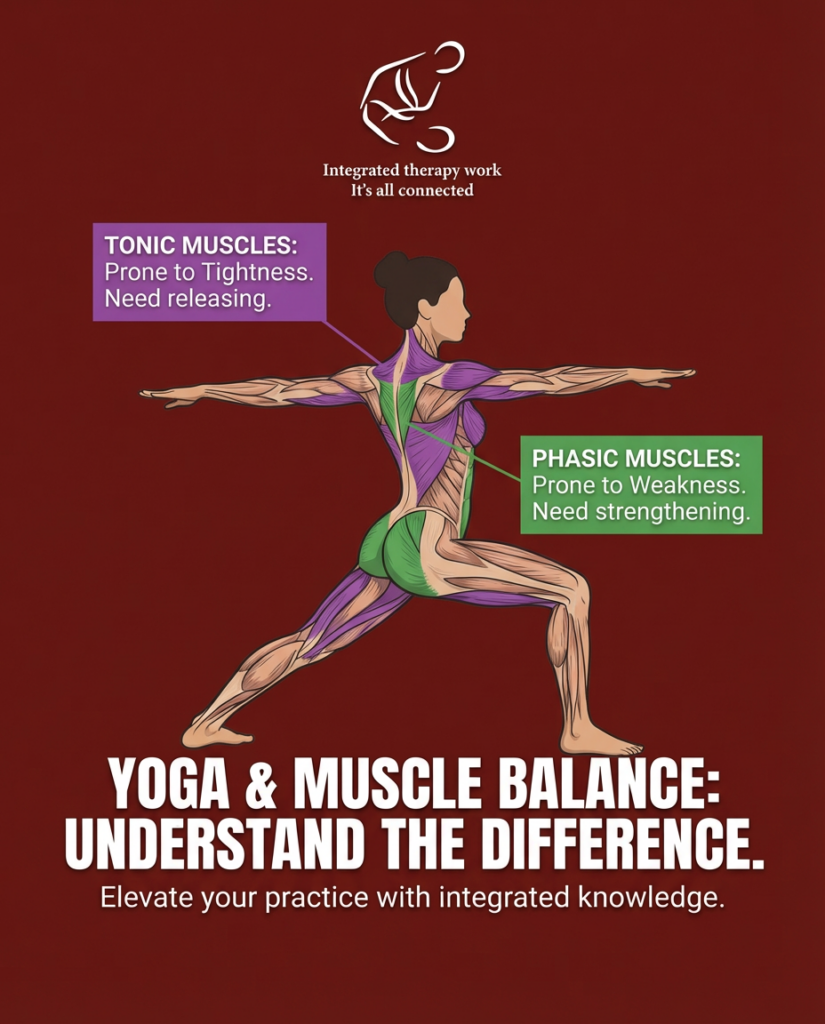
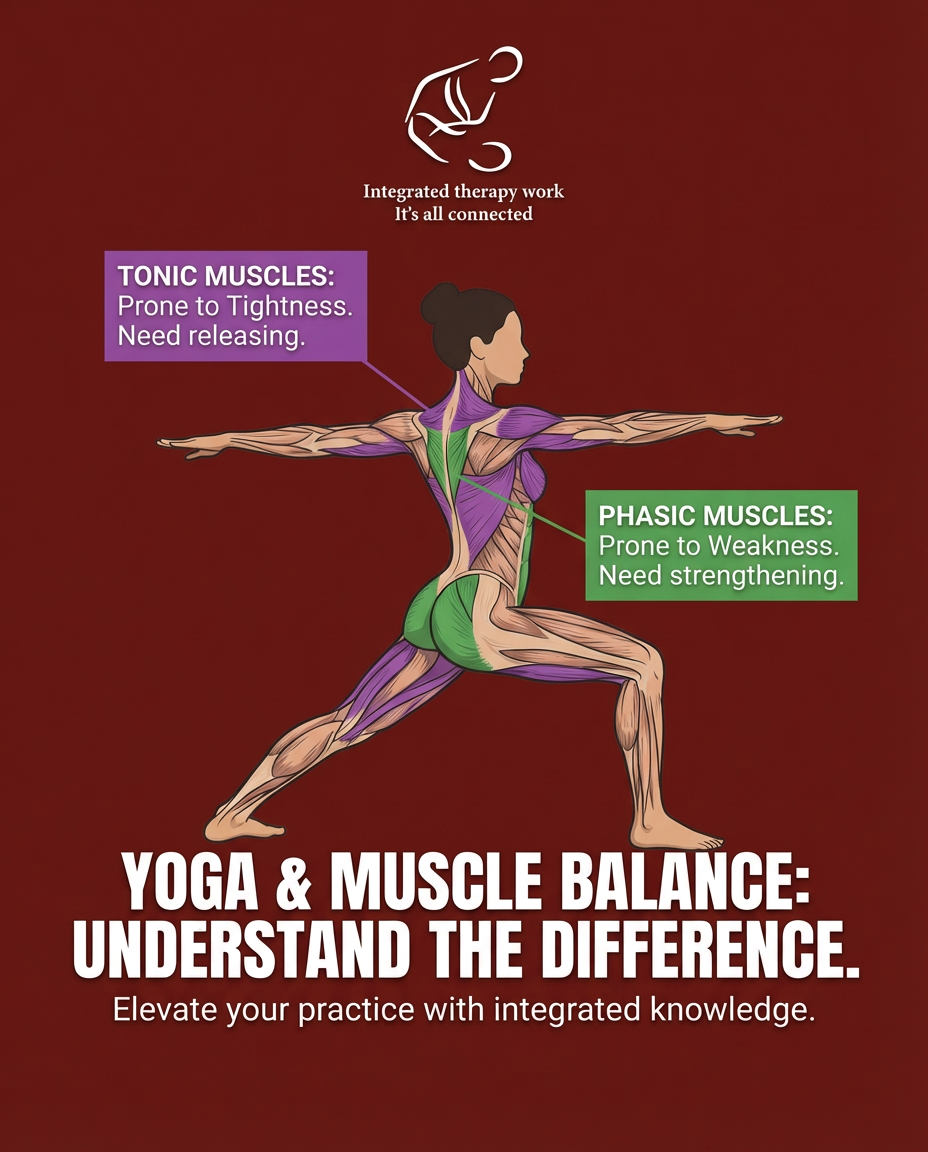
Tonic muscles are the body’s MARATHON RUNNERS. They are built for endurance to hold your posture all day. These muscles, rich in slow-twitch fibers, are constantly working to keep you upright. However, their tireless nature makes them prone to tightness and shortening. Think of the hip flexors, hamstrings, and upper trapezius.
Phasic muscles are the body’s SPRINTERS. They provide powerful, fast movements for dynamic actions like jumping or lifting. Composed of fast-twitch fibers, they contract forcefully but fatigue quickly. If not used regularly, they tend to become weak and inhibited. Examples include the gluteus maximus, abdominals, and middle/lower trapezius.
Why This Matters in Your Yoga Class
This isn’t just trivia for anatomy geeks. This knowledge directly impacts how you teach and sequence.
•Tonic (Postural) Muscles: When you see a student with rounded shoulders or an arched lower back, you are often looking at tight, overactive tonic muscles. Your sequencing should focus on lengthening and releasing these areas through sustained holds and gentle, mindful stretching. Forcing a tight hamstring in a forward fold is counterproductive; understanding its tonic nature encourages a more patient and effective approach.
•Phasic (Movement) Muscles: Conversely, when a student struggles to maintain a strong core in Plank Pose or activate their glutes in Bridge Pose, it often points to weak or “sleepy” phasic muscles. Your cues and sequencing should focus on activation and strengthening. This is why dynamic movements and poses that build strength are just as vital as deep stretches.
Achieving balance between these two muscle groups is the essence of a sophisticated physical yoga practice. It’s about creating harmony between stability (tonic) and mobility (phasic).
The Hallmark of a Premier Yoga Certificate Program
Anyone can memorize a sequence of poses. However, a truly competent and confident instructor, armed with a reputable yoga certificate, can explain the why behind the practice. They can look at a student’s posture and movement patterns and identify potential imbalances between their tonic and phasic systems.
This is why a comprehensive yoga certificate program must integrate modern anatomy and movement science. It empowers you to:
1.Teach with Confidence: Provide clear, intelligent cues that are rooted in anatomical principles.
2.Create Purposeful Sequences: Design classes that effectively address common postural imbalances by stretching what’s tight and strengthening what’s weak.
3.Ensure Student Safety: Recognize contraindications and offer modifications that respect individual body limitations.
4.Elevate Your Credibility: Stand out as a knowledgeable professional who offers more than just a workout, but a path to sustainable well-being.
Deepen Your Knowledge with an ITW Yoga Certificate
Are you ready to move beyond simply leading poses and start teaching with true anatomical insight? The yoga certificate programs at Integrated Therapy Work are designed for aspiring instructors who are passionate about the science of movement.
We equip you with the in-depth knowledge of concepts like phasic and tonic muscles, so you can build a career based on expertise and integrity. Explore our upcoming yoga teacher training courses and take the first step toward becoming a leader in the field.
[Link to ITW’s Yoga Teacher Training Page]
Beyond the Pose: Understanding Phasic vs. Tonic Muscles for a Deeper Yoga Practice
Why Your Yoga Certificate Must Cover Phasic vs. Tonic Muscles | ITW
Elevate your teaching by understanding the body’s two muscle systems. Discover why a quality yoga certificate program emphasizes the science of phasic and tonic muscles for safer, more effective classes.
Keywords: yoga certificate, yoga teacher training, anatomy for yoga, phasic muscles, tonic muscles, certified yoga instructor, ITW
As yoga instructors, we guide students through a flow of asanas, but how deeply do we understand the muscular mechanics behind each movement? True mastery in teaching goes beyond demonstrating poses; it lies in comprehending the intricate science of the human body. This is where the crucial distinction between phasic and tonic muscles comes into play—a fundamental concept that every high-quality yoga certificate program should cover in depth.
At Integrated Therapy Work (ITW), we believe that an educated instructor is an empowered one. Understanding this muscular duality is not just academic—it is the key to designing smarter sequences, preventing injuries, and helping your students achieve profound results.
The Body’s Two Teams: Sprinters and Marathon Runners
To simplify a complex anatomical concept, think of your muscles as two specialized teams:
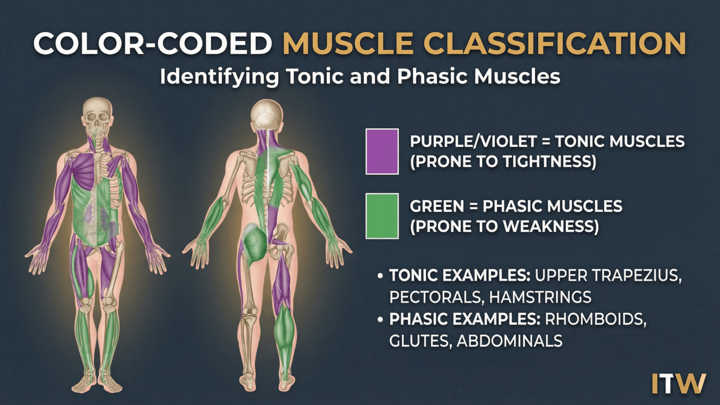
Tonic muscles are the body’s MARATHON RUNNERS. They are built for endurance to hold your posture all day. These muscles, rich in slow-twitch fibers, are constantly working to keep you upright. However, their tireless nature makes them prone to tightness and shortening. Think of the hip flexors, hamstrings, and upper trapezius.
Phasic muscles are the body’s SPRINTERS. They provide powerful, fast movements for dynamic actions like jumping or lifting. Composed of fast-twitch fibers, they contract forcefully but fatigue quickly. If not used regularly, they tend to become weak and inhibited. Examples include the gluteus maximus, abdominals, and middle/lower trapezius.
Why This Matters in Your Yoga Class
This isn’t just trivia for anatomy geeks. This knowledge directly impacts how you teach and sequence.
•Tonic (Postural) Muscles: When you see a student with rounded shoulders or an arched lower back, you are often looking at tight, overactive tonic muscles. Your sequencing should focus on lengthening and releasing these areas through sustained holds and gentle, mindful stretching. Forcing a tight hamstring in a forward fold is counterproductive; understanding its tonic nature encourages a more patient and effective approach.
•Phasic (Movement) Muscles: Conversely, when a student struggles to maintain a strong core in Plank Pose or activate their glutes in Bridge Pose, it often points to weak or “sleepy” phasic muscles. Your cues and sequencing should focus on activation and strengthening. This is why dynamic movements and poses that build strength are just as vital as deep stretches.
Achieving balance between these two muscle groups is the essence of a sophisticated physical yoga practice. It’s about creating harmony between stability (tonic) and mobility (phasic).
The Hallmark of a Premier Yoga Certificate Program
Anyone can memorize a sequence of poses. However, a truly competent and confident instructor, armed with a reputable yoga certificate, can explain the why behind the practice. They can look at a student’s posture and movement patterns and identify potential imbalances between their tonic and phasic systems.
This is why a comprehensive yoga certificate program must integrate modern anatomy and movement science. It empowers you to:
1.Teach with Confidence: Provide clear, intelligent cues that are rooted in anatomical principles.
2.Create Purposeful Sequences: Design classes that effectively address common postural imbalances by stretching what’s tight and strengthening what’s weak.
3.Ensure Student Safety: Recognize contraindications and offer modifications that respect individual body limitations.
4.Elevate Your Credibility: Stand out as a knowledgeable professional who offers more than just a workout, but a path to sustainable well-being.
Deepen Your Knowledge with an ITW Yoga Certificate
Are you ready to move beyond simply leading poses and start teaching with true anatomical insight? The yoga certificate programs at Integrated Therapy Work are designed for aspiring instructors who are passionate about the science of movement.
We equip you with the in-depth knowledge of concepts like phasic and tonic muscles, so you can build a career based on expertise and integrity. Explore our upcoming yoga teacher training courses and take the first step toward becoming a leader in the field.
[Link to ITW’s Yoga Teacher Training Page]