Opens in a new tab

Passive stretching workshop level 2 (Neck and upper extremities)

Categories: Manual Therapy, Workshops
Wishlist Share

About Course

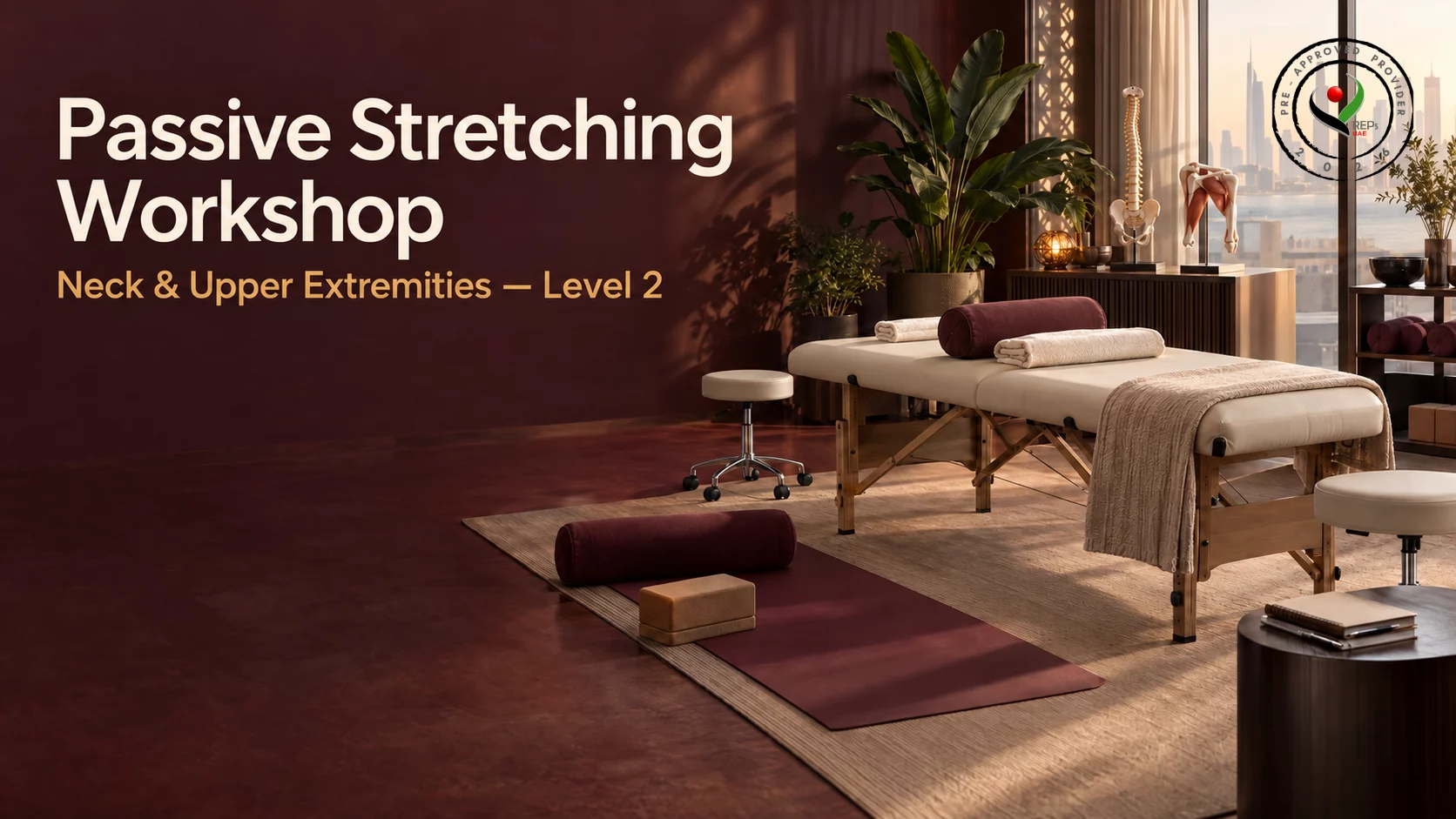
People-free professional workshop space prepared with a treatment table, bolsters, anatomical models, and yoga props
Professional development • Dubai

Passive Stretching Workshop Neck & Upper Extremities — Level 2

A 14 guided-learning-hour, face-to-face workshop for qualified wellness and fitness professionals who want to deliver safe, consent-led, therapist-assisted stretching within their existing professional scope.

Early bird: AED 550 when booked by 1 November 2026. 14 REPS UAE CPD points applied for, pending written endorsement.

Application pending

Integrated Therapy Work (ITW) is bringing a practical, safety-first passive-stretching workshop to Eco Yoga Sanctuary in Jumeirah, Dubai. Across two supervised Sundays, qualified professionals learn how to screen, communicate, position, apply, and recheck low-force stretching options for the neck, shoulder girdle, arm, forearm, wrist, and hand—without diagnosing, forcing range, or stepping outside their professional scope.

FormatTwo in-person Sundays14 guided learning hours
VenueEco Yoga SanctuaryJumeirah, Dubai, UAE
Early birdAED 550Book by 1 November 2026
REPS UAE status14 points applied forType 1 CPD application pending endorsement
What makes the learning different

Learn the decision-making that comes before the stretch.

Passive stretching is not a test of toughness. Integrated Therapy Work teaches a repeatable professional sequence: understand the goal, obtain consent, use stable support, progress only within comfort, listen continuously, and recheck before closing.

01

Consent-led contact

Rehearse a verbal pre-contact check, a clear stop signal, respectful boundaries, and professional communication with every practice partner.

02

Anatomy that guides safer choices

Connect osteology, principal muscle actions, and introductory neural anatomy to supported positioning—not to diagnosis.

03

Supervised partner practice

Build confidence through low-force demonstrations, coached practice, observation, feedback, rechecks, and case-based decisions.

People-free professional development space prepared for an upper-extremity stretching workshop
People-free feature visual of the prepared learning environment. Hands-on practice is consent-led, supervised, low-force, and guided by each participant’s comfort and feedback.
Two-day learning path

One safety framework, applied region by region.

Day 1 is dedicated to cervical foundations and supervised neck practice. Day 2 applies the same screening, consent, support, and recheck process to the shoulder girdle, arm, forearm, wrist, and hand.

Day 1 • Sunday 29 November 2026

Neck: foundations, screening & supported practice

11:00–19:00 • 7 guided learning hours + 1-hour lunch break

  • Course scope, consent, stop signal, and four questions before stretching
  • Static, dynamic, passive, PNF, PIR, contract–relax, agonist-contract, CRAC, and pin-and-stretch terminology
  • Cervical osteology, introductory neuroanatomy, myology, red flags, and stop/modify/refer decisions
  • Practitioner body mechanics, partner positioning, instructor demonstration, and supervised neck-only practical labs
  • Low-intensity PNF/PIR integration, review, reflection, and next-day preparation
Day 2 • Sunday 6 December 2026

Upper extremities: practical application & competency

11:00–19:00 • 7 guided learning hours + 1-hour lunch break

  • Day 1 review, consent reset, and upper-extremity safety recap
  • Osteology, myology, introductory neural anatomy, risk screen, and positioning principles for the shoulder to hand
  • Instructor demonstrations and supervised practical lab for shoulder, arm, forearm, wrist, and hand stretching
  • PNF/PIR and pin-and-stretch integration, case rotation, feedback, and recheck
  • Individual practical assessment, evaluation, outcome discussion, and certificate eligibility close
Detailed timetable

Know exactly how the 14 hours are used.

TimeSunday 29 November — NeckSunday 6 December — Upper Extremities
11:00–11:30Welcome; course scope; consent; four questions before stretching; stop signal.Day 1 review; consent reset; upper-extremity safety recap.
11:30–12:30Static, dynamic, passive, PNF, PIR, CR, AC, CRAC, and pin-and-stretch terminology; limits of simplified inhibition models.Osteology, myology, and introductory neurology of the shoulder girdle, arm, forearm, wrist, and hand.
12:30–13:30Cervical osteology, introductory neuroanatomy, and myology.Risk screen, contraindications, and support/positioning principles for upper extremities.
13:30–14:30Lunch — excluded from guided learning hours.Lunch — excluded from guided learning hours.
14:30–15:30Neck risk screen; red flags; stop, modify, refer; professional boundaries.Instructor demonstrations: shoulder and arm stretching positions.
15:30–16:30 / 16:45Practitioner body mechanics; partner positioning; instructor demonstration of neck techniques.Supervised practical lab: shoulder, arm, forearm, wrist, and hand stretches.
16:30 / 16:45–17:45Supervised practical lab: upper trapezius, levator scapulae, posterior cervical group, and suboccipital positioning.PNF/PIR and pin-and-stretch integration; case rotation and recheck.
17:45–19:00Supervised practical lab: sternocleidomastoid and scalene-region guarded positioning; PNF/PIR integration, review, and reflection.Final individual practical assessment, feedback, evaluation, assessment outcomes, certificate eligibility, and close.
Learning outcomes

What qualified participants will practise.

Integrated Therapy Work teaches a conservative, scope-aware approach that prioritises comfort, feedback, and professional judgement.

Assessment & communication

  • Complete a consent-led pre-contact check and identify stop criteria, precautions, and appropriate referral situations.
  • Use stable practitioner body mechanics, supported partner positioning, and leverage rather than force.
  • Communicate during and after contact, stop when required, and recheck without making a diagnosis or promising an outcome.

Technique selection & setup

  • Use accurate terminology for active, passive, static, dynamic, PNF, PIR, contract–relax, agonist-contract, CRAC, and pin-and-stretch approaches.
  • Connect regional osteology, principal muscles/actions, and introductory neural anatomy to safer stretching setup choices.
  • Demonstrate supported low-force stretching options for the neck, shoulder girdle, arm, forearm, wrist, and hand.
Professional boundary: This is a conservative professional-development course in therapist-assisted stretching. It is not a diagnostic, medical-treatment, or independent-practice qualification. No high-velocity techniques, end-range cervical loading, traction/compression provocation tests, or deep anterior-neck pressure are taught.

Who this workshop is for

Passive Stretching Workshop — Neck & Upper Extremities (Level 2) is designed for appropriately qualified professionals who already have foundational anatomy knowledge and an existing scope of practice.

  • Recognised Level 3 Personal Trainers or professionals with an equivalent fitness qualification
  • Massage therapists, manual therapists, sports massage specialists, yoga teachers, and allied-health or fitness professionals
  • Adults aged 18+ who can communicate clearly in the workshop language and give/receive informed consent during supervised partner practice

Practical learning & assessment

The workshop combines short interactive presentations, instructor demonstrations, anatomy mapping, consent rehearsal, supervised partner practice, case-based decisions, individual feedback, and a competency assessment.

  • Full attendance across all 14 guided learning hours is required.
  • The final individual practical assessment is 8–10 minutes and covers safety screen, consent, set-up, technique, recheck, and scope-appropriate close.
  • Certificate eligibility requires at least 70/100 with no safety-critical failure. The completion certificate does not convey a licence or authority beyond existing scope, competence, insurance, and local requirements.
Instructor & booking

Learn with a UAE healthcare educator.

Kamaleldein Saad Ali Edrees
(Kamal Saad)

Kamal Saad is the Founder and Lead Therapist of Integrated Therapy Work (ITW), a DHA-licensed Allied Health Therapist, healthcare lecturer, and certified trainer with more than seven years of UAE healthcare, corporate-wellness, and education experience. His training includes a Diploma in Osteopathy and accredited Training of Trainers and Training Materials Design qualifications.

Early-bird registration

AED 550

Secure the early-bird rate by 1 November 2026. The rate applies to the complete two-day, 14-hour workshop.

Reserve Your Place
Frequently asked questions

Practical answers before you book.

How much does the Passive Stretching Workshop cost in Dubai?

The early-bird price is AED 550 per participant when booked by 1 November 2026. The price covers both face-to-face workshop dates: 29 November and 6 December 2026.

Who is the workshop designed for?

Integrated Therapy Work designed this workshop for qualified Personal Trainers, massage and manual therapists, sports massage specialists, yoga teachers, and other allied-health or fitness professionals with foundational anatomy knowledge and an appropriate existing scope.

Where and when is the workshop held?

The workshop takes place in person at Eco Yoga Sanctuary, Jumeirah, Dubai, on Sunday 29 November and Sunday 6 December 2026. Each day runs from 11:00 to 19:00, including a one-hour lunch break excluded from learning hours.

Does the workshop include REPS UAE CPD points?

Integrated Therapy Work has submitted a Type 1 CPD application requesting 14 REPS UAE CPD points for 14 documented learning hours. The supplied application states that endorsement is pending; the workshop must not be presented as REPS UAE endorsed until written approval is received.

Do I need previous experience in passive stretching?

No prior passive-stretching qualification is required, but participants need a recognised Level 3 Personal Trainer qualification or equivalent professional qualification, foundational anatomy knowledge, and the ability to give and receive informed consent in supervised partner practice.

Will this qualification allow me to diagnose or treat medical conditions?

No. The completion certificate confirms attendance and assessment outcome for this professional-development course only. Participants must always work within their existing scope, competence, insurance, and local regulatory requirements.

Course material references include Hindle et al. (2012) on proprioceptive neuromuscular facilitation and the International IFOMPT Cervical Framework translation by Cagnie et al. (2023). Last updated: 7 October 2026.

Earn a certificate

Add this certificate to your resume to demonstrate your skills & increase your chances of getting noticed.

selected template

Student Ratings & Reviews

No Review Yet
No Review Yet
whatsapp-logo
Need Help?

Get 10% Off Your Next ITW Training!

Help shape the future of ITW workshops by answering a few quick questions.
Your feedback guides our next training and you’ll receive an exclusive 10% discount as a thank-you.