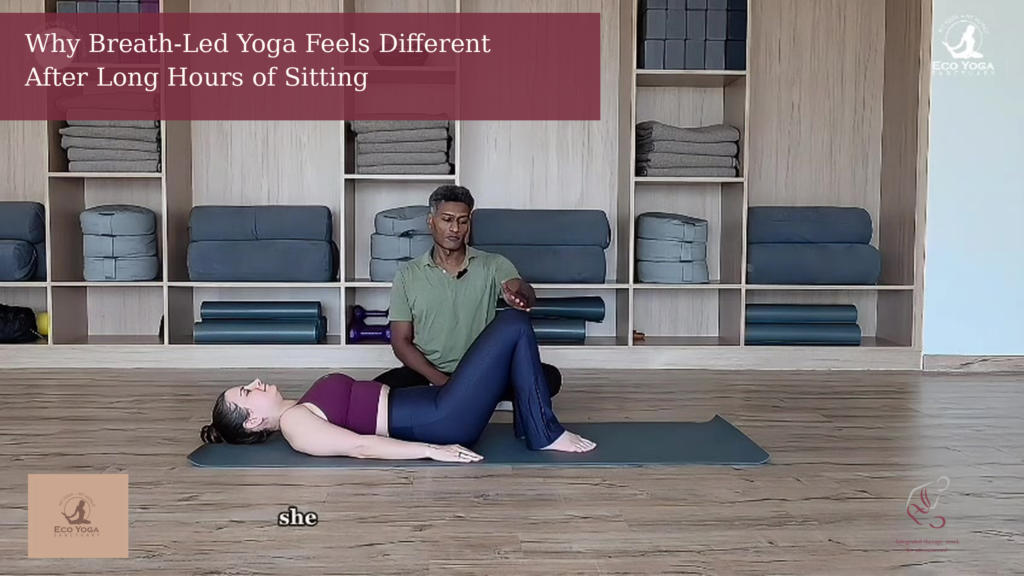


Why Breath-Led Yoga Feels Different After Long Hours of Sitting
Moving beyond the shape: How the Viniyoga approach transforms the transition from the desk to the mat for the experienced practitioner.
By Kamal Saad · Eco Yoga Sanctuary, Jumeirah · 4 min read
“For the experienced practitioner, the challenge is no longer reaching the toes, but rather noticing the quality of the breath as they move toward them. After eight hours at a desk in Downtown Dubai, your body has forgotten how to be led by its own internal rhythm.”
— Kamal Saad, Lead Therapist, ITW Dubai
Breath-led yoga can make the transition from a sedentary workday to movement feel more deliberate by prioritising attention over the complexity of a shape. In Dubai’s demanding professional environment, breath can be used as a pacing tool: it gives practitioners a way to slow down, observe, and choose an appropriate next movement after long hours of sitting.
The Sedentary Toll: Beyond Tight Muscles
After extended sitting, the hips, spine, and surrounding muscles may feel unfamiliar when you first stand and move. A breath-led approach does not assume one universal response. Instead, conscious inhalation and exhalation provide a pace for noticing how the body responds before choosing more range, more effort, or a simpler option.
In Dubai working life, long commutes and meetings can leave little time to transition between sitting and practice. An experienced practitioner need not assume that a feeling of tightness has one cause. The Viniyoga approach at Eco Yoga Sanctuary instead asks what each movement is for on that day, favouring function, feedback, and appropriate range over outward form.
Position vs. Posture: The Practitioner’s Distinction
In Viniyoga, a position is a specific orientation in space, while posture refers to individual habit or conscious asana. The distinction invites the practitioner to move beyond simply holding a shape and instead observe the breath, intention, and response that occur within it.
When you sit at a desk, your body is in a particular position. Sometimes a way of organising oneself can persist after standing, and sometimes it changes immediately. For an experienced practitioner, the aim is not to replace a “bad” posture with a supposedly perfect one; it is to develop awareness and choice between positions. Breath-led movement makes that observation easier by creating a clear beginning, middle, and end for each transition.
Why Breath Matters: Pacing and Attention
Breathing does not make one “better” at yoga. It can, however, offer useful pacing and attention. When breath leads movement, a practitioner has more opportunity to notice whether a transition feels rushed, strained, or appropriate, rather than forcing a predetermined position.
For those seeking breath-led yoga in Dubai, pranayama and breath awareness may be part of the interest. In this article, the practical value is attention: when breath leads, movement follows a chosen cadence. If breathing becomes strained, that is useful information to reduce intensity, shorten the range, or pause. This feedback can help an experienced practitioner adapt a personal practice after a demanding workday.
A Practice-Awareness Sequence for the Sedentary Day
A brief transition sequence can use breathing, gentle hip movement, and simple weight shifts to coordinate attention with effort. The suggestions below are not a protocol. They invite the practitioner to notice what feels available and to adapt, omit, or simplify a movement rather than pursuing a fixed result.
Consider the following awareness-based movements, ensuring that a qualified clinician assesses any persistent or severe pain before beginning a new practice:
- Seated to Standing Awareness: Before leaving your desk, take three deep breaths. Notice the contact of your feet on the floor. As you inhale, feel the spine lengthen; as you exhale, engage the lower abdomen slightly. Stand up slowly, leading the movement with the crown of your head.
- Dynamic Hip Circles: Standing with hands on a stable surface, gently circle the hips. Inhale as you move forward and side; exhale as you move back and side. Focus on the sensation in the hip sockets rather than the range of motion.
- Breath-Led Glute Activation: In a standing position, shift your weight to one leg. As you exhale, gently engage the glute of the standing leg and lift the opposite heel. Inhale to release. Repeat five times on each side, focusing on the timing of the contraction.
Lineage and Scope
The approach discussed at Eco Yoga Sanctuary and through Integrated Therapy Work (ITW) is informed by Viniyoga, which adapts breath, movement, and sequencing to the individual. T.K.V. Desikachar’s teaching informed Gary Kraftsow’s work and the American Viniyoga Institute. The practical question is simple: can the practice serve the person’s present intention and response, rather than asking the person to reproduce a fixed form?
Frequently Asked Questions
How does breath-led yoga help with the ‘Dubai desk-hunch’?
A desk day often leaves people feeling ready for a change of position. Breath-led yoga can offer a slow, structured way to move out of sitting: allow inhalation and exhalation to set the pace, and choose a modest range that feels appropriate. It does not promise a particular postural or symptom outcome.
Can I practice these movements in my office in the DIFC?
Some awareness-based movements can be performed beside a desk or in a quiet office corner if your setting allows. The key is not the size of the movement but the quality of attention and coordination with breath. Treat a brief pause as an opportunity to observe rather than as a promised productivity intervention.
Why is glute activation yoga important after sitting?
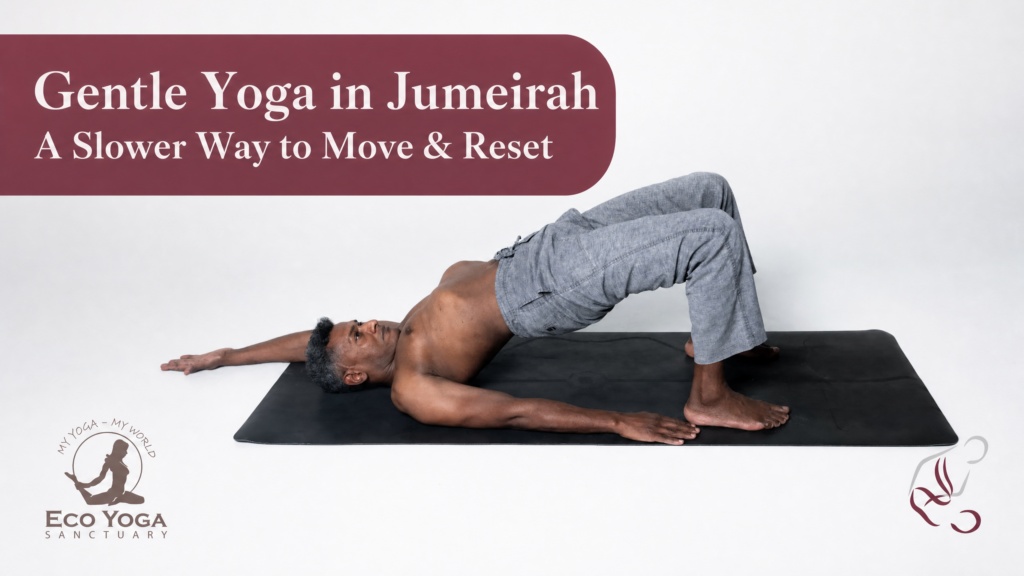
Some movement teachers use the informal term “gluteal amnesia” to describe a feeling of reduced awareness in the buttock muscles after sitting. The phrase is not a diagnosis. A simple, comfortable bridge or standing weight shift may help a practitioner notice how the hips and glutes participate in movement; responses vary.
What should I do if I have persistent back pain from sitting?
A qualified clinician should assess persistent, severe, radiating, neurological, post-operative, or pregnancy-related concerns before a new practice. Yoga classes and this article are educational resources, not a diagnosis or treatment plan.
EXPERIENCE THE DIFFERENCE
Join Viniyoga Therapy Classes at Eco Yoga Sanctuary, Jumeirah
Practice asana in function — not just in form. Small groups, breath-led sequencing, and therapeutic adaptation to your unique structure.
AUGUST 2026
ITW Mastery Series
Deepen your anatomical knowledge and earn YACEP continuing education credits. For yoga teachers and advanced practitioners. Eco Yoga Sanctuary, Jumeirah — Upcoming Dates.
Note: Please replace the {MASTERY_SERIES_BUNDLE_LINK} placeholder before publishing.
Last updated: 23 August 2026 · Written by Kamal Saad, E-RYT 500 yoga teacher, American Viniyoga teacher, manual osteopath, and massage therapist
ASANA IN FUNCTION SERIES
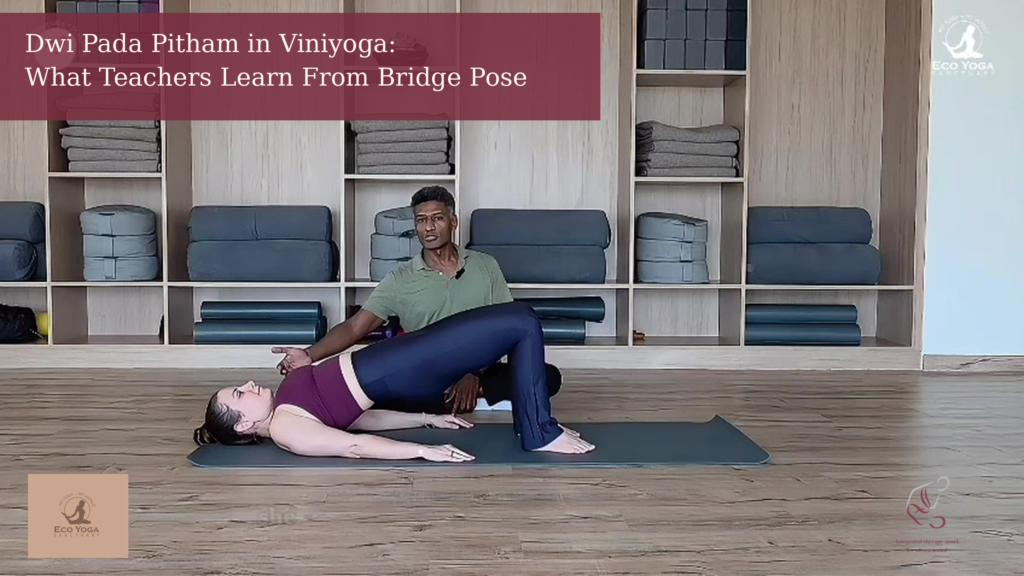
Up Next: Dwi Pada Pitham in Viniyoga: What Yoga Teachers Learn From a Simple Bridge Pose
Explore the mechanics of Bridge Pose and the observations a teacher can make about breath, pace, and individual response.
Further reading: American Viniyoga Institute https://viniyoga.com/
Internal linking suggestion: [Insert link to Article 2: Breath-Led Movement for Office Professionals] | [Insert link to Article 4: Dwi Pada Pitham Analysis]