

Swing Yoga Journal · Teacher Education
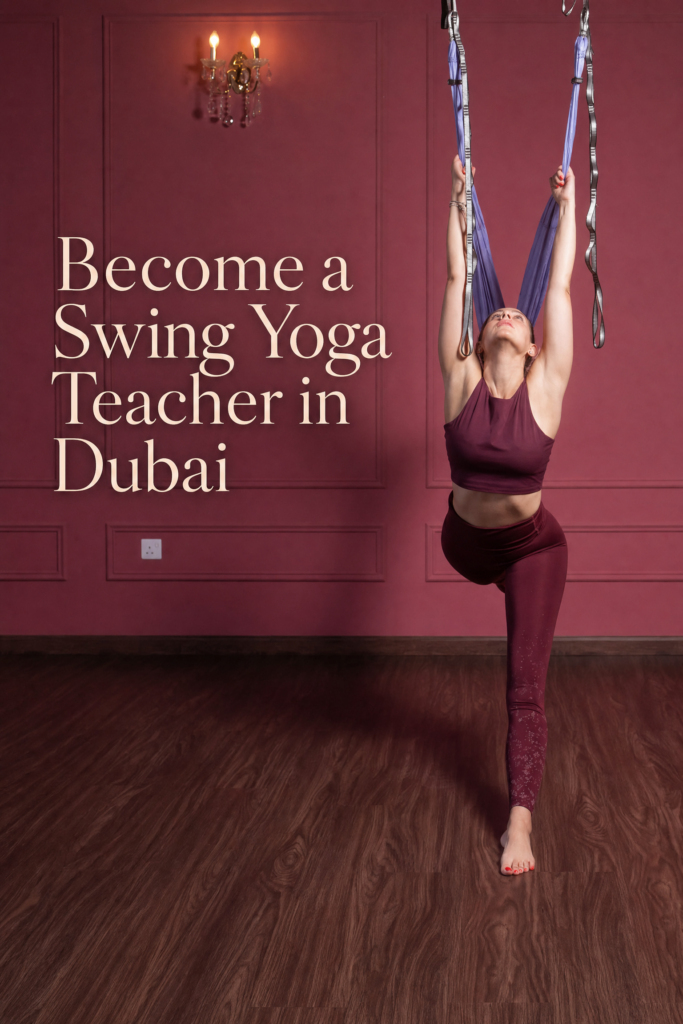
Become a Swing Yoga Teacher in Dubai
A clear route from fabric curiosity to confident, purposeful teaching.
A hammock can make a sequence look inventive. Teaching it well requires something more durable: a clear understanding of support, progression, safety, and the person in front of you.
The short answer
The 50-hour Swing Yoga Teacher Training with Yara Barqawi takes place at Crimson Chamber in The Sustainable City, Dubai, UAE, across 17–18, 24–25, and 31 October 2026. It is designed for 200-hour yoga teachers, Pilates instructors, and fitness trainers who want to teach hammock-based movement with more clarity, confidence, and purpose. The stated curriculum includes swing foundations, fabric safety, shoulder stability, spine-focused practice, hip work, functional anatomy, and teaching methodology.[1]
Who is the Swing Yoga Teacher Training for?
This training is for movement professionals who want more than a collection of visually striking shapes. It is intended for 200-hour yoga teachers, Pilates instructors, and fitness trainers who are ready to study how the fabric can be used as a support, a challenge, and a tool for more precise teaching.[1]
You do not need to arrive with every aerial skill. You do need a genuine interest in teaching responsibly, learning how to build progressions, and paying attention to how different bodies may experience the same setup. Review the live registration page before enrolling, especially if you have questions about eligibility or current availability.
What will you learn in a 50-hour Swing Yoga training?
The course page describes a structured curriculum that begins with swing foundations and fabric safety. From there, participants study basic swing positions, shoulder stability and strength, spine-focused practice, hip work, functional anatomy, and teaching methodology. The intention is to help teachers move beyond random sequencing and into purposeful, progressive, body-aware instruction.[1]
A meaningful training also asks how you communicate. Can you describe a setup clearly? Can you offer a step before the bigger variation? Can you notice when a student needs more support, less range, or a different option? Those teaching decisions are what make a class feel intentional rather than merely exciting.
Why are safety and progressions central to hammock teaching?
A hammock changes the relationship between a student, gravity, and support. That creates possibility, but it also requires clear setup, sensible pacing, and an ability to manage risk. “Advanced” should not mean rushed. It should mean that a student has a stable foundation and understands the pathway into and out of a position.
The training’s focus on fabric safety, foundations, and methodology reflects that principle. A teacher who can offer grounded and supported choices gives more people a realistic way to participate. That is especially important when classes include mixed experience levels or students who are new to aerial movement.
How does this training connect to a broader yoga education?
Swing Yoga can be a specialist skill within a broader teaching practice. It can add a new way to explore balance, strength, mobility, and cueing. Yet fabric work is most useful when it is informed by a deeper relationship with breath, anatomy, individual variation, sequencing, and the ethics of teaching.
That is why Crimson Chamber in partnership with Integrated Therapy Work (ITW) also offers a Professional Viniyoga Certification described as a 200-hour Yoga Teacher Training. The programme brings together Viniyoga methodology, applied anatomy, biomechanics, pranayama, philosophy, sequencing, practicum, and therapeutic observation.[2] The two pathways are distinct, but they can be complementary for a teacher who wants both a specialist hammock modality and a deeper teaching foundation.
What should you confirm before registering?
Confirm the current dates, daily schedule, course fee, discount terms, attendance requirements, and eligibility directly on the registration page. Course information can change, so the live page is the source of truth. If you are unsure whether your background is appropriate, contact Integrated Therapy Work before booking.
Most importantly, be clear about your reason for training. If the answer is that you want to teach with more discernment, more creativity, and more respect for individual differences, the training may be a strong next step. If you are seeking a fast route to advanced tricks, pause and reconsider what kind of teacher you want to become.
The stated training focus includes
- Swing foundations and fabric safety.
- Basic positions and progressive class-building.
- Shoulder stability, spine-focused practice, and hip work.
- Functional anatomy, cueing, and teaching methodology.
Frequently asked questions
When is the next Swing Yoga Teacher Training in Dubai?
The current programme page lists 17–18, 24–25, and 31 October 2026 at Crimson Chamber in The Sustainable City, Dubai. Confirm the final daily timetable and availability on the live registration page before booking.[1]
How many hours is the Swing Yoga Teacher Training?
The programme is listed as a 50-hour Swing Yoga Teacher Training led by Yara Barqawi. The course page provides the current format and enrolment details.[1]
Do I need to be a yoga teacher before joining?
The course page identifies 200-hour yoga teachers, Pilates instructors, and fitness trainers as the intended audience. If your experience is different, contact Integrated Therapy Work to confirm whether the training is appropriate for you.[1]
How is the 50-hour Swing Yoga training different from a 200-hour Yoga Teacher Training?
The 50-hour course is a specialist hammock-based training. The 200-hour Professional Viniyoga Certification is a broader yoga-teaching foundation that includes methodology, anatomy, pranayama, philosophy, sequencing, practicum, and therapeutic observation.[2]