Unlock Deeper Forward Bends: A Key Lesson from Yoga Teacher Training
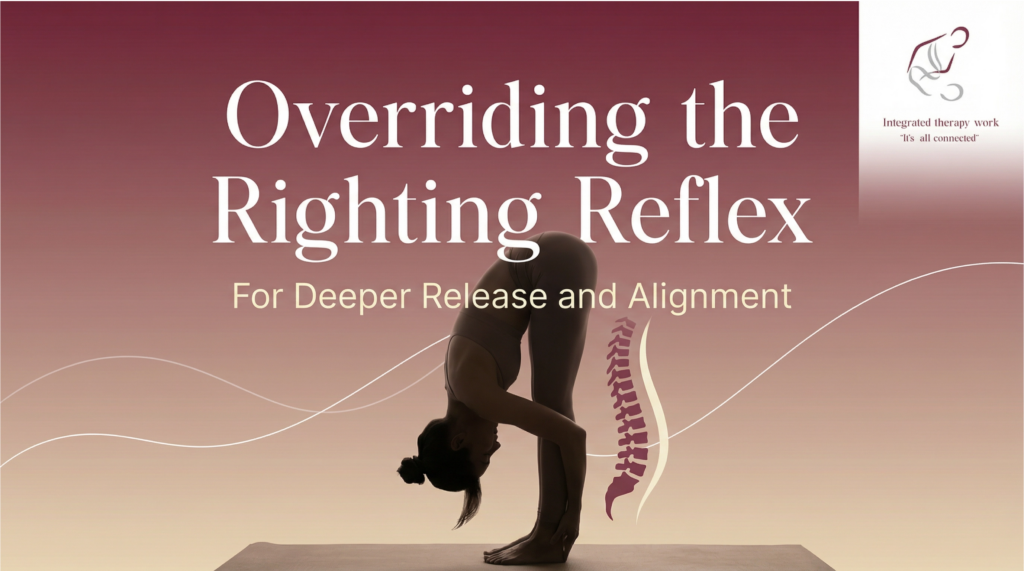
Are you a dedicated yoga student or currently enrolled in a yoga teacher training program? If so, you’ve likely encountered a common plateau in forward-bending postures like Paschimottanasana (Seated Forward Bend) or Uttanasana (Standing Forward Bend). You stretch, you breathe, but you just can’t seem to release deeper into the pose. The culprit might not be your hamstrings, but a primitive, automatic neurological response: the righting reflex.
Understanding and learning to override this reflex is a cornerstone of advanced asana practice and a critical piece of knowledge for any aspiring yoga instructor. At Integrated Therapy Work (ITW), we emphasize these foundational biomechanics to ensure our graduates are not just instructors, but true body-work informed teachers.
What is the Righting Reflex and Why Does It Matter in Yoga?
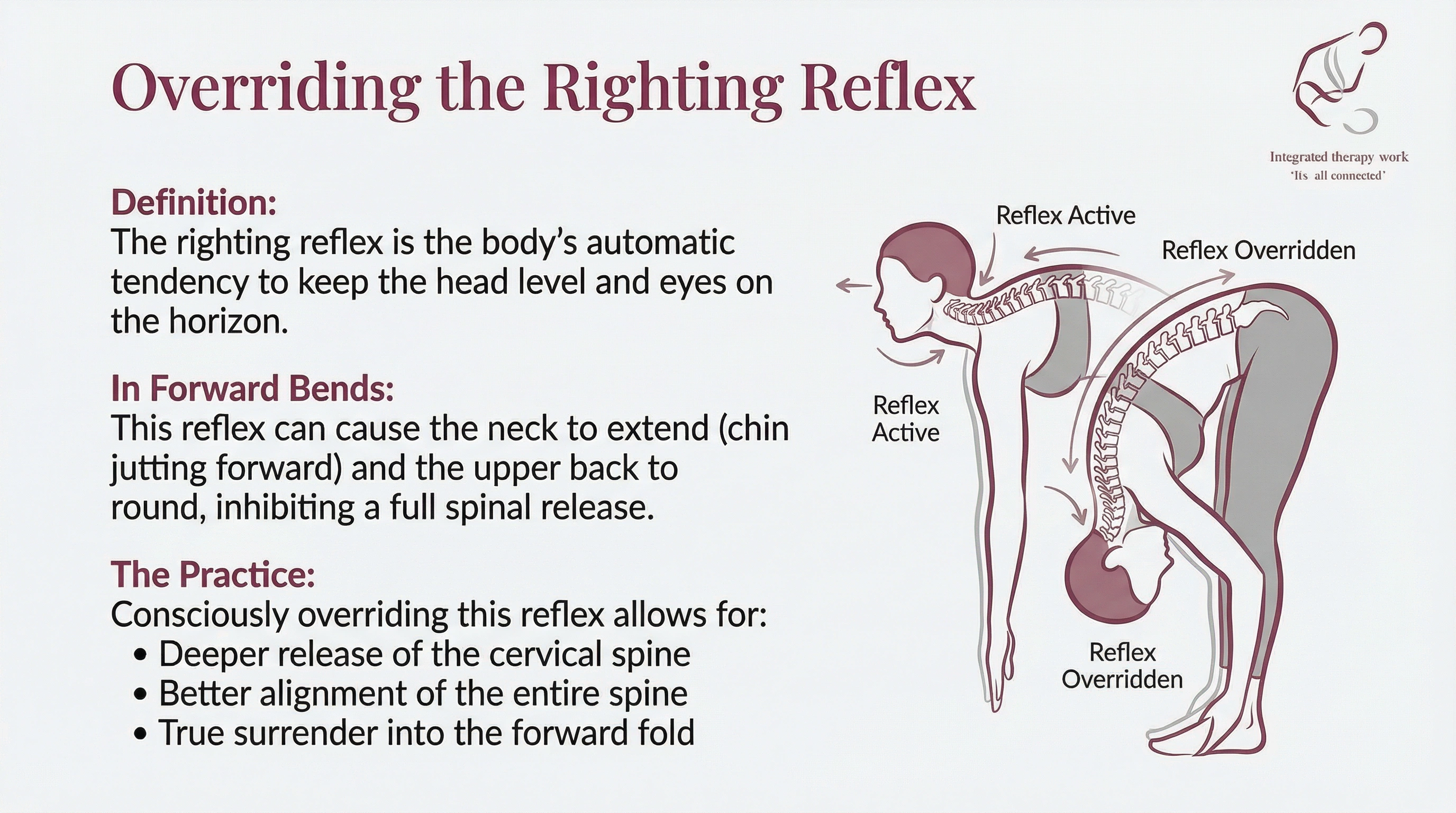
The righting reflex is the body’s innate tendency to keep the head level and the eyes on the horizon. It’s a survival mechanism that helps us maintain balance and orient ourselves in space. While essential for daily life, this reflex can become a significant obstacle in our yoga practice, particularly in forward folds.
When you attempt to fold forward, this reflex instinctively tells your neck muscles to resist gravity and lift the head. This creates a chain reaction of tension that prevents the spine from achieving a full, passive release.
The Anatomy of a Blocked Forward Bend
When the righting reflex is active during a forward bend, you might notice:
•A Jutting Chin: Instead of tucking naturally, the chin pushes forward as the neck extends.
•Tension in the Neck and Shoulders: The muscles at the back of the neck and across the upper back engage to hold the head up.
•A Rounded Upper Back: The thoracic spine rounds to compensate for the lack of release in the cervical spine (neck).
This compensatory pattern not only limits the depth of your posture but also negates one of the primary benefits of forward bends: the calming, restorative effect of releasing the entire posterior chain, including the intricate muscles of the neck and back.
How to Override the Righting Reflex: A Guide for Your Practice
Consciously overriding this reflex is a practice of mindful surrender. It’s a key skill we refine in our yoga teacher training because it transforms the asana from a purely physical stretch into a profound neurological release.
1.Initiate the Fold: As you begin to move into your forward bend, bring your awareness to your head and neck.
2.Exhale and Let Go: On an exhale, consciously give your head permission to be heavy. Imagine it as a ripe fruit hanging from a branch.
3.Tuck the Chin: Gently tuck your chin towards your chest. This is not an aggressive action but a soft release.
4.Feel the Cascade: Notice the chain reaction of release that follows. As the neck muscles soften, you may feel the upper back, mid-back, and even the lower back let go more completely.
Why This is a Game-Changer for Your Yoga Teacher Training Journey
For anyone on the path to becoming a yoga teacher, understanding concepts like the righting reflex is what separates a good instructor from a great one. It allows you to:
•Provide Deeper Cues: Move beyond generic cues like “relax your neck” and explain the why and how to your students.
•Troubleshoot Postures: Identify why a student is struggling and offer specific, anatomy-based guidance.
•Embody the Practice: Deepen your own physical practice, allowing you to teach from a place of authentic experience.
Mastering the subtleties of movement and anatomy is at the heart of the ITW philosophy. It is this depth of knowledge that empowers you to guide your students safely and effectively.
Ready to transform your understanding of yoga? Explore the comprehensive curriculum of the Integrated Therapy Work (ITW) yoga teacher training programs and take the next step in your journey. Visit our website to learn more.